Perhaps, but I thought there were luthier firms who could straighten twisted necks. I realize the heel is what it is, but what about the rest of a neck, for those whose buzzing occurs on treble strings only?No choices .. file the frets and, if this is not enough, the whole fretboard .. if this is two times the cost of the instrument then buy another one and hope that the neck will be made of wood of higher elastic modulus .. this is substantially the thread’s conclusion ..

Enjoy the benefits of a premium membership!
Upgrade Account
-
TalkBass has been independent since 1998. Add your voice.
Create a free account to reply to discussions, view embedded media, and browse with fewer display ads.
Join free Log in
Want zero display ads or expanded classifieds tools? Compare plans.
You are using an out of date browser. It may not display this or other websites correctly.
You should upgrade or use an alternative browser.
You should upgrade or use an alternative browser.
Getting the Facts about Ski Jumps
- Thread starter Turnaround
- Start date
More options
Who Replied?
There are firms that straighten twisted and warped necks. They use a heat process to re-align the wood. Some bassists report that such straightening has worked out even in the longer term while some report that the neck proceeded to warp again after some time. Buzzing on the treble side only does not necessarily mean that the neck is twisted. It may just have a hump or dip on the treble side. Sometimes the remedy is re-leveling the frets, sometimes it means planing the fretboard. In some cases there may be a compromise setup that works well enough.Perhaps, but I thought there were luthier firms who could straighten twisted necks. I realize the heel is what it is, but what about the rest of a neck, for those whose buzzing occurs on treble strings only?



All my bolt-on basses have a ski jump. Every single one. I think what I have learned from all this is that my next bass needs to be a fully graphite bass.
Neck through basses sometimes get ski jumps too. And some graphite necks have been known to bow - rare though.All my bolt-on basses have a ski jump. Every single one. I think what I have learned from all this is that my next bass needs to be a fully graphite bass.

All my bolt-on basses have a ski jump. Every single one. I think what I have learned from all this is that my next bass needs to be a fully graphite bass.
Bolt-on necks can be built well, so that they never develop ski jump (12th fret kink) problems. They can be designed thicker, or have internal reinforcements installed. I started putting carbon fiber backstraps in necks in 1993. Since then, I've been putting them in all of my own model basses, and most of the necks I've built for other Luthiers. Somewhere over 1100 necks total, over those years. And I can honestly say that I've never heard of a single one of my necks, with the carbon fiber backstrap, developing a ski jump, ever. I understand the problem, and I've worked out a solution. And I've been very open and helpful sharing the information with other Luthiers, whether they have been customers of mine or not. I don't want to see anyone's fine basses end up with unplayable bent necks.
The big manufacturers like Fender don't care. They accept that some percentage of their necks will kink, but it will be a slow failure, well out of warranty. They are too cheap to add the fix.
Most boutique builders pay attention and build their necks carefully enough that they don't kink. It's rare to see a ski jump in a $3000+ bass, bolt-on or not.
Neck-through and set-neck basses can develop ski jumps, but it's not common. Most of them have a thicker, smoother transition from the neck to the body thickness, enough depth that the wood doesn't get overstressed.
Remember, it doesn't take much to go over the line into the kink zone. 1/16" difference in neck thickness at the 12th fret can make the difference between a neck that stretches and kinks, and one that doesn't.
Bruce, I think it’s not much a question of cost rather than of care or market target/range as you said ... I mean, carbon straps are not very expensive and the same may be said for the posiflex rods that Fender installs on some of their MIA models.Bolt-on necks can be built well, so that they never develop ski jump (12th fret kink) problems. They can be designed thicker, or have internal reinforcements installed. I started putting carbon fiber backstraps in necks in 1993. Since then, I've been putting them in all of my own model basses, and most of the necks I've built for other Luthiers. Somewhere over 1100 necks total, over those years. And I can honestly say that I've never heard of a single one of my necks, with the carbon fiber backstrap, developing a ski jump, ever. I understand the problem, and I've worked out a solution. And I've been very open and helpful sharing the information with other Luthiers, whether they have been customers of mine or not. I don't want to see anyone's fine basses end up with unplayable bent necks.
The big manufacturers like Fender don't care. They accept that some percentage of their necks will kink, but it will be a slow failure, well out of warranty. They are too cheap to add the fix.
Most boutique builders pay attention and build their necks carefully enough that they don't kink. It's rare to see a ski jump in a $3000+ bass, bolt-on or not.
Neck-through and set-neck basses can develop ski jumps, but it's not common. Most of them have a thicker, smoother transition from the neck to the body thickness, enough depth that the wood doesn't get overstressed.
Remember, it doesn't take much to go over the line into the kink zone. 1/16" difference in neck thickness at the 12th fret can make the difference between a neck that stretches and kinks, and one that doesn't.
It may be interesting for somebody like me, who likes the tone of Fender-like basses, because of their inherent design features, to know from a qualified repair technician or a luthier, who accepts to work a lot on the adjustment of serially-made basses, whether or not the incidence of ski-jump occurrences in basses whose necks have been reinforced with carbon rods (posiflex in Fender’s case) is as high as for the same models with unreinforced necks, it being understood, for instance, that carbon reinforcing has been banned for tone-related reasons (disputable IMO) by some high-level makers, such as Elrick.
Edit:
As a note, moreover, I’d like to say that I’m under the impression that many players do not have a clear idea of what a ski-jump actually is; hence, there’s a lot of talking in this regard, which, sometimes, is just generating dust around the issue and may be misleading
I don't know where you got this idea, but Rob Elrick does not eschew carbon reinforcing for tone-related reasons. He doesn't use carbon reinforcement because he feels that a properly constructed neck doesn't need it....it being understood, for instance, that carbon reinforcing has been banned for tone-related reasons (disputable IMO) by some high-level makers, such as Elrick.
Yes, at Elrick (I don’t know Robert in person of course), they told me that a properly constructed neck doesn’t need any “alien” material also because, they added, stiffening rods other than the truss-rod affect the instrument’s’ tone .. so it’s not an idea, but actually what one of their senior staff (can’t recall the name, but I may look for the email they sent me in reply to an enquiry of mine) wrote to meI don't know where you got this idea, but Rob Elrick does not eschew carbon reinforcing for tone-related reasons. He doesn't use carbon reinforcement because he feels that a properly constructed neck doesn't need it.

Sometimes life is really strange ...
I don't believe that Rob has never said that stiffening rods affect the instrument's tone. I don't know who you spoke to ("senior staff") but Elrick is a one-man operation. Perhaps you spoke to a distributor, not the maker.Yes, at Elrick (I don’t know Robert in person of course), they told me that a properly constructed neck doesn’t need any “alien” material also because, they added, stiffening rods other than the truss-rod affect the instrument’s’ tone .. so it’s not an idea, but actually what one of their senior staff (can’t recall the name, but I may look for the email they sent me in reply to an enquiry of mine) wrote to me
Sometimes life is really strange ...
Dear @Turnaround, believing or not to what I write is amongst your prerogatives; there’s nothing I can do for you in this regard, nor there’s anything I can add further on this subject, unfortunately.I don't believe that Rob has never said that stiffening rods affect the instrument's tone. I don't know who you spoke to ("senior staff") but Elrick is a one-man operation. Perhaps you spoke to a distributor, not the maker.
I remember that I contacted Elrick when I wanted to buy a hand-carved bolt-on bass (think it was an Evo Gold, 4 strings) and, amongst several questions I asked them at the time, there was one concerning the presence of not of stiffening rods inside their necks.
I reported part of the answer I received.
In the end, I didn’t buy this bass because the application of the import taxes plus VAT made the operation extremely expensive.
On the other hand, I found a 2nd hand Expat model at BassDirect at a very good price and I bought it.
I’d like to know now what I missed in acquiring the Czech version of the bass instead of the USA one; I’ll discover it when I’ll get the money to buy another one.
In that case I’ll fly to Chicago to pick it up; it will be cheaper.
Last edited:
You are quite right - there are no stiffening rods in Elrick's necks. But that's not because he thinks they negatively affect tone. The way Rob makes his neck stiffening rods are not needed. I just didn't want anyone getting the wrong idea.Dear @Turnaround, believing or not to what I write is amongst your prerogatives; there’s nothing I can do for you in this regard, nor there’s anything I can add further on this subject, unfortunately.
I remember that I contacted Elrick when I wanted to buy a hand-carved bolt-on bass (think it was an Evo Gold, 4 strings) and, amongst several questions I asked them at the time, there was one concerning the presence of not of stiffening rods inside their necks.
I reported part of the answer I received.
Sure.You are quite right - there are no stiffening rods in Elrick's necks. But that's not because he thinks they negatively affect tone. The way Rob makes his neck stiffening rods are not needed. I just didn't want anyone getting the wrong idea.
Is there any evidence that roasted necks have lower incidence of ski jump ? Maybe the process is too new for any definitive data. Subsequently, could a bad neck be straightened & then roasted - for a permanent repair?
edit - roasting a finished neck is probably not a great idea...
edit - roasting a finished neck is probably not a great idea...
Last edited:
You could not roast a finished neck without removing the finish first. And I'm not sure that the process would be advisable. You really want to roast the wood before it is made into a neck.Is there any evidence that roasted necks have lower incidence of ski jump ? Maybe the process is too new for any definitive data. Subsequently, could a bad neck be straightened & then roasted - for a permanent repair?
edit - roasting a finished neck is probably not a great idea...
Properly roasted wood is more rigid than unroasted. So a roasted wood neck is less likely to develop a ski jump than unroasted, all else being equal.
Correct.You could not roast a finished neck without removing the finish first. And I'm not sure that the process would be advisable. You really want to roast the wood before it is made into a neck.
Properly roasted wood is more rigid than unroasted. So a roasted wood neck is less likely to develop a ski jump than unroasted, all else being equal.
A precise procedure has to be followed otherwise the possibility of the neck warping or bending in an uncontrolled manner may not be excluded.
Moreover, roasting beyond certain limits will increase the wood’s carbon content making it too fragile and leading to a deterioration of its structure, which may have the effect opposite to the one thats’s sought.

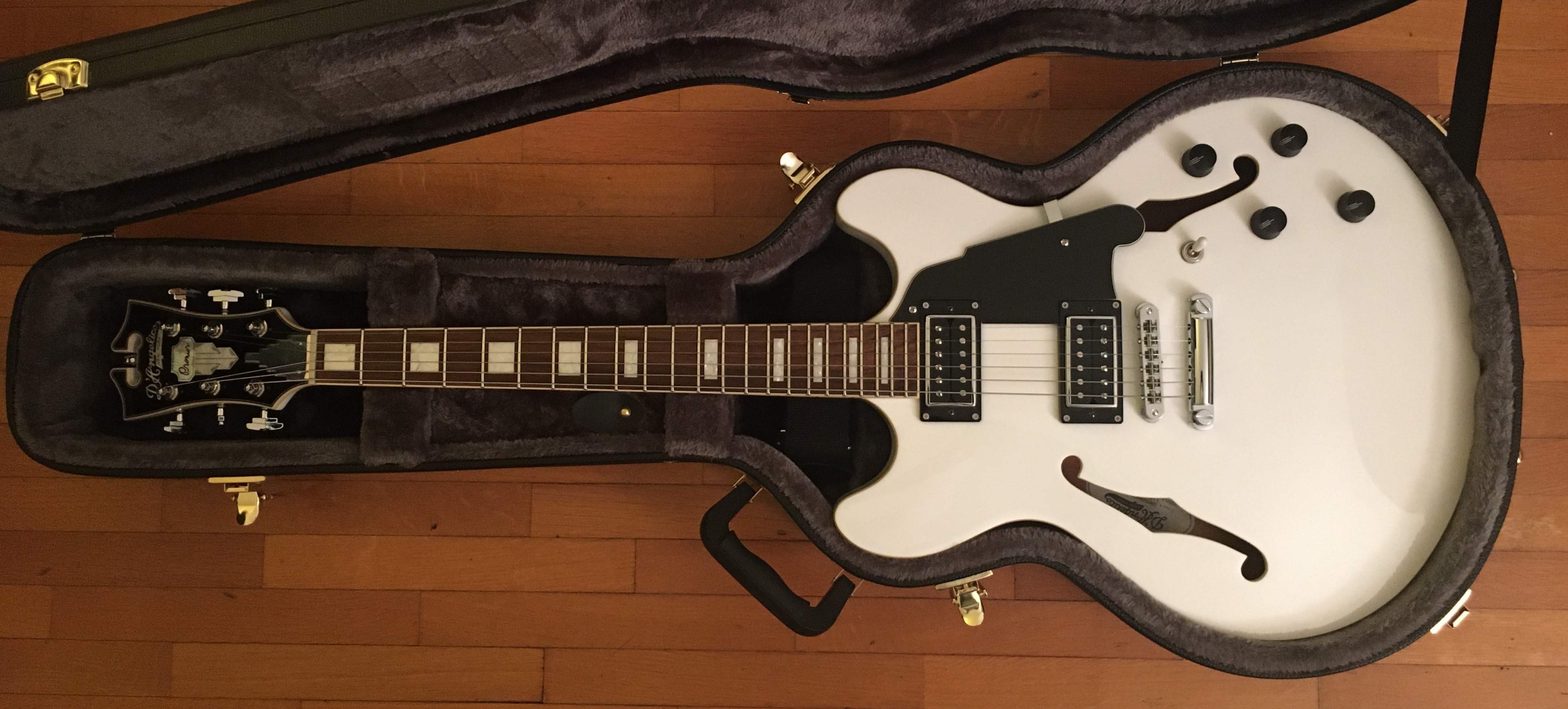
Great thread indeed, thanks to everybody. I just registered because I'm experiencing what I've just learned to be a Sky Jump on a 335-style guitar: did anybody have the same issue on other tenon type necks? Matter of fact is, it disappears totally when I straight up the neck completely, but with no relief at all I cannot succeed in lowering the action down to a certain degree; and as soon as I turn the truss rod nut a little, the jump immediately appears. I guess Richard might suggest to correct the last frets, that was my original thought too.

Great thread indeed, thanks to everybody. I just registered because I'm experiencing what I've just learned to be a Sky Jump on a 335-style guitar: did anybody have the same issue on other tenon type necks? Matter of fact is, it disappears totally when I straight up the neck completely, but with no relief at all I cannot succeed in lowering the action down to a certain degree; and as soon as I turn the truss rod nut a little, the jump immediately appears. I guess Richard might suggest to correct the last frets, that was my original thought too.
Pictures or it didn't happen! And 335's are cool.
I agree, pictures are coming on Monday; it's an heavily modded D'Angelico, actually.