Im looking for a neck and bridge replacement pickups for a epiphone newport body. I cant really afford vintage gibson ones so im looking for good sounding decently priced pickups. I know a DiMarzio neck pickup would fit the bill but im still looking for a bridge pic that would blend well with it. it doesnt even have to be a gibson or its style but it would have to sound good and different than the neck. Any suggestions, tips, pointers would be greatly apprechiated!! Thanks

Enjoy the benefits of a premium membership!
Upgrade Account
-
TalkBass has been independent since 1998. Add your voice.
Create a free account to reply to discussions, view embedded media, and browse with fewer display ads.
Join free Log in
Want zero display ads or expanded classifieds tools? Compare plans.
You are using an out of date browser. It may not display this or other websites correctly.
You should upgrade or use an alternative browser.
You should upgrade or use an alternative browser.
Gibson SG-EBO-2-3 style Pickup REPLACEMENTS?
- Thread starter Bozmonaut777
- Start date
More options
Who Replied?
- Aug 21, 2008
- 10,386
- 252
- 68
- Disclosures
- Owner, SGD Music Products
Are you looking for a neck pickup that sounds like the original? Or something clearer?
at this point anything something different from the dimarzio neck humbucker it could be something that soudns like the original but whatever i can find for a clear sound and a managable price.
One doesn't typically play a Gibson-style bass when looking for a "clear" sound. Gibson-style basses bring the fuzz, boom, woof, and aggression. Clarity? No.
- Aug 21, 2008
- 10,386
- 252
- 68
- Disclosures
- Owner, SGD Music Products
One doesn't typically play a Gibson-style bass when looking for a "clear" sound. Gibson-style basses bring the fuzz, boom, woof, and aggression. Clarity? No.
Well that's why DiMarzio originally made the Model One, because people wanted a clearer tone. Now it's retro and all, but at the some people didn't like the mudbucker tone.
Look at Mike Watt's bass as an example.

I have been making quite a few mudbucker replacements lately. Everyone wants them to be brighter and sound more like a Fender.
Yeah i love mike watt for sure. My original idea was to get the whole gibson set up and ADD a Fender P BASS style pickup deadsmack in the middle of my Newport coming in if it was ever POSSIBLE. Id have to visit the fine luthiers in my town. its all up for disgustion at this point.
IMO, trying to make a Gibson sound brighter and more like a Fender completely defeats the purpose of the Gibson bass. If that's your aim, you're better off getting a P-bass and sticking a mudbucker above the split-coil.
IMO, trying to make a Gibson sound brighter and more like a Fender completely defeats the purpose of the Gibson bass. If that's your aim, you're better off getting a P-bass and sticking a mudbucker above the split-coil.
But this is what after market and custom pickups are all about. People also buy basses on look, feel, and many other characterstics that can't be changed as easily as pickups can.
Funnyfingers your spot on my friend its hard to tell people they cant do things i mean it might not be someones prefrance but its creating something new.... and i dont have to look to 2 guitars to sound different its all in the mix
Doner Designs
Steve Doner
- Jun 2, 2012
- 5,784
- 6,819
- Disclosures
- Doner Designs is an alias for Steve Doner
I have used the Gotoh and the "Economy" sold by Guitar Parts Resource. I liked both but had to do a rewire on the economy one to get it working right. They sell both neck and bridge in the Gotoh. Allparts has them too.
I use them in Fenders to expand the tonal palatte and have been satisfied with both. I would try a Curtis Novak, but the price is really up there. Maybe some day. The Gotohs are about $50 each.
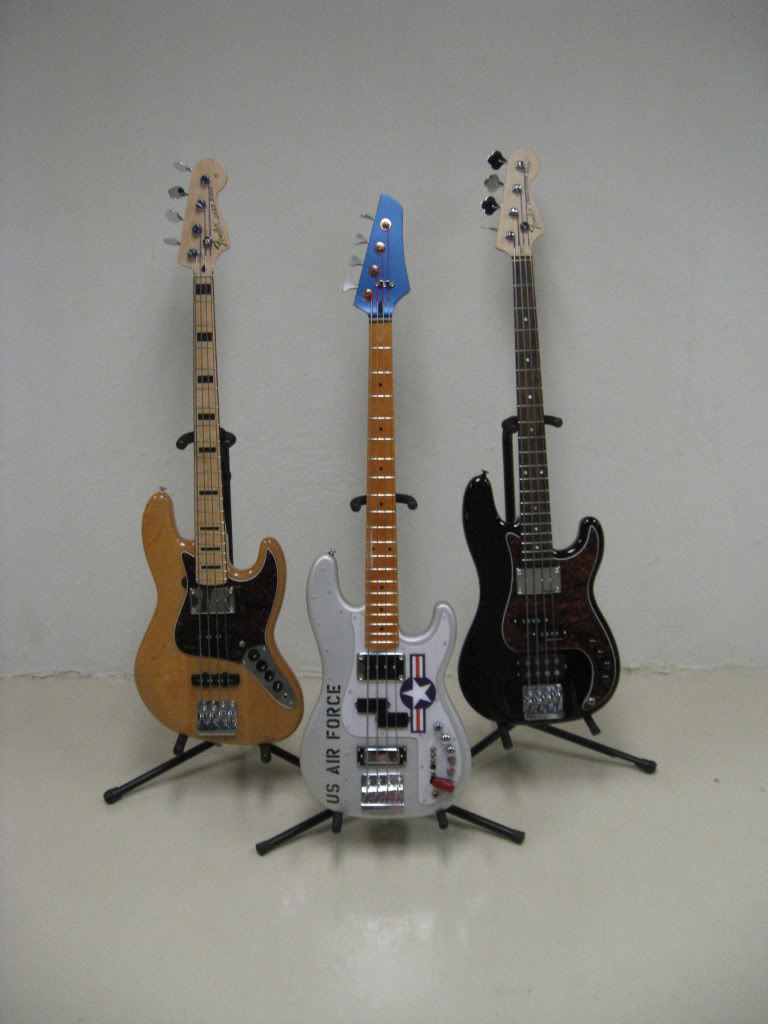

I use them in Fenders to expand the tonal palatte and have been satisfied with both. I would try a Curtis Novak, but the price is really up there. Maybe some day. The Gotohs are about $50 each.
But this is what after market and custom pickups are all about. People also buy basses on look, feel, and many other characterstics that can't be changed as easily as pickups can.
Eh, I disagree. Aftermarket pickups are about getting your bass to sound its best, not about making something it isn't.
wow doner designs you have to tell me how to run schematics like that those tone switches are unbelievable some real stealth bomber action up in that piece.
- Aug 21, 2008
- 10,386
- 252
- 68
- Disclosures
- Owner, SGD Music Products
Eh, I disagree. Aftermarket pickups are about getting your bass to sound its best, not about making something it isn't.
And I disagree with that statement. There's no law that says a Gibson EB bass has to sound the way they did back in the 60s, and in fact the new ones don't. Same is true of any other bass.
The very first replacement pickups (Hi-A/Bartolini and DiMarzio) came on the market to sound different than the stock pickups. These days you have 20 different Jazz and P pickups that are made like vintage Fenders, but that's like seven different brands of chocolate ice-cream. They might be a little different, but it's still the same flavor.
Sometimes you want vanilla.
When there were less brands of basses on the market than there is now, it was common to see Fender basses with Gibson pickups, and Gibson basses with Fender pickups, and Rickenbackers with all kinds of mods. You like the bass you like, but you might want it to sound different. That's OK. That sets you apart from everyone else.
These days too many people play the exact same bass and are lacking any originality IMO. It's good to personalize you instrument and come up with your tone, not the tone the bass came with. Everyone else has that tone.

And thats coming from SDG luthrie, a person that makes there own pickups for a living..... waait you are the person that makes them...right??? cause i know on my search here i was seriously considering your very unique pickups that iv only heard half a handful of tones like that... If thats you im honored for you to grace my page with your kind wisdom. Yeah if i really want the real macoy vintage sound ill hunt down a vintage instrument. I could have just as well got a vintage BROWN SG with two pickups for a grand but i said to myself "for that much i could create something all on my own for the same amount. So i waited and found the newport which is an absolutely amazing unique desgin compared to the Jack Bruce SG thing and it will sound exactly how i want it like the DIY mike watt spirit.
HERES a vintage GUILD JETSTAR BASS for one 800 dollars. was one of my choices and IMO better than GIBSON... someone should buy it..
http://www.guitarcenter.com/In-Stor...JS1-JETSTAR-BASS-CHERRY-108486244-i2923875.gc
http://www.guitarcenter.com/In-Stor...JS1-JETSTAR-BASS-CHERRY-108486244-i2923875.gc
- Aug 21, 2008
- 10,386
- 252
- 68
- Disclosures
- Owner, SGD Music Products
And thats coming from SDG luthrie, a person that makes there own pickups for a living..... waait you are the person that makes them...right???
Yep, that's me. And thanks for the kind words.
There's no law that says a Gibson EB bass has to sound the way they did back in the 60s, and in fact the new ones don't. Same is true of any other bass.
Well, there oughta be. Those 60s EBs had an incredibly unique tone that set them apart. I don't see why Gibson had to change the (in)famous mudbucker, but they did. The TB pup isn't bad sounding, but the raw uninhibited mudbucker is definitely missed. After buying a mudbucker from Curtis Novak, I laughed when I compared the SG bass's TB pup to a vintage spec mudbucker - the TB pup was literally half its size. Mudbuckers are prettay, prettay, prettay, prettay, pretty beastly.
When there were less brands of basses on the market than there is now, it was common to see Fender basses with Gibson pickups, and Gibson basses with Fender pickups, and Rickenbackers with all kinds of mods. You like the bass you like, but you might want it to sound different. That's OK. That sets you apart from everyone else.
And despite Fenders with Gibson pups and Gibsons with Fender pups, neither sounded like the other. Funny how that works. There's a phrase that comes to mind: "The right tool for the job." If you want to make an EB3 sound like a P, you're welcome to try until the cows come home. You might even cop a unique tone out of it. But don't be surprised when it doesn't sound like a P.
On another note, I'm in the process of putting a Thunderbucker Max in the bridge of my SG bass. The mini-humbucker is lacking to my ears. I reckon this goes back to getting the most out of my bass.
These days too many people play the exact same bass and are lacking any originality IMO. It's good to personalize you instrument and come up with your tone, not the tone the bass came with. Everyone else has that tone.
Eh, I'm all for personalizing your instrument but I think the similarities in tone between modern players comes down more to crappy technique and amp settings. Lots of great players have gotten by with great tone without fiddling with the guts of their instrument.
Case in point: Geddy Lee. He plays an unremarkable '72 Jazz bass and there are many others just like it. I believe everything on it is stock, yet he gets more out of it than many of us, who dick around with our electronics and such, will. I have no doubt this is because of his technique and rig.
- Aug 21, 2008
- 10,386
- 252
- 68
- Disclosures
- Owner, SGD Music Products
Well, there oughta be. Those 60s EBs had an incredibly unique tone that set them apart. I don't see why Gibson had to change the (in)famous mudbucker, but they did.
I partly agree, but they didn't sell as well as other basses, and they are pretty much a one trick pony.
I used to own this bass:
I ended up rewinding the neck pickup to get it to balance better with the bridge. I actually rewound a NOS pickup, and not the one it came with. I also rewired the useless baritone switch to be a varitone.
I like the quirky mudbucker tone, but you can't use it for everything.
I will say that Gibson's new replacement for the mudbucker isn't very good.
And despite Fenders with Gibson pups and Gibsons with Fender pups, neither sounded like the other. Funny how that works. There's a phrase that comes to mind: "The right tool for the job." If you want to make an EB3 sound like a P, you're welcome to try until the cows come home. You might even cop a unique tone out of it. But don't be surprised when it doesn't sound like a P.
I don't think the point was to make one sound like the other. part of that was the scale lenfgth. I put a mudbucker on my Rickenbacker 4001, and it did sound very much like a Gibson, or more like an Epiphone Newport, which is what I was trying to get it to sound like.
You have to remember that until recently your choices in replacement pickups was confined to Fender, Gibson and maybe Guild parts. I also had a Fender P pickup on another Rick. It let me get those types of tones.
Then you see players like Dennis Dunaway putting Fender pickups on his EB3, which gave it a more useable tone.
You also see people putting humbuckers on Strats. They don't sound like a Les Paul, but they give the guitar a tone it didn't have.
So it's not about copying, it's about changing the character of the instrument into something more usable to the player. Guitars and basses are tools. And one size does not always fit all.
On another note, I'm in the process of putting a Thunderbucker Max in the bridge of my SG bass. The mini-humbucker is lacking to my ears. I reckon this goes back to getting the most out of my bass.
Well there you go. You aren't getting the most out of it, you are changing the tone to one you like better. That's why I make replacements for the mini humbuckers. The stock ones are fairly useless pickups.
My replacement allows the bass to look the same while improving the tone and you don't have to rout anything. But it does not sound like the stock pickup. It sounds better. It's fuller and clearer sounding, and you can actually solo it. And that's what the OP is talking about. With these basses you often have to get a different sounding pickup to make the bass sound better.
The SG bass neck pickup is another bad design. it has fake pole pieces mounted to a big block of aluminum. That block sucks the tone out of the pickup because of eddy currents, and places the dual blades too far from the top of the cover. Gibson didn't even try and make a new pickup, so they took the bobbins from the bridge pickup and used those.
Eh, I'm all for personalizing your instrument but I think the similarities in tone between modern players comes down more to crappy technique and amp settings. Lots of great players have gotten by with great tone without fiddling with the guts of their instrument.
That true, and it's also the choices. Too many people playing the same gear as everyone else.
I will say though that the gear today is better than when I started playing bass in 1969. Amps were underpowered, selection of basses and strings were limited, and forget about effects! Modern bass has evolved because that's what the players wanted. The tone is brighter and more up front now.
Case in point: Geddy Lee. He plays an unremarkable '72 Jazz bass and there are many others just like it. I believe everything on it is stock, yet he gets more out of it than many of us, who dick around with our electronics and such, will. I have no doubt this is because of his technique and rig.
It's all about the attitude. I was a progressive rock player. Back then even Ricks came with flat wounds. People used to look at me funny because I wasn't playing a Fender, was using a bright tone, and even a fuzz pedal. Now all those things seem old hat. Geddy also steps out and plays more forward than some players. That's why you notice him. It's more of a lead bass style.
But before there was a Geddy you had Chris Squier and John Entwistle, who created those tones and that lead bass style. That was a very different sound at the time. Same with Stanley Clarke. People had never heard a bass tone like that.
Like I said, it seems old now, but that super bright clear tone was revolutionary. It also made the electric bass a more respectable instrument.
And they all did something a little different. Entwistle helped develop round wound strings, and of course later modded his Fenders with brighter T bird pickups. Squier was using a Rick, which wasn't as common, and did the stereo two amp thing and distortion. And Stanley was using the Alembic. So none of them used the "standard" bass setup that was common at the time.
Latest posts
-

-

-

-
 Future Impact now available!! WAS: deep impact reissue!!! interested?
- Latest: Andras Szalay
-
 I didn't need it but I bought it anyway new (to me) cab day...
- Latest: S-Bigbottom