• TalkBass has been independent since 1998. Add your voice.
    Create a free account to reply to discussions, view embedded media, and browse with fewer display ads.
    Join freeLog in
    Want zero display ads or expanded classifieds tools? Compare plans.

Going in the studio.. having second thoughts.

i heard ZERO bass on each recording he played for us.

We are a melodic metal band, layers and dynamics are very important. So i asked the engineer to play something with some audible bass - he laughs and puts on some crappy ska band. :rollno: I was actually insulted by that. I asked to hear something else and was given the cold shoulder as the other guys went back to talking about "how big the guitars will sound". After that incident there is no way I (if it was up to me), would EVER record at this facility.

We then discussed how i want to record the bass and the engineer kept changing it around to "we'll use the Sansamp". I had to say over and over again that i want to go direct from my Streamliner (which has produced some great recordings), to which he replied "yeah and we'll put it through the Sansamp". :eyebrow:

When you record turn your volume down to zero and see if anyone notices.

I am still waiting for metal bands to start performing without a bass player ... just 2 or 3 7 or 8 string guitars detuned and turned up too loud.

 
One way to handle the pushy engineer situation is when you get everything set up like they want it and you do your initial test track, when you listen back, tell them you don't care for the sound of your bass. Then tell the engineer what you want and let them set it up. If they try to bluff or bulldoze, remind those doing so who's paying for your studio time and the more we stand around knocking dickheads the more expensive it gets. If the engineer plays the "it's gonna sound like $%!+" card politely remind him that it is you who will have to live with that. It might cost you a few extra bucks this way, but as long as you insist you want it changed and you are one of the paying members you should be able to get your way without having to be confrontational. If you do everything short of that and still no love for what you want, tell the band they need to find a bass player better suited to their goals, pack your trash and step away. I saw this method used by a drummer the last time I was in a studio and it worked to great effect. It never got to the do it or else phase but he did have to insist he get what he wanted before they would set it up for him.

The few times I've been in a studio I was just glad to be there and put myself (and my sound) in the hands of the producer and engineer and every time I was amazed at how good they made me sound. Not having the luxury of knowing what it takes to engineer sound, I have little choice but to trust those hired to do so.
 
I've faced this kind of situation a number of times over the years. Initial tracking is the most stressful piece of work for everyone and especially for an engineer, even one who knows his / her stuff and is familiar with their gear. There's just a whole lot to do all at once, and everything that follows is riding on that rough mix.

Assuming I'll have any hand in mix decisions (which is sometimes), I try to make sure there will be both punch & re-amp opportunities later if desired (make sure that's a firm "yes" because it's easy to be ignored later). With that agreement (I usually get a yes just to get me off their backs), I've come around to working on the best DI sound I can get, whether through a my own DI or the studio's box (never been offered a Sansamp, so not sure how I'd react), including an agreement to a listen-back after one or a few initial takes to make sure the bass presence (not volume) in the mix is desirable.

Adding effects or plug-ins in the mixing stage, when things can be more deliberate, works fine, and re-amping can allow you to fine-tune and play with a cab/mic sound if all else fails or it's just what you want to hear. All of this takes time later, but then the stress of tracking is past. I usually try for a one-on-one mixing session with the mixer if it's at all possible within the budget ...get their full attention, however briefly, so they can buy in to your concerns at their leisure.

Co-operation up front can help to make sure the bass is not neglected in the end. I say all this knowing you'll be involved in mixing. If not, it's a different ball game for sure.

Good luck!
 
+1 for re-amping.

JUST SAY NO TO SANSAMP.

I'm not against the Sansamp altogether, just make sure it's nowhere near your bass signal during the initial (clean) tracking, which can be sent through the Sansamp later if so desired.

In my limited experience, I've found the (real) experts to be correct: initial tracking is crucial as nothing can be "fixed in the mix".
 
We're all friends. I just don't want to be the bad guy and squash all the energy when it comes to the recording session.

If money wasn't so tight right now, i probably wouldn't really stress on it. I'm obviously going to be hands on in mixdown, but the thought of forking over good money for a @#$% product scares me.

Again, we haven't even started tracking, but i was really turned off by the engineer and his recordings. Part of me is saying "suck it up cupcake", the other part of me is not.


You are so right. The guys were so pumped... i couldn't be the bad guy. aww crap.

If you were my friend, I'd want you to tell me exactly this.
 
I feel ya. Although I don't play metal I talked to a guy who did sound along with engineering work for some hair bands from the 80's. He was a complete drunk egotistical prick. He basically said you need bass and guitar to be seamless, in which the bass is just an extension of the guitar. When I challenged that view he started balking about Bon Jovi and Guns and Roses. I think the guy was poisoned by all the aqua-net he used in the 80's and stuck there.
 
I remember one record I was engineering these metal guys came in and the bass guy was very concerned that his bass be heard in the mix. Being a bass player myself that seemed to reassure him and he was present for the recording and I constantly asked him how he was liking his tone, etc. He always said he liked it.

Towards the end of the session he got blisteringly drunk and had to basically be carried out. Don't be that guy. Ever. Studio is fun but it's not a bar. You need your game face on.

During mix I tried as hard as I could to separate the bass from the guitars with some good success I thought. The problem was that the bass player played the exact lines the guitar player was, no differentiation at all. He had a nice tone, he played with fingers though and his tone just extended the range of the guitars. He was the only one that didn't like the final mixes.

I could hear the bass because I knew that without it the guitars would sound tinny as heck but all he could hear was the record sounded like a huge wall of guitars and he couldn't tell where his bass attack was.

Arrangement is key.
 
I've been through this process several times. For metal, capturing a good bass tone (as you would when you play a show or practice) straight from the amp/DI is rarely the approach the engineer will take. Definitely use your own amp and run a DI also to have options when it's time for mixing. Usually most guys will have you dime your tone knob on your bass and get you tracking with a very high frequency setting on your amp. Almost clanky. It'll sound like crap. The reasoning behind it is that the low end can be added in and the tone can be shaped much more easily during the mix and allow your instrument to stand out. It's about having (and allowing) each instrument to have it's own space. This gives the engineer some leeway when dealing with bottom heavy guitar tones. If you lay down a bed track with a ton of bottom end, the guitars on top of it (metal guitars) will probably turn it to mud.
 
When recording my bass, I usually do two channels: 1 mic, and one direct out of my amp. Works great.

I agree with the others: Stand up for yourself.

As a fan of this genre, you are correct that most of the time, the bass seems to be an after thought. Don't let them do that to you. If the guitarists can have two rhythm guitars going under a harmony solo (i.e. 4 guitars) you should definitly be "allowed" to have a few tracks so that your bass can be heard.


When recording with others, I view my equipment as "available for use as needed". If somebody comes in with their own amp, we'll record theirs unless they'd prefer to use mine. No harm no foul. Their rig is their sound. This works the same for the guitars, drums, keys, or whatever. It really is just that simple as the goal is to get the best recording possible regardless of whos gear it is.
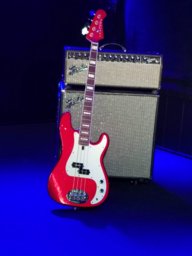
 
When recording with others, I view my equipment as "available for use as needed". If somebody comes in with their own amp, we'll record theirs unless they'd prefer to use mine. No harm no foul. Their rig is their sound. This works the same for the guitars, drums, keys, or whatever. It really is just that simple as the goal is to get the best recording possible regardless of whos gear it is.


Well stated, especially the point about multi-tracking the bass with a DI and a mic. Plenty of virtual tracks available these days.

I've been in many studios that usually have a Fender Precision hanging on the wall. The engineers tell me that occasionally the band is bass-less, or the bass player's gear is tracking extremely poorly, so it's reserved for those extreme situations. But, extremes aside, every bassist deserves the opportunity to track his bass and his signal chain.
 
How can you be in a band and not voice your concerns to your fellow members ? Do you have a mix of some bands that you guys can agree on ? I would bring it up, pronto. Btw, maybe I missed this but how is the recording being funded ? Here's the good news, if you're recording into a Tech 21 RBI or RPM, it's going to sound very good. Be sure you have a tone that allows you to cut through but , yes, be there for the mixdown and make sure you feel comfortable with this guy, beforehand. Don't worry about the guitarists feelings and just talk to them. Then talk to the engineer. If you don't feel good about it. Tell everyone this isn't the studio and keep looking. If it's a solid group, tbey should want you to be happy as well.

Edit. O.k. so your helping to pay for it. Satisfy your concerns now and avoid being a pushover. Resentment will build if you don't.
 
Haven't you ever heard of Metallica? You don't need bass in the mix.

Sub'd. & Joking.

I'd really like to hear some recordings. Our recording process went terribly. I'll share another time. SHoot me a PM if you're not planning to post the name or recordings for the googleverse. I'd love to listen to the old music and the new.
 
So yesterday we began tracking. First off, i found out that Gung-Ho guitarist had gotten us a better deal than what i thought we were paying. That is making be feel better because i ended up only getting 2 signals. My STL 900 and the Sansamp.

HOWEVER, it took some wrangling to get the engineer to give me my own channel for the STL 900. Once we got over that hump and he actually HEARD the DI from the 900 he was basically just "oh... wow!". Yeah buddy, I know. :rolleyes:. So anyway we were actually able to get a great sound by adding just a bit of the Sansamp to the 900. I'm more than happy with it.

On to the actual tracking! The drummer and i prefer to record at the same time to really keep a live feel. We both put a lot into preparation, it showed by us knocking out bass & drums to 6 tunes in a short period. We are going track the remaining 5 songs this evening. We did get some great results yesterday with minimal punches.

Now, in conclusion to day #1, i would say it wasn't the most ideal situation. A little less professional than i am used to. But, that being said - I was able to get a great sound (to me & the band at least), and by being highly prepared we are moving much faster than expected and saving some money in the process. I can live with that. So far so good.
 

Latest posts