• TalkBass has been independent since 1998. Add your voice.
    Create a free account to reply to discussions, view embedded media, and browse with fewer display ads.
    Join freeLog in
    Want zero display ads or expanded classifieds tools? Compare plans.

Headless Club???

exfactor.jpg


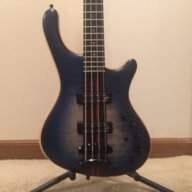
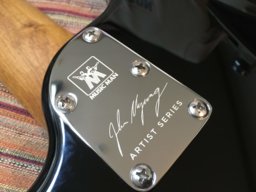
Here's my Kubicki Ex Factor 4 (1994) which I purchased for 1,560,000 KRW (approx. 1,400 USD) a couple of days ago. (I live in South Korea.)

Its overall condition was excellent, except for the VERY noisy pickup blend control. A few bursts of DeoxIT into the pots got rid of the noise completely though. It's a fun-and-easy-to-play 32" scale bass with many interesting features. I guess I'll need a little time to get comfortable with this 'scale-extender' type D-tuner, since I am more used to 'tension-lowering' Hipshot Xtenders and dropped D fretboard mapping.
Thanks to its headless design, there's no neck dive at all - but the maple body and the bridge, which is a huge chunk of metal indeed, cause the opposite of neck dive only when I try to play it sitting. When I play standing up, the balance is just perfect.
The 6-position rotary switch is a bit overwhelming but I do find the normal passive position sounds very good to my ears.
 
No dead spots from resonances from the flippers, I mean headstocks, easy and fast string changing, better turns ratio on the tuners, no headstock to take up stage space, more compact for travelling and they stay in tune far, far better than any conventional instrument I have. These apply to all the headless basses I have; Steinberger (XL2), Spirit, Status and Hohner.
 
  • Like
Reactions: deak21
Cool descrip of why headless vs. conventional neck but I meant ...

Lemme ask it this way: What benefit do you gain from a headless neck on a more conventional body shape vs. a headless neck on a Steinberger-type body?
Extended upper horn. It's not just about balance, but about the lateral position of the bass, the reach to the first fret.
 
Interesting. Seems to me tho' that ya give up some of the portable-nessossity with a regular body. By what I mean, it's got advantages vs. a standard neck, but not all those of the Steinberger-stylee ...

I will say, my main issue with my Hohners is going between them and a conventional P or Jazz - I find sometimes I'm off by a whole note. I have a Hohner headless guitar, also, and have the same issue switching between that and more conventional guitars.
 
Cool descrip of why headless vs. conventional neck but I meant ...

Lemme ask it this way: What benefit do you gain from a headless neck on a more conventional body shape vs. a headless neck on a Steinberger-type body?
Sorry, I misread your question.
jbyjb answers as I would have, quoted below, but if you already have the small paddle bodies, there are extenders that can be made that will give the same as a full body. Member MPU has also made clones of the original XL2 pivot plates, and I think some are still available; they are very nice quality and I'll be adding inserts to all my small bodied basses so that I can use them. I may even add it to my conventional Ibanez 6 string as I play more vertically than most people.

The most comfortable bass I have ever played is my XL2 with a later Steinberger designed Boomerang pivot plate.

The extender details are in the Steinberger Spirit Club thread.

Extended upper horn. It's not just about balance, but about the lateral position of the bass, the reach to the first fret.
 
As an Amazon Associate, TalkBass may receive commissions from qualifying purchases made via links on this site.
It is my understanding that the Kubicki X-Factor Bass was the result of Phil seeking to design the most ergonomic bass.
I have an X-Factor and two custom Clement headless. They are indeed the most comfortable, easy to play basses I Own. The upper horn is crucial.
 
  • Like
Reactions: saltydude
View attachment 3198061

Here's my Kubicki Ex Factor 4 (1994) which I purchased for 1,560,000 KRW (approx. 1,400 USD) a couple of days ago. (I live in South Korea.)

Its overall condition was excellent, except for the VERY noisy pickup blend control. A few bursts of DeoxIT into the pots got rid of the noise completely though. It's a fun-and-easy-to-play 32" scale bass with many interesting features. I guess I'll need a little time to get comfortable with this 'scale-extender' type D-tuner, since I am more used to 'tension-lowering' Hipshot Xtenders and dropped D fretboard mapping.
Thanks to its headless design, there's no neck dive at all - but the maple body and the bridge, which is a huge chunk of metal indeed, cause the opposite of neck dive only when I try to play it sitting. When I play standing up, the balance is just perfect.
The 6-position rotary switch is a bit overwhelming but I do find the normal passive position sounds very good to my ears.

You got one hell of a deal my friend at $1400 USD.
 
  • Like
Reactions: loopee
I hope I am in the right place.I am looking for any and all info/specs on a headless bass I saw on a YouTube video.The first 25 seconds are the best views of the bass, but details are poorly seen.The bass player is Paul Fakhourie and he is backing Lauryn Hill on her hit "DooWop-That Thing" at the 1998 Billboard Awards Show.My best guess is that it is a Steinberger L2 or XL2, but I am far from certain.
I am hoping that someone may know what Paul was playing at that time, even if the video is too indistinct to tell for sure.
This is the link to the video.
 
  • Like
Reactions: Jeff Elkins

Latest posts