• TalkBass has been independent since 1998. Add your voice.
    Create a free account to reply to discussions, view embedded media, and browse with fewer display ads.
    Join freeLog in
    Want zero display ads or expanded classifieds tools? Compare plans.

Help me find my spot in the mix

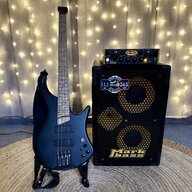
I’m a college student from Athens, Ga. I play in a classic rock band in a college town with ~80 bars and a large Greek life scene. We play bars, frat houses, date nights, events, etc. 4 piece band, lead guitarist on a 3 pick- up les Paul, singer who plays rhythm guitar with a strat, drummer, and me, I recently upgraded from a squire p bass with SD quarter pound pickups to a Gibson SG standard bass. I play it through an Acoustic B300H 300W head to an Acoustic B410C cab.

I don’t think my set up is nearly loud enough and I’m wondering what may be the most cost effective option to fix that. I live with the lead guitarist and we are both obsessed with tone. It’s very hard to chase a clear punchy tone when you have to run your master on 9 with gain just to hear yourself. I want to be able to actually use my eq and pickups to get some fuzz or get some drive or play clean tones.
My thoughts are maybe I could get another cab? I know the one I have has the parallel out so I could run the same head and just get another of the cab I already have. It would certainly be cost effective. The question is whether or not 300w is enough for 2 4x10 cabs. I’ve gotten differing opinions in the past. I welcome all input. I just don’t want to be stuck sending my master volume to the moon just to find my place in the mix. I could also look at other heads? I love ampeg heads but they get pretty pricey.
Thoughts and recommendations?
thanks so much for all the help!!!
 
  • Like
Reactions: Razman
I don’t think my set up is nearly loud enough and I’m wondering what may be the most cost effective option to fix that. I live with the lead guitarist and we are both obsessed with tone. It’s very hard to chase a clear punchy tone when you have to run your master on 9 with gain just to hear yourself. I want to be able to actually use my eq and pickups to get some fuzz or get some drive or play clean tones.
Matter of opinion: I'd try to find my niche in the frequency range and in the "rhythmic space", rather than in the volume. (As any band member, not just the bass player.) Stereo panning may also help. - Using fuzz would be counterproductive.

The matter of the "frequency ranges" may become clear when you listen to studio recordings from the 60s (the original mixes): they have often been mixed down for mono playback through devices with limited frequency response. (I remember John Fogerty being said to check the sound of new CCR recordings through a car radio. Recently, I noticed Manfred Mann recordings sounding rather "hollow".) So, as a bass player, I'd try to keep clear of the lead guitar (including overtones), and the lead guitar should allow the bass the room needed for his part. (Could be dynamic: when the lead goes high, the bass could venture far into the guitar range.)

By "rhythmic space" I mean the "sounding together". The bass is likely to sound simultaneously with a kick drum, but the sound of that drum is punchier than the bass, so both can be heard. The problem there may be more between rhythm guitar and snare drum.

I could imagine differences developing between "planned" and "performed". In any respect, like setting the tone controls (and selecting the pick-ups on the instrument) different at gigs from the sound you prefer, in order to sound better together. Or simplifying licks.
 
  • Like
Reactions: Jay2U
Finding your place in the mix is as much about songwriting as it is about sound and power, as others have said. 300W ist not a lot in a rock band, but it still should be enough - if the guitar volumes and EQs are set reasonably and your bass amp isn't just blowing out lows and highs. Sometimes it helps to experiment with different positions in the room, both for your amp and for you (directly in front of an amp that ends at your waist isn't always a great idea).

In rock bands it may be a problem that a bass is often more felt than heard. The classic example would be palm muted 8th note power chords on guitar and the root on bass. If that happens a lot with you guys, you will have to compromise to make out your notes more clearly: you may move the guitar part up an octave, you may boost a lot of (highish) mids in the bass, but the overall sound will suffer.
 
  • Like
Reactions: pbass2
Get the second cab, your amp should be able to push it fine for what sounds like a loud party band. Down the line, if your tone chasing gets more intense, you'll probably sell the rig for something more upscale and flexible.

Some would say, with justification, that you should just invest in a higher end rig now, but that may be a financial commitment that you're not ready/able to make. I certainly couldn't afford anything cutting edge/pro when I was starting out but at the end of the day it didn't prevent me having fun or putting on good shows. Have fun and protect your ears.
 
  • Like
Reactions: boxerrider
Matter of opinion: I'd try to find my niche in the frequency range and in the "rhythmic space", rather than in the volume. (As any band member, not just the bass player.) Stereo panning may also help. - Using fuzz would be counterproductive.

The matter of the "frequency ranges" may become clear when you listen to studio recordings from the 60s (the original mixes): they have often been mixed down for mono playback through devices with limited frequency response. (I remember John Fogerty being said to check the sound of new CCR recordings through a car radio. Recently, I noticed Manfred Mann recordings sounding rather "hollow".) So, as a bass player, I'd try to keep clear of the lead guitar (including overtones), and the lead guitar should allow the bass the room needed for his part. (Could be dynamic: when the lead goes high, the bass could venture far into the guitar range.)

By "rhythmic space" I mean the "sounding together". The bass is likely to sound simultaneously with a kick drum, but the sound of that drum is punchier than the bass, so both can be heard. The problem there may be more between rhythm guitar and snare drum.

I could imagine differences developing between "planned" and "performed". In any respect, like setting the tone controls (and selecting the pick-ups on the instrument) different at gigs from the sound you prefer, in order to sound better together. Or simplifying licks.


Nothing beats the tone from the 60’s to early 70’s. I’ll always be chasing Andy Fraser’s sound.
I’m gonna try to reply to you and anyone else interested in this post.
I am certainly always trying to find my place rhythmically in the band. I was involved in the school band when I grew up. I played percussion from 5th grade until 10th grade in highschool. I marched snare drum along side my current lead guitarist who played quads. My cab is always set up nearest the drummer so that me and him can hold down the tempo and allow our guitarist some flexibility.
Everyone seems to share the sentiment that my current set up should be loud enough. Let me elaborate on what is going on. Lead guitarist is playing through a hot rod deluxe he had custom built that sounds AMAZING but it does get rowdy. The main problem is the singer playing rhythm through a fender champion 100w. He usually runs that champion pretty high gain and compressed. I think that’s where I’m getting lost in the mix. Everyone stays out of my way on the low end, my open e comes out almost exactly how I want it. I also like where my open g fits in the mix (only use that when the guitarist go high or I’m doing a fill). My A and D string played open can barely be felt or heard.
I try to run my master high to get those mids where I want them, I eq them a little higher but quickly run into the problem of drowning out the rhythm if I get to compressed. recently my best solution has left me having to very carefully pick my middle two strings much harder than my low and high string.
I’m still new to this and most of you on here know tons more than me and I’m trying to learn as much as I can. If I am missing something or doing something wrong please feel free to let me know. I am not the type to get offended by constructive criticism
Thanks again for all the input! I brag about how cool talkbass is all the time. You guys are the best !
 
I’m a college student from Athens, Ga. I play in a classic rock band in a college town with ~80 bars and a large Greek life scene. We play bars, frat houses, date nights, events, etc. 4 piece band, lead guitarist on a 3 pick- up les Paul, singer who plays rhythm guitar with a strat, drummer, and me, I recently upgraded from a squire p bass with SD quarter pound pickups to a Gibson SG standard bass. I play it through an Acoustic B300H 300W head to an Acoustic B410C cab.

I don’t think my set up is nearly loud enough and I’m wondering what may be the most cost effective option to fix that. I live with the lead guitarist and we are both obsessed with tone. It’s very hard to chase a clear punchy tone when you have to run your master on 9 with gain just to hear yourself. I want to be able to actually use my eq and pickups to get some fuzz or get some drive or play clean tones.
My thoughts are maybe I could get another cab? I know the one I have has the parallel out so I could run the same head and just get another of the cab I already have. It would certainly be cost effective. The question is whether or not 300w is enough for 2 4x10 cabs. I’ve gotten differing opinions in the past. I welcome all input. I just don’t want to be stuck sending my master volume to the moon just to find my place in the mix. I could also look at other heads? I love ampeg heads but they get pretty pricey.
Thoughts and recommendations?
thanks so much for all the help!!!
Guitarists seem to believe that they are entitled to whatever tone they want and everyone else must fit in with it. Working out your tones at home won't be all that helpful, since everywhere you play will have its own acoustics.
 
I’m a college student from Athens, Ga. I play in a classic rock band in a college town with ~80 bars and a large Greek life scene. We play bars, frat houses, date nights, events, etc. 4 piece band, lead guitarist on a 3 pick- up les Paul, singer who plays rhythm guitar with a strat, drummer, and me, I recently upgraded from a squire p bass with SD quarter pound pickups to a Gibson SG standard bass. I play it through an Acoustic B300H 300W head to an Acoustic B410C cab.

I don’t think my set up is nearly loud enough and I’m wondering what may be the most cost effective option to fix that. I live with the lead guitarist and we are both obsessed with tone. It’s very hard to chase a clear punchy tone when you have to run your master on 9 with gain just to hear yourself. I want to be able to actually use my eq and pickups to get some fuzz or get some drive or play clean tones.
My thoughts are maybe I could get another cab? I know the one I have has the parallel out so I could run the same head and just get another of the cab I already have. It would certainly be cost effective. The question is whether or not 300w is enough for 2 4x10 cabs. I’ve gotten differing opinions in the past. I welcome all input. I just don’t want to be stuck sending my master volume to the moon just to find my place in the mix. I could also look at other heads? I love ampeg heads but they get pretty pricey.
Thoughts and recommendations?
thanks so much for all the help!!!
Your set up is plenty. Your band is playing too loud.
 
Are you using flats? If yes then maybe you should try ground wound, pressure wound, or even round wound strings.

Then start your soundcheck with drums and your bass, if it sounds good then add guitars in and see what happens, if they drown you out start seeing what you can do about it. If the kick is in the PA that can also easily drown you out when tuned to similar frequencies. If the guitarists love the bass control see if you can at least highpass it. Like someone else mentioned, use eq on your amp and find some low or high mids to help you cut through, try hpf/lpf if you have it available. Also compressors can help alot imho. One way to do it is to start with the gear you have, if that doesnt work then add in what you are missing until you are good.
 
  • Like
Reactions: BlueTalon
Welcome to TB, OP! Some good posts here, and while I might lean towards not using the SG bass, I think you should still be focused on tone but from a different angle.

The best bedroom amp I think I have owned was a Fender Bassman 400 210 combo. It had a ton of lows and clear highs - sounded like a lot of recorded bass I've heard - and sounded great all by itself. Only problem was I couldn't get it loud enough in a band context so it was hard to hear.

Now that might have been a combination of things - voicing of the amp, cab, or both - my bass did work with other rigs I've used, so I eliminated that as a cause. Room dynamics can come into play, but I think you need to find a good, general mix where you can hear yourself and then adjust as needed.

Setting EQ for listening by yourself is going to be different than what is needed for a band mix. [This invalid link has been removed] to help become more familiar with EQ'ing in a band context. Try cutting lows (40 Hz), setting mid-lows at noon or boosting slightly (400 Hz) and boosting mid highs (1500 Hz). Brightness is between 4-5K Hz. Above that is usually hiss.

Raz
 
  • Like
Reactions: jtg and Dust2Dust
competing with two loud guitarists/drums...lol fun!:banghead:...turn those guys down or get an extra cab. but never had a problem with my hartke 4x10 in that scenario. My last hardrock thing i used a homebuilt 2x15" cab with a vintage traynor 140w head....plenty loud. So yours being 300w shouldn't be a problem i'd think. Not familiar with SG basses tho.
 
  • Like
Reactions: Dust2Dust