• TalkBass has been independent since 1998. Add your voice.
    Create a free account to reply to discussions, view embedded media, and browse with fewer display ads.
    Join freeLog in
    Want zero display ads or expanded classifieds tools? Compare plans.

Highway 1 or Highway One

were doing fine , I dont want to correct you, I dont own a hwy 1 body , but i know they are closer to the mexi standards than the new ones,if just for the neck , are the pickups in yours both neck size? and do the old ones have a channel from the neck pup to the control cavity?

I have not owned a Hwy 1 Jazz for 4-5 years now, and that did NOT have a routing channel to the control cavity, and the Hwy ONE (Jazz) I just sold was a 2010, and that as well had no routing or CNC hole under the pickguard ... every MIM Standard Jazz I owned/seen did have the channel routing ... as far as pup sizes on the Hwy 1, your testing my good, but short memory again ... I am relatively sure than the bridge pup was longer than the neck pup, as should be, as the alnico pups used in that model should be the same as what is in the current Hwy One, as well as what is in all of the Classic Series 60's Jazz's that I have had ... :)
 
There's a Hwy 1 P bass with the BA bridge at the local store and it's probably the best playing, sounding and looking P bass I have played - including some MIA models. Its also very light and well balanced. I wish I liked P bass tone more.
 
I have not owned a Hwy 1 Jazz for 4-5 years now, and that did NOT have a routing channel to the control cavity, and the Hwy ONE (Jazz) I just sold was a 2010, and that as well had no routing or CNC hole under the pickguard ... every MIM Standard Jazz I owned/seen did have the channel routing ... as far as pup sizes on the Hwy 1, your testing my good, but short memory again ... I am relatively sure than the bridge pup was longer than the neck pup, as should be, as the alnico pups used in that model should be the same as what is in the current Hwy One, as well as what is in all of the Classic Series 60's Jazz's that I have had ... :)

yeah i have a 2010 that I just changed the pups on and it has the same numbers written in white marker on the underside as the pups that came in my classic 70's jazz
 
Why is the BA2 moronic?
Well, to begin with, it's less critical than a decent set of machines, which FMIC actually DOWNGRADED from previous H1s to pay for the BAII. :spit:

That's moronic on the face of it.

Secondly, true high-mass bridges trade thump for plink (a number of people have explained how high-mass bridges work in detail here many times so I won't go into it now). A P is about thump. If you want plink, go to a "modern" bass, don't f up a perfectly good Precision with this junk. Some people do want a "modern," plinky-sounding Jazz, so -- for them -- a BAII isn't a total waste of money, but it's not worth the price on a corner-cut model like the H1s.

[I have a pair of these coming in (eventually!) to set up as a pair of P and J "working" basses and I'm ordering low-mass bridges for them this week as these will use flats.]

Recent builds from FMIC use a lot of cross-purposed vintage vs. modern features that make no sense except to appeal to focus groups.
 
Yes, cheap, nasty matte finishes that fall apart quickly, though I think the current ones may be a bit more durable and less likely to peel.

I was just polishing one out last night. If you are EXTREMELY careful, you can wet-sand out most of the orange peel on the clearcoat with 2000 wet/dry and hand-polish it out with swirl remover without penetrating the topcoat and have a pretty nice finish (I was doing this last night), but I would guess at least 80% of the people who try it will blow it. It is super-thin...which contrary to undying popular fallacy does absolutely nothing for tone on a solid-body instrument.

couldnt agree more about the fragile nature of the finish i have several dings on mine already that have caused the paint to flake off , so I think because of this wet sanding is out of the question , as is buffing. Its starting to get shiny in the normal wear spots after only 1 month , I just hope the paint doesnt come off and turn this baby into a couch-worn bass
 
I think because of this wet sanding is out of the question , as is buffing.
You only wet-sand off the tops of the orange peel (which happens almost instantly (even with #2000!) on the flat portions of the body, which doesn't actually change the thickness of the paint at its thinnest spot anyway.

Hand-buffing it out with a little wax or swirl remover won't hurt.

I've been following this on some finishing forums.

If you want to get super-trick, get some clear gloss spray nitro from Reranch and build up the clear coat as thick as you want to and give it the high-gloss treatment with 2000 + polish. It'll look like the American Standards.
 
"Well, to begin with, it's less critical than a decent set of machines, which FMIC actually DOWNGRADED from previous H1s to pay for the BAII."

well, nothing like a jog to an old memory ... thanks for posting ... I do THINK I remember seeing Hwy 1's did have Fender STAMPED tuners, or at least the '03-4 I had ... I cant say I remember them working all that much better than what is used now, but I do THINK I remember seeing the logo on them ... so that would mean that the Hwy 1 actually used a different (possibly USA?) tuner than the Standard for that time ??
 
I have a "2006" Highway whatever the distinction is. It was from around the time of changeover and it came with the BAII. The body stamp was an '05 and neck and '06 IIRC. It's my favorite P that I've ever laid hands on and I will never let it go. I've owned too many basses and played many, many more but this is still up there as my #1. 'Nuff said.
 
Well, to begin with, it's less critical than a decent set of machines, which FMIC actually DOWNGRADED from previous H1s to pay for the BAII. :spit:

That's moronic on the face of it.

Secondly, true high-mass bridges trade thump for plink (a number of people have explained how high-mass bridges work in detail here many times so I won't go into it now). A P is about thump. If you want plink, go to a "modern" bass, don't f up a perfectly good Precision with this junk. Some people do want a "modern," plinky-sounding Jazz, so -- for them -- a BAII isn't a total waste of money, but it's not worth the price on a corner-cut model like the H1s.

[I have a pair of these coming in (eventually!) to set up as a pair of P and J "working" basses and I'm ordering low-mass bridges for them this week as these will use flats.]

Recent builds from FMIC use a lot of cross-purposed vintage vs. modern features that make no sense except to appeal to focus groups.


I totally understand what you are saying, but I don't know, I just don't see it affecting the sound that much...it is because the BA2 pulls the string a little tighter? Why do so many people make the move to a BA2 then?

BTW...I looked for a thread about highmass/lowmass but really didn't find that much...
 
... this thread has come a loooooooong way from the OP question ... I dont think I ever answered it ... finely threaded saddles are more important to me than high-mass ... JMHO, but I don't see the killer tone on the Jazz bass's since the 60's+ being hampered by not having a high-mass bridge ... and as long as it intonates well, and I have some control over string alignment I call it good ...
 
I do THINK I remember seeing Hwy 1's did have Fender STAMPED tuners, or at least the '03-4 I had ... I cant say I remember them working all that much better than what is used now
At one point they had better machines, but now they have the cheap Asian punchouts...like on the MIM standards. Very iffy. Sometimes they are OK, sometimes they are horrible, gritty and scraping.
 
I totally understand what you are saying, but I don't know, I just don't see it affecting the sound that much...it is because the BA2 pulls the string a little tighter?
No, that's not possible.

A high-mass bridge increases vibrational isolation of the string from the body. That's all it does. More mass = more isolation.

What does that mean in tonal terms? It keeps more vibration in the string so it sustains longer, reduces harmonic content and keeps a simpler, brighter (modern) tone. It really does, and this isn't imaginary (like so many things here).

A low-mass bridge allows much more of the string's energy to pass to the body, permitting more tonal interaction between the string and the bass. There is much less sustain, but the tone is much more complex, more "woody," more traditional. If you play groove bass on a P with flats, you definitely have zero use for a BadAss or other high-mass bridge.

Why do so many people make the move to a BA2 then?
1. "It's made of win and awesome!" Most musicians are monkey-see-monkey-do morons who love marketing because it's exciting and hate actual knowledge because it's boring and reminds them of school, I suppose.

2. The few people who actually understand how these work and still want them are after a "modern" sound, to which a high-mass bridge does contribute. But if you want that, why are you buying a Precision (with "vintage" pickups, no less) in the first place? See 1, above.
 
At one point they had better machines, but now they have the cheap Asian punchouts...like on the MIM standards. Very iffy. Sometimes they are OK, sometimes they are horrible, gritty and scraping.

... the more I think about it, I dont know if I remember that or not .. it would have had to have been on the first year, because I had '04's and '05's, both P and J's, and I remember thinking and hearing a lot of comments over on the FDP as well that tuners were probably the weak link in the whole line, I dont remember if I felt that way with the '03 ... and now the same ones are showing up on the MIM Standards, Hwy Ones, American Specials and it looks like possibly even on some Squiers ...
 
... the more I think about it, I dont know if I remember that or not .. it would have had to have been on the first year, because I had '04's and '05's, both P and J's, and I remember thinking and hearing a lot of comments over on the FDP as well that tuners were probably the weak link in the whole line, I dont remember if I felt that way with the '03 ... and now the same ones are showing up on the MIM Standards, Hwy Ones, American Specials and it looks like possibly even on some Squiers ...
They upgraded them, then they downgraded them again so they could waste the savings on the BAII. Same with the pickups.

There have been a lot of changes in this line, not all for the best and not all documented.
 
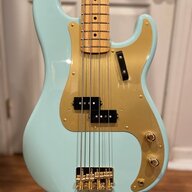
Just for the record, here is my 2006 Highway One. No route under pickguard (a selling point for me). Bridge pickup is longer than neck. Grease Bucket circuitry (although I don't really know what that means). The matte finish has buffed out to a (dull) shine from forearm wear and lap wear (I have spent most of the time playing it in the seated position). No skunk stripe. 9.06 pounds. Excellent for recording.

DSCN2256.jpg


DSCN2158.jpg


DSCN2144.jpg


DSCN2135.jpg
 
  • Like
Reactions: 2cooltoolz