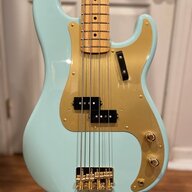
I have a Highway 1 P-bass, not one of the earliest ones but one from just before the 2006 changeover to the closely similar but slightly different Highway One model. Based on my instrument, I think that some of the other comments posted here may not be entirely accurate.
Both the Highway 1 and Highway One models are assembled-in-USA P-basses which Fender offers as a "made in USA" model at a somewhat lower price point than the American Standard models by having the bodies painted in Mexico (where environmental regulations are less stringent) and selling them with a gig bag instead of a hard case. Both the Highway 1 and the Highway One are, in my view, somewhat better instruments than the Squier P-bass or Fender's MIM "Standard" P-bass, which is assembled in Mexico using slightly different components than the American models.
The pre-2006 Highway 1 P-bass I have came with a graphite truss rod in the neck, a very nice satin nitrocellulose lacquer finish, a vintage-style Fender P-bass bridge, stock Fender P-bass alnico pickups, Fender's "greasebucket" tone control, roundwound strings, and a Fender gig bag. From what I understand, the main change made in 2006 from the Highway 1 to the Highway One model was to replace the vintage-style Fender P-bass bridge with a Leo Quan BadAss II bridge, which has somewhat higher mass and gives a bit more low bass and sustain. Other than that, the pre-2006 Highway 1 and the post-2006 Highway One appear to be nearly identical in terms of truss rod, finish, pickup, tone circuit, strings, etc. It's possible that the very earliest Highway 1 models might have slightly different specs, but I can't speak to that.
The design goal of using a graphite truss rod appears to be to have a somewhat lighter neck, so that it balances well and musicians don't have to keep supporting it while playing. As with all design choices, there may be a bit of tradeoff involved, in that the graphite truss rod has more than adequate strength to deal with standard light-gauge bass strings (.045/.065/.080/.100 or so), but may not be designed to handle the higher stresses generated by using thicker strings. There's nothing wrong with having a graphite truss rod; it balances well, keeps the instrument light and comfortable to play, and works fine with light-gauge strings. Just don't put heavy-gauge strings on a graphite neck which is not designed to handle them.
Like many other P-bass owners, I couldn't resist tinkering with the instrument, so I had a Gotoh 201 bridge, a Bartolini 8S pickup, a mock-tortoise pickguard and Thomastik-Infeld Jazz Flat strings installed. There was nothing wrong with the stock components, and I didn't consider them deficient in any way. I just liked the new components a bit better, and I thought they made a modest and incremental but noticeable improvement in the low bass, sustain, tone and playability of the instrument -- nothing dramatic, but I liked the changes.
The Gotoh bridge is a fully-adjustable bridge, made in Japan, with somewhat higher mass than the stock vintage-style bridge. It provides a bit more low bass and sustain than the stock bridge, but is not as expensive as the BadAss II, which is made in the US. I like the Gotoh bridge, but for what it's worth, the BadAss II bridge also has a very good reputation.
The Bartolini 8S pickup has a nice, deep tone. The Thomastik-Infeld Jazz Flats are more expensive than most bass strings, but they don't stress the neck, feel much easier to play than standard roundwounds or other flatwounds, and produce a really nice tone that includes a hint of double-bass tone.
From what I can tell, Fender's new American Special P-bass is closely similar to a Highway 1 or Highway One P-bass except for just two things: it returns to the less expensive, low-mass Fender vintage bridge instead of the BadAss II bridge; and it has a gloss urethane finish rather than a satin nitrocellulose lacquer finish. Other than that, the American Special appears to be just like the Highway One, down to the greasebucket tone circuit and the gig bag it comes with.
Whether the formal model designation is Highway 1, Highway One or American Special, these instruments are pretty close in specifications and general characteristics. After playing my Highway 1 P-bass for a couple of years now, I really like it. It is light and comfortable to play, balances well, sounds great with the mods I had installed, and looks good too. It appears to be a somewhat better-playing instrument than the Squier or MIM models, and is more affordable than the American Standard models. The post-2006 Highway One P-bass is closely similar, with the exception of coming with a high-mass BadAss II bridge stock. The American Special now comes with the old, low-mass vintage bridge, but you can always buy a Gotoh or BadAss bridge if you want.
As always, there is a basic truth here: the musician, and musicianship, are more important than the instrument, and more important than relatively minor differences in specifications between closely similar models. It's interesting to discuss such things, but put an average bass in the hands of a top-notch musician, and an excellent bass in the hands of an average musician, and the top-notch musician will still sound better. For those of us who are average musicians, though, it's still nice to have a good instrument to play, and Fender's Highway 1, Highway One and American Special P-basses are definitely good instruments.