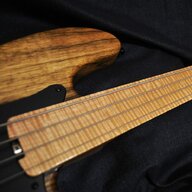
I am building the 5 channel version. I think that one has the circuit that you are referring to?
Yes

TalkBass has been independent since 1998. Add your voice.
Create a free account to reply to discussions, view embedded media, and browse with fewer display ads.
Join free Log in
Want zero display ads or expanded classifieds tools? Compare plans.
I am building the 5 channel version. I think that one has the circuit that you are referring to?



Seems like it might be preferable to leave out the limiter part of the circuit.
If I understand correctly, that's more a protection circuit for the 2nd op amp than a real limiter. So if something hits a bass string hard (or you drop the bass!) It doesn't blow up your circuit.
I am going to see how it works out, and then decide how to proceed.
There are several options for DB strings for 1/4 size basses that are 36” in length. So you might want to reconceive your approach to scaleA thought. 34" is pretty close to the 4th - 5th fret of 4/4 scale length. In theory, using an E - C set Tuned B - G, the string tension should be similar?
There are several options for DB strings for 1/4 size basses that are 36” in length. So you might want to reconceive your approach to scale
Try eBay, I got 1/4 size a set of D’addario Helicore for under $70. I successfully use 1/4 size DB strings on a a very small DB with a mensur of 34”. But they don’t compare to Spirocore if your’e doing primarily pizzI think @DoubleMIDI and I pretty well hashed this out before I applied saw to wood (in any case adding 2" to the scale at this point is impossible). But I am thinking about extending the bridge holes through the body (there is a support brace in place for this) so that longer strings are an option.
I am hoping that I can find a 'cheap' set of 1/4 scale DB strings to try on this thing, but I am leaning towards EB flats designed for fretless playing. Will I be able to bow them properly? probably not, but I am looking forward to getting this bass finished and ready to play!


Wish my box store had some of that….


Apparently I have some geometry to figure out.
View attachment 4285444
I think I am going to bevel the center curved section so that it better intersects with the side.
Anyone else have a suggestion?


