
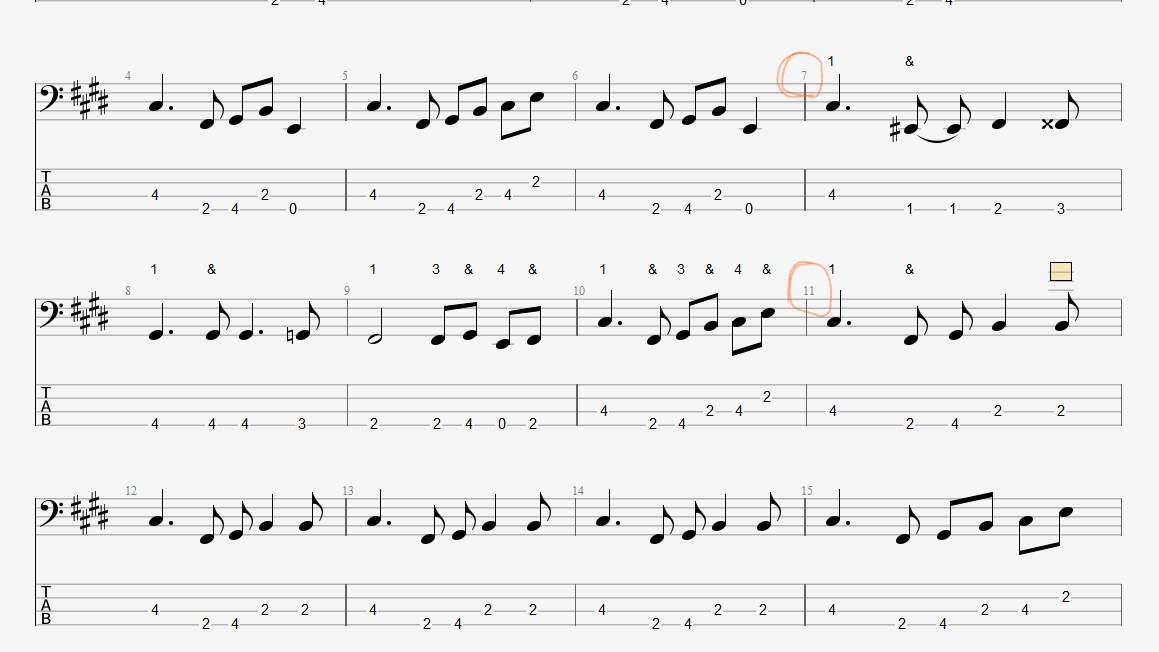
Would appreciate some input on how to count measures 7 and 11. The eighth note after "&" is throwing me off. I think it is on 3 but it doesn't seem right.
Thanks,
Jack
Thanks,
Jack

TalkBass has been independent since 1998. Add your voice.
Create a free account to reply to discussions, view embedded media, and browse with fewer display ads.
Join free Log in
Want zero display ads or expanded classifieds tools? Compare plans.


In measure 11, the second eighth note is on beat three.There are no notes played on beats 3 or 4 in measures 7 and 11. Rather, the notes are played on the &. Do you have a recording of this song you can listen to to get the sound in your head?

Measure 7: ONE and two AND three AND four ANDWould appreciate some input on how to count measures 7 and 11. The eighth note after "&" is throwing me off. I think it is on 3 but it doesn't seem right.View attachment 1087824
Thanks,
Jack
So Febs is this what you are saying it should be counted as?Measure 7: ONE and two AND three AND four AND
Measure 11: ONE and two AND THREE AND four AND
So Febs is this what you are saying it should be counted as?View attachment 1087857
In measure 11 that's a quarter note, doesn't that have to be on 3, not &?
So as I see this the first 1/4 note is counted as 1, the 1/4 rest is 2, the 1/8th rest is 3, the D# is & and the last 1/8th note is & also?Correct.
A quarter note can start on the downbeat as long as you count it's full value. So it can be on the downbeat (i.e., "3 and") or the upbeat (i.e., "and 3"). In fact, here's an example I just played a few minutes ago at the gig I'm playing tonight. These measures are counted ONE and two and three AND four AND. (I'm using capital letters to show where the note starts and underlining to show how long each note is held.)
View attachment 1087909
That's what I thought also ak but it doesn't look right.In measure 11, the second eighth note is on beat three.
Exactly right.So as I see this the first 1/4 note is counted as 1, the 1/4 rest is 2, the 1/8th rest is 3, the D# is & and the last 1/8th note is & also?
In measure 11, the second eighth note is on beat three.
Hey Mushroo not to worry, I surprised myself by noticing it. What I find aggravating is I've been banging away on drums for a couple of years now and have no trouble counting as long as it's reasonably simple. What I can't figure out is why in measure 11 the 3 & aren't tied together with a bar like in measure 10.Your absolutely right of course. I had a brain fart and didn't notice measure 11 doesn't have a tie like measure 7.
Sorry for the confusion, FenderB. My bad!
So as I see this the first 1/4 note is counted as 1, the 1/4 rest is 2, the 1/8th rest is 3, the D# is & and the last 1/8th note is & also?
What I can't figure out is why in measure 11 the 3 & aren't tied together with a bar like in measure 10.
You're getting the hang of it!
These rhythms are an example of "syncopation" which basically means rhythms that feel "off the beat" or "funky." Bootsy Collins gives a good demonstration of funky/syncopated rhythms in this video. The basic concept he is demonstrating, is first to set up a strong feel of "the one" (beat 1, the downbeat of the measure), and then you can emphasize the off-beats. Another way to feel it is, tap your foot on the beats, and play the bass in the spaces between your foot taps. Listening to this video, can you keep a steady 1-2-3-4 going with your foot, and play along (or clap your hands, snap your fingers, sing, etc.) along with his bass line?
Yes, thank you for explaining that to me.Ties can only be used to connect notes of the same pitch. In measure 7, the tie connects eighth note E# to eighth note E#, creating a quarter note E#. (But it is notated as tied eighth notes, because of tradition.) In measure 11 however, the notes are eighth note F# and eighth note G#, two different pitches, and so they cannot be tied together into a single quarter note. Does that make any sense?


