• TalkBass has been independent since 1998. Add your voice.
    Create a free account to reply to discussions, view embedded media, and browse with fewer display ads.
    Join freeLog in
    Want zero display ads or expanded classifieds tools? Compare plans.

How does colour affect tone?

It might but it might not make the biggest difference! I would say that not all paint is equally “dense” and not all of it weighs the same. Some pigments are heavy enough to add weight to the bass, some colours can cut down the weight of a bass. On top of that some pigments are organic some are inorganic, inorganic ones would be heavier and require more binder, organic pigments tend to be heavy stainers, require very little binder(paint material).

I think transparent would be brighter if it makes a difference and opaque would be darker, depending on the colour. A sunburst for example would be made with transparent oxide reds and yellows, so it would be an inorganic paint job. A transparent green however would likely be made with the inorganic compound pthalocyanine and sound different from the sunburst.

that is of course if it makes a difference! Drummers are very very particular about this belief but it might not matter on an electric bass.

I would also say if a finish makes a sound difference then you would “hear the nitrocellulose more” with a transparent pigment and you would “hear the pigment more” with a non transparent pigment(with inorganic transparents being the exception)
 
Last edited:
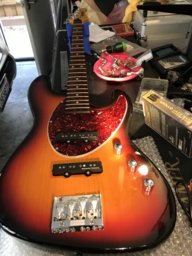
I like black basses as they sound very dark. Red basses as a rule are very bright, natural basses are very transparent sounding and white basses sound very clean. Sunburst basses give you the whole palette of sounds which is why they're the best, bonus if they have a tort pickguard.


I was asked why I didn't include pickguards and yes on second thought that was an oversight. As a rule if the pickguard is a darker color than the bass, it will of course darken the sound and if the pickguard is lighter than the bass it of course brightens up the sound. If the pickguard is the same color as the bass it will accentuate whatever the color is. A red bass with a red pickguard would be very bright, a black bass with a black pickguard will be very dark, etc. You can think of pickguards as being a kind of fine tuning of the sound.
Now a Sunburst bass with a tort pickguard will have the widest range of sound of any color but you could tilt the sound spectrum to the brighter side of the palette by using a lighter tort pickguard and of course darken the sound with a darker tort pickguard.
But the Sunburst/Tort combination is the standard by which all others are judged and the original is kept under glass in the National Bureau of Standards and Technology at 100 Bureau Dr. Stop 1070 Gaithersburg, MD 20899-1070. Inquiries: [email protected]
 
Last edited:
  • Like
Reactions: Roger W and Loring
Explain the physics of how


(I’m inclined to agree with you, but I want to know why you think this)

From the Sadowsky website

Wood and Sound in Amplified Guitars and Basses - Sadowsky Guitars

Fingerboards: I feel very confident in saying that I have found the fingerboard to be the most important factor in relationship to wood and tone. Here are my observations:

Maple: Tightest and brightest. Best for slap on basses and for bright, glassy tones on guitars. Can produce more string and fret noise than other woods.

Ebony: Not as bright as maple. Most immediate attack and punch of all fingerboard woods. Virtually no “bloom” to the note after the initial attack. Note has more fundamental with less overtones.

Rosewoods: Sweetest and warmest of the fingerboard woods. South American Rosewoods are tighter and punchier than Indian Rosewoods, which are darker and rounder.

Pau Ferro: (Also known as Morado, Caviuna or Bolivian Rosewood): Pau Fero is not a true Rosewood, but I have been a fan of this wood for fingerboards for over 35 years. Grain is very tight and silky smooth. More warmth than Maple or Ebony but tighter sounding than the other Rosewoods.

Neck Woods: Neck woods are primarily mahogany or maple. Mahogany is the warmest and Maple is the brightest. I have made archtops and solidbody guitars with both. For basses, I have always used Maple for tightness and punch.
 
  • Like
Reactions: GlennRH
My best-sounding finishes are oil finishes. So I'd say the best sounding color is colorless. Surface-mounting bridges on 1/8"+ of resin does sound like something to my ears (alas, my favorite Jazz clone does exactly that and it busts out over that limitation easily).
 
correlation.png
 
If you play death metal, and sho up with a pink bass, you will hear a distinctly different sound - coming from the audience. Change that to blood red, and you're back in business. So yes, color does affect sound.
 
  • Like
Reactions: Roger W