
Enjoy the benefits of a premium membership!
Upgrade Account
-
TalkBass has been independent since 1998. Add your voice.
Create a free account to reply to discussions, view embedded media, and browse with fewer display ads.
Join free Log in
Want zero display ads or expanded classifieds tools? Compare plans.
You are using an out of date browser. It may not display this or other websites correctly.
You should upgrade or use an alternative browser.
You should upgrade or use an alternative browser.
How does colour affect tone?
- Thread starter BassyBill
- Start date
More options
Who Replied?

Explain the physics of how
(I’m inclined to agree with you, but I want to know why you think this)
This question was asked as to how the fingerboard/neck affects the tone the most.
I am a Physicist, and one schooled in the Physics of musical instruments - I have a degree in this stuff. This does make sense.
An electric instrument senses (through the pickups) the motion of the strings. Oh wait, that's not quite it - the pickups are mounted to the body, not floating in free space. They sense RELATIVE motion - changes in the distance between the body where they are mounted, and the strings. If either moves, they produce output. Does the wood move? Absolutely it does. If you want proof , buy a Snark tuner - it works because no matter where you put it on the instrument, that part is vibrating - it's moving. OK, so anything that moves can be a culprit for changing the sound. But what makes the most difference?
The string's motion is affected by what it's attached to. If you've ever played a bass with a dead spot, you know that the thing(s) the string is attached to (it has 2 ends) can vary how it vibrates. So, we have two ends on the string. One is attached to a big hunk of metal, that is in turn attached to a big hunk of wood - thick, wide, heavy , stiff. The other end is attached (held) to a thin strip of metal, that is in turn attached to a relatively thin piece of wood - the neck end is less stiff, less heavy - it definitely is more movable. So, the neck end of the string has more impact on how it moves - the string will lose more energy on that end as it transfers energy into neck motion. So, the things that it attaches to on that end are the most important in terms of what changes the string vibration from the "ideal". These are, in order that they interact with the string:
1) The fret. Stainless frets do sound different from nickel ones. Bigger frets are more clacky than tiny ones. Harder metal, more metal makes the bass better for "Metal".
2) The fretboard - it's the anchor for the fret, it comes next in importance.
3) The neck (the rest of it) - the neck is definitely responsible for dead spots (the stiffness and mass of the fretboard is part of that equation as well). I have owned a few Aluminum necked Kramer basses - if you've ever played one of those, you will have experienced that, at the very least, the sustain is much longer on those instruments. Yes, neck material can make a clearly audible difference - at least in that case.
Anything that vibrates on a bass (which means the whole thing, when you understand the Snark thing) will make it operate differently. The only questions left are:
1) Can YOU hear the difference? From my work on Pro Audio gear listening tests, I understand that certain people are much more attuned to certain sonic things than others.
2) Do you care?
I know my answers to these questions, but I will leave it to you to figure out your answers.


You mean correctly, or incorrectly?I think it depends more on how one spells "color". But, I could be wrong.

I feel like moving an EQ nob 2 mm in one direction or the other will have more of an effect than a layer of paint, but what do I know?
If this is true then the colour that the bass is sprayed with will also make a differenceFinish type absolutely does impact the sound: thin nitro with hard sealer Vs thick poly Vs oil vs raw wood. I have seen it / heard it many times - actually it's shocking how apparent the change of sound is if you remove ie. Poly finish coat from a bass


If you put a soft layer of latex paint under the bridge, you would hear a big difference. Hopefully, nobody is that foolish.I feel like moving an EQ nob 2 mm in one direction or the other will have more of an effect than a layer of paint, but what do I know?

I have a few basses painted and unpainted. They pretty much do as advertised but they definitely have a different feel. The raw finishes work best for me in the warm weather since there’s no gloss to stick to.
The glossy neck are best when it’s dry and cool. I tend to pay closer attention to this during peak summer time since we play often outdoors and if it’s hot and humid the natural finished basses are the choice.
I’ve not noticed the actual color having and sonic impact.
The glossy neck are best when it’s dry and cool. I tend to pay closer attention to this during peak summer time since we play often outdoors and if it’s hot and humid the natural finished basses are the choice.
I’ve not noticed the actual color having and sonic impact.
If you put a soft layer of latex paint under the bridge, you would hear a big difference. Hopefully, nobody is that foolish.
If the screws holding the bridge down are tight, the bridge has a pretty decent mechanical ground through that connection - the screws "short circuit" the paint issue by and large. If you had one of those floating wood bridges (like on a Hofner, but we're mentally putting it on a solid body) where the string tension holds it in place, then that soft paint would make a much bigger difference.

- Apr 18, 2008
- 16,006
- 1
- 31,700
- Disclosures
- I'm highly opinionated and extremely self-assured
The only thing I've ever noticed that made a big difference and in a great way was the removal of ALL finish from the body. It sounded so much better I was amazed.
Was it a bolt-on? Did you remove the neck before the finish work, and reinstall it after? The bridge too? And the pickups?

Everything was removed. All finish removed. Bare wood.Was it a bolt-on? Did you remove the neck before the finish work, and reinstall it after? The bridge too? And the pickups?
- Apr 18, 2008
- 16,006
- 1
- 31,700
- Disclosures
- I'm highly opinionated and extremely self-assured
Everything was removed. All finish removed. Bare wood.
Thought so. I’m quite certain the improvement you experienced was due to reassembly, and not finish removal. All of your fasteners were nice and tight. That means less energy is robbed from the vibrating string.
Assigning causality is a tricky, tricky business.


It’s really the color of the pickup cover.One e of the other such questions I've seen is 'What are the best pickups for this kind of music?' A FB group I was in had that come up every few days and was always for same music. I should be thankful they don't ask what colour pickups they should have.

Is that the ‘kingsford’ signature model?I once took a torch and burned a p bass body. After wiping down I sprayed it with a light coat of clear satin. Sounds great! Has a dark charcoal type of sound!View attachment 4797478View attachment 4797479View attachment 4797480View attachment 4797481View attachment 4797482


I’ll drink to that!It's not the color so much as the amount of alcohol that goes into the audience.
Remember the rule of all gigs: "The more you drink, the better we sound."
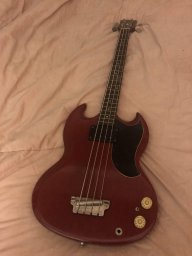

I like black basses as they sound very dark. Red basses as a rule are very bright, natural basses are very transparent sounding and white basses sound very clean. Sunburst basses give you the whole palette of sounds which is why they're the best, bonus if they have a tort pickguard.
Gotcha (almost) covered!!


 What about Blue Flower & Sonic Blue?!?
Last edited:


