• TalkBass has been independent since 1998. Add your voice.
    Create a free account to reply to discussions, view embedded media, and browse with fewer display ads.
    Join freeLog in
    Want zero display ads or expanded classifieds tools? Compare plans.

How does colour affect tone?

Maybe it depends on the type of guitar? The Beatles had Epiphone Casinos in the mid 60's, on which John and George sanded off the finish. George said that once they’d removed the finish, they became much better guitars. “I think that works on a lot of guitars,” he explained. “If you take the paint and varnish off and get the bare wood, it seems to sort of breathe.” Of course, those Casinos are acoustic instruments, to an extent, not solid body, no center block. So there's that. They did change the color, by scraping it off to the bare wood, though this may be more about finish than color. Anyway they felt it made a difference, and they were pretty savvy about music. For what that's worth. :)
 
From the Sadowsky website

Wood and Sound in Amplified Guitars and Basses - Sadowsky Guitars

Fingerboards: I feel very confident in saying that I have found the fingerboard to be the most important factor in relationship to wood and tone. Here are my observations:

Maple: Tightest and brightest. Best for slap on basses and for bright, glassy tones on guitars. Can produce more string and fret noise than other woods.

Ebony: Not as bright as maple. Most immediate attack and punch of all fingerboard woods. Virtually no “bloom” to the note after the initial attack. Note has more fundamental with less overtones.

Rosewoods: Sweetest and warmest of the fingerboard woods. South American Rosewoods are tighter and punchier than Indian Rosewoods, which are darker and rounder.

Pau Ferro: (Also known as Morado, Caviuna or Bolivian Rosewood): Pau Fero is not a true Rosewood, but I have been a fan of this wood for fingerboards for over 35 years. Grain is very tight and silky smooth. More warmth than Maple or Ebony but tighter sounding than the other Rosewoods.

Neck Woods: Neck woods are primarily mahogany or maple. Mahogany is the warmest and Maple is the brightest. I have made archtops and solidbody guitars with both. For basses, I have always used Maple for tightness and punch.
Sorry, I don’t see any physics in this explanation. It’s not that I disagree with these observations, there’s just nothing in here to explain why it is this way. Check out Micguy’s post for a great explanation.
 
Last edited:
It's been proven time and time again that paints are chosen for their tonal properties. Obviously brighter colors like orange, and yellow, produce brighter tones. The tonepaint debate will go on forever...
 
  • Like
Reactions: Roger W
270
 
Thank you so much for posting this!
From reading posts on TB I get the feeling a lot of people have misconceptions about how the signal is produced and also misconceptions about how the different parts of the bass affect the relationship between the pickups and the strings.

You're welcome. Happy to help - especially when people appreciate it.
 
I can’t believe it’s still a thing by which someone can “do”.

People just need to understand that design considerations for an acoustic instrument are different than that of an electro-acoustic instrument. The method of sound amplification is completely different.

but whatever- some people believe in the “healing power of gemstones” and can’t be convinced otherwise, so I’ll pick my battles.
Right up there with 'essential oils'
 
Thank you so much for posting this!
From reading posts on TB I get the feeling a lot of people have misconceptions about how the signal is produced and also misconceptions about how the different parts of the bass affect the relationship between the pickups and the strings.
Relationships can be difficult
 
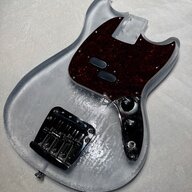
Adding sparkle to the finish dramatically affects tone by embedding small metallic flakes into the finish in close proximity to the pickups. This causes EMI interference to be reflected and magnified and fed directly into the pickups. For these reasons a ground wire should be run from under these kinds of finishes to the bridge plate. Otherwise, a noise gate is necessary to stop the hum and buzzing from these kinds of finishes. However, if you have a skilled person doing your finish, they can often use reverse wound/reverse polarity metallic flakes, which turns the entire finish into a humbucker. If the refinisher wires the metallic flakes in series, it will also thicken your tone.

As a side note, metallic finishes often also affect resale value because they add a couple of ounces to the answer to the "weight?" question most often asked in the Talkbass Classifieds.
This is good writing right here!
 
Right, but I asked for an explanation of the physics behind the observation. See Micguy’s post for a great explanation
Right. We have multiple, multiple threads here dealing with science related to this, been there done that. You're looking for physics, the Sadowsky comment to which you responded is not about that, it's about what he's experienced himself in his years of instrument building. Pretty basic.

I should add that Micguy's post does indeed do a good job of describing some of the mechanisms relating to amplified instrument sound. But Sadowsky wasn't getting into that, just talking about the what, not the why.
 
Last edited:
  • Like
Reactions: Mark Ambler
Yeah, there are multiple such tests, giving various results. We do have several looong threads on this stuff, been there done that. People can just go with what they believe, from my point of view.
If people weren’t spending money on the concept, it wouldn’t bother me at all… but bass manufacturers depend on it for marketing. Most recently I was rolling my eyes at the salesmanship of the Yamaha BB34 where they talk about how the laminated maple core really improves the tone. I used to buy into it, and I hate that I could be so easily manipulated.

most musicians are gear fanatics, and most of us hunt for that defining characteristic that makes one instrument superior to others. For electric bass players that list becomes very small and unexciting if we take “tone woods” out of the picture. I think that’s part of the reason it persists. People want it to be true. Maybe even need it to be true.
 
  • Like
Reactions: jd56hawk