

Perhaps you can give us some first hand experience at how color tailors the sound?


TalkBass has been independent since 1998. Add your voice.
Create a free account to reply to discussions, view embedded media, and browse with fewer display ads.
Join free Log in
Want zero display ads or expanded classifieds tools? Compare plans.

Perhaps you can give us some first hand experience at how color tailors the sound?
 Me thinks the Fralins have a bit more to do wit dat

'Bout the same as red cars are faster than other colors.I just saw a Facebook post from someone asking if getting a pro paint job would affect the tone of his Warwick natural ash bass. I said no, it wouldn’t. I’m going to be interested to see where that one goes.
'Bout the same as red cars are faster than other colors.
I have a brown car and a red car, my red car is faster than my brown car, case closed.

I have only gotten three or four speeding tickets in my lifetime. All of them were in red cars.I have a brown car and a red car, my red car is faster than my brown car, case closed.

I have only gotten three or four speeding tickets in my lifetime. All of them were in red cars.
I just saw a Facebook post from someone asking if getting a pro paint job would affect the tone of his Warwick natural ash bass. I said no, it wouldn’t. I’m going to be interested to see where that one goes.

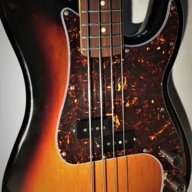
 ...I will stick with sunburst. It just may cover all the basses...

Yes, you are wrong. It's spelled "colour".I think it depends more on how one spells "color". But, I could be wrong.
26762830[/URL], member: 28178"]Did I miss the best color for metal post?

Yes I know.It’s really the color of the pickup cover.

Wow, that is really smokin'Why yes it is! Lol!

I can’t believe it’s still a thing by which someone can “do”.You done did it now!
Thank you so much for posting this!This question was asked as to how the fingerboard/neck affects the tone the most.
I am a Physicist, and one schooled in the Physics of musical instruments - I have a degree in this stuff. This does make sense.
An electric instrument senses (through the pickups) the motion of the strings. Oh wait, that's not quite it - the pickups are mounted to the body, not floating in free space. They sense RELATIVE motion - changes in the distance between the body where they are mounted, and the strings. If either moves, they produce output. Does the wood move? Absolutely it does. If you want proof , buy a Snark tuner - it works because no matter where you put it on the instrument, that part is vibrating - it's moving. OK, so anything that moves can be a culprit for changing the sound. But what makes the most difference?
The string's motion is affected by what it's attached to. If you've ever played a bass with a dead spot, you know that the thing(s) the string is attached to (it has 2 ends) can vary how it vibrates. So, we have two ends on the string. One is attached to a big hunk of metal, that is in turn attached to a big hunk of wood - thick, wide, heavy , stiff. The other end is attached (held) to a thin strip of metal, that is in turn attached to a relatively thin piece of wood - the neck end is less stiff, less heavy - it definitely is more movable. So, the neck end of the string has more impact on how it moves - the string will lose more energy on that end as it transfers energy into neck motion. So, the things that it attaches to on that end are the most important in terms of what changes the string vibration from the "ideal". These are, in order that they interact with the string:
1) The fret. Stainless frets do sound different from nickel ones. Bigger frets are more clacky than tiny ones. Harder metal, more metal makes the bass better for "Metal".
2) The fretboard - it's the anchor for the fret, it comes next in importance.
3) The neck (the rest of it) - the neck is definitely responsible for dead spots (the stiffness and mass of the fretboard is part of that equation as well). I have owned a few Aluminum necked Kramer basses - if you've ever played one of those, you will have experienced that, at the very least, the sustain is much longer on those instruments. Yes, neck material can make a clearly audible difference - at least in that case.
Anything that vibrates on a bass (which means the whole thing, when you understand the Snark thing) will make it operate differently. The only questions left are:
1) Can YOU hear the difference? From my work on Pro Audio gear listening tests, I understand that certain people are much more attuned to certain sonic things than others.
2) Do you care?
I know my answers to these questions, but I will leave it to you to figure out your answers.