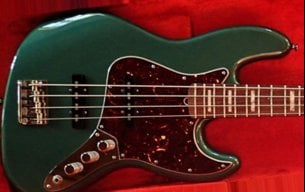
$2100 for a Fender? My problem is Fender charging over $1000 for any of their basses!

Last edited:

TalkBass has been independent since 1998. Add your voice.
Create a free account to reply to discussions, view embedded media, and browse with fewer display ads.
Join free Log in
Want zero display ads or expanded classifieds tools? Compare plans.
is this sarcasm? that thing looks like it came from a high school " intro to metal shop " class.Given the volume of production and price point they hit, Fender's QC is somewhat above average. If you want perfection in every aspect of every unit produced, why are you even bothering with Fender. If you want perfection, buy Fodera or Alembic. If OTOH, you want above average quality in a mass produced instrument, Fender is your huckleberry. If you want the same playability with lower cost, shop Fender's MIM line, the level of finish is not as high as their MIA line, but the playability is there and for less than half the cost of an MIA. If you want perfection there are plenty of boutique houses where perfection is the norm, but not at the Fender price point. Nothing personal, but waddya want fer nutin??? A ruuuuubbbber biscuit??
Simple answer is tolerance stacking.
Longer answer is still tolerance stacking, but with more words. Every single screw hole has a dimension from one or more surfaces on the body of the bass. So does the neck pocket, and the routing for the pickups, control cavity, etc.
All of these have an amount +/- they can deviate from that dimension. The tighter that tolerance, the more time and cost you incur holding that tolerance. A CNC machine is very good at holding tolerances, but it is not, nor can it ever be, perfect.
So as a designer* we have to decide what areas need to be held closest, and which ones can vary. In the case of a Jazz bass, I'd try to nail the neck pocket, and the pickups and bridge will all be based on that pocket, because those are more location critical based on distance from the frets, alignment with the neck, and so on. The control cavity can more or less be wherever, so who cares.
The pickguard is kind of the same. By itself it's really of no importance, except that here, you have a choice to make. It's relieved to go around the pickup, and to fit around the control plate. So which do you favor? Well, since the pickup is an important piece, you probably want the pickup opening to be favored, which means that the control plate isn't.
So, you have a tolerance for the neck pocket, which impacts the pickup position which itself has a tolerance, which impacts both location and angle of the pickguard, and it's interface with the control plate, which of course has it's own location tolerance.
And this doesn't even get into the fact that both pickguard and control plate have their own overall dimensional tolerances from their separate manufacturing processes that will impact all of the above. For example, even if all the above mentioned holes and routings in the bass body are 100% accurate with no deviation, if the opening in the pickguard is off and at a slight angle, then it's interface with the control plate will be off.
Some of this can be helped with order of operations, like maybe not drill the screw holes for the pickguard until the pickup placement is set (using a template over the pickup, perhaps) or by doing some final fit/finish work by hand, like trimming a bit off the pickguard so it doesn't look out of place, or reshaping the end of the control plate, etc. But that takes a lot of extra time and ends up with bespoke parts that can't always be easily replaced later, as any replacement would need to be fitted as well.
TL : DR- Tolerances impact tolerances, machines aren't perfect, and getting as close as one can will cost more in time, money, or both.
*- I'm a mechanical designer who has done work with stamped, bent, machined, etc bits of metal and plastic. There is almost always an option to hold tighter tolerances, but cost is a big factor. If nothing else, the machine runs slower to keep those tolerances. Some machines are better than others of course, but those usually also cost more. Always about the $$.



As long as customers accept it it will continue.Pretty poor fit for $2k. I don't get it. With all the modern day CC machinery, how could this happen?
My advice, return it. Even if it sounds and plays great, just return it, so they learn to do better.

Over the last 40+ years I've owned dozens upon dozens of USA, Mexican, Chinese, Korean, and Indonesian Fenders and Squiers. Some amazing, some perfect, some ok, some kinda bad. Some of the Chinese Squiers, alarmingly, have been absolutely perfect. Every now and then, a USA Fender is as well.
However.
I have never seen such non-existent quality control and pisspoor attention to detail in 40+ years as this latest purchase, a new $1900 (before tax) American Professional II Jazz Bass in Miami Blue that no less than FIVE people signed off on.
View attachment 5472182
View attachment 5472173
View attachment 5472170
$2097.60 with tax.
$2100!!!!!!!!!!!!!!!!!!!!!!!!!!!!!!!!!!!!!

Get a Stingray bass. You won't have this problem.

It makes money by eliminating defective product from production costs.
Doing nothing, the popular method allows it to grow and degenerate the company image. Worst still, it tells emlloyees that producing defective product is ok.
Most managers are the real trash in a company. Bigger companies just subdivide the trash. Quality Systems prove this to be true. Quality Auditors never don't speak of it.
When Quality Standards are revised, Management reponsibility is usually the most overhauled area for that reason.
I HAVE TO KNOW!
Why do people spell it 7ender, otherwise read as Sevenender? The curiosity gnaws at me brain.

Huh, weird .... those appear to be functional and well-made.It's those red things in the picture below...


What were they out of curiosity?EBMM is NOT impeccable. See my post above. I returned 3 of them because of "quality control" issues.
The 7 looks like the capital F in 7ender's logo.