
• TalkBass has been independent since 1998. Add your voice.
    Create a free account to reply to discussions, view embedded media, and browse with fewer display ads.
    Join freeLog in
    Want zero display ads or expanded classifieds tools? Compare plans.

How many basses do you take?

Depends on the gig...

In most cases 2 but sometimes more.

Is there fretless?
Is there drastic tonal changes? (some needing a MM or some needing a J)
:hiding:

Sure you can go years and years with just one and be fine. However if something was to happen I want to have others to rely on and get me through a show.

I never been on the road without 3.
 
I will usually take two: Pbass w/flats, and my 5 string w/rounds. Different sounds for different tunes. That said, when building a set list, I lobby for a sequence where I don't have to keep juggling them.

We have two songs I like to play on my 8 string, so if we anticipate doing those, I bring that as well, so that makes three. :hiding: Yeah, it makes for a handful and a few trips to/from the car, but we all suffer for our art from time to time, don't we?
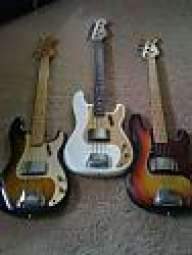
:bassist::bassist:
 
I usually try to have extra everything -
cables, set of strings, DI (I carry an active and a cheapie passive. just in case). I usually carry 2 basses, but just leave one in the case, or even in the truck, if the parking for the band looks secure.

This past saturday night, I took one bass with me (trying to streamline my load in). I hooked everything up, turned on my amp, and...nothing. Checked all my volumes, changed out cables, nothing. Had the Guitar player plug his guitar into my rig, and he got noise, so then I panicked. 2 hours from home and no back-up. Plugged my bass back in, and boom, it worked fine and I had no issues the rest of the night. I have no idea what had happened, or why it didn't work, but I won't leave without a backup again.
 
Almost always two.

I've had catastrophic failures happen twice in 30 years. First time a strap button screw broke inside the body of my main P. No backup, set was delayed and I ended up finishing the night with a really ugly duct tape fix. Second time was a wiring failure in a Jazz not too long ago. Just picked up the spare and finished the night.

Of course now that I've said that, I'm flying to a gig tomorrow with only one so I'm sure I've just guaranteed myself a catastrophic bass failure two minutes before show time.
 
Two, both four string. Usually only play one the entire night and the other sits on the stand. As a professional photographer for over 20 years I would never go to a paying job without backup equipment! The same should be said for a paying band gig!
 
I bring two- a Fender P5 with flats and a Lakland 55-94 with rounds. I've been using the P5 the majority of the time but the Lakland gets a much nicer slap tone so I use it on sets that have songs with slap bass. Since I usually make the setlists I make a point of putting those songs in the same set, which are less than a handful of songs anyway.
 
I played a gig (on drums) a few weeks ago. The bass player had only one bass. He broke a string during a song. He finished the song with only three strings then we had to sit and wait while he futzed with putting a new string on. It so happened that he didn't even have a spare G string, so he had to put a really crappy old D string on and tune it up to G.

But, even if he had a good spare G string ready to go, the interruption in the set would have been too long, in my opinion - if the gig is to be considered professional. Professional == having a spare bass sitting there ready to go, so even if something as minor as breaking a string happens, the interruption is as absolutely short as possible.

And if you have a spare bass sitting there ready to go, you're covered in the event that something even worse happens - e.g. strap button screw pulls out or breaks, somebody steps on the instrument cable and the bass' output jack gets broken, the bass is active only and the battery dies, etc.. It's just too easy to have something really minor throw a major wrinkle into a smooth set to not have a hot spare bass.

That's also why I personally would also have my little Class D amp and SABDDI there and at the ready, just in case my SVT takes a dump for any reason. But, if I were using a solid state amp as my main amp, I would feel a lot less worried about that than the possibility of one of the aforementioned things happening to the bass itself.
 
I take two. I play my Cirrus 5 with rounds as the #1, and then rotate between my 78 P with flats and my fretless L2500 with flats. I use either of those two for the country tunes where you need that round P sound. I used to use a Radial Bassbone and now use the VT Deluxe, so carrying two and switching between songs is soooooooo easy. I had a cable go bad a few gigs ago and almost seamlessly switched basses. My guitar player looked confused at the end of the song when he saw me playing a different bass than what I started the song with.

I never got the "I bring extra strings". So if you break a string....do you stop playing, restring, and then rejoin the song. Or do you keep playing, make fingerboard adjustments, and then restring between songs. Either way, seems like way too much down time. But then again, I've never broken a string on a bass (yup, just jinxed myself).
 
Two. I discovered the hard way during a major performance that my active 5er bass doesn't work at all if the battery dies. Not a sound.

So I usually take:

A friend's borrowed Squier VM 4er. Tuned to EADG.
My 5er Yamaha. Standard tuning except my A is tuned to G.
My Shergold fretless, tuned to cello tuning (CGDA)