Dumble and Fisher used big filter values. Many people think their stuff is okay. Come to think of it, I guess those are off-brands.I can think of a few exceptions to this though -- mostly in off-brands...

Enjoy the benefits of a premium membership!
Upgrade Account
-
TalkBass has been independent since 1998. Add your voice.
Create a free account to reply to discussions, view embedded media, and browse with fewer display ads.
Join free Log in
Want zero display ads or expanded classifieds tools? Compare plans.
You are using an out of date browser. It may not display this or other websites correctly.
You should upgrade or use an alternative browser.
You should upgrade or use an alternative browser.
How many watts will 2 EL84's do ?
- Thread starter LevinFan
- Start date
More options
Who Replied?
- Feb 16, 2008
- 21,240
- 23,634
- Disclosures
- John K Custom Basses
personally, i've never heard a Dumble that i liked, and i've played thru quite a few. i never could understand all the hype or expense. to me, they're WAY over-rated
Me either. Is this The Gear Page?personally, i've never heard a Dumble that i liked, and i've played thru quite a few. i never could understand all the hype or expense. to me, they're WAY over-rated

Passinwind
I know nothing.
- Dec 3, 2003
- 23,054
- 45,952
- Disclosures
- Designer/Toaster Tech @ Passinwind Electronics
Dumble and Fisher used big filter values. Many people think their stuff is okay. Come to think of it, I guess those are off-brands.
LOL!

Higher uf value caps always make tube amps sound more harsh, stiff and brittle. i have repaired/serviced/restored thousands of vintage tube musical instrument amps in the last 35 years, and this has ALWAYS been the case. There is definitely NOT more low end (actually less!). Electronic engineers seem to always think its better to put in higher values, because in theory, it provides cleaner power, and in solid state amps, it can benefit them, but not in vintage tube amps. Ask any tube amp repairman or boutique amp builder that has alot of experience and you'll find that they agree with me.
an excellent example is the Fender Tone Master amp. I have modified more than 50 of them by replacing their 220 uf primary main filter caps (wired in series to get 110uf) with 80uf caps (also wired in series to get 40 uf) to make them sound alot more like vintage blonde Fender amps from the early '60's. every customer, from novice to expert was thrilled with the results, giving the amp more low end, depth, and compression, rather than having them 'bark' at you in their stock form. it is very surprising how good those amps really are, but only after the mod.
the reissue '59 bassman is also another excellent example. they don't sound anything like the originals, and its not just due to the vintage speakers or USA tubes. their power supply filtering is very different. the input caps on the original Bassman has two 20uf in parallel for 40uf total, whereas the reissue has two 100uf in series for 50uf total (not a big difference, but NOT the same). there's also extra capacitance on the filter output stage. the original Bassman had a single 8uf cap whereas the reissue has two 22uf caps in parallel for a total of 44uf (huge difference!). some techs just clip out one of the 22uf caps to get it closer to the original, but i always replaced them to the stock values or at the very least, rewire them to series to get 11uf.
i wish i had a nickel for how many times my customers complained that after having a previous tech go thru their amp, replacing their filter caps with higher uf values, that their amp was never the same and sounded harsh so they stopped using it. i always told them, bring it in and i'll put it back to the way it was when you loved it. it never failed.
back in the day, the CBS 'engineers' at Fender also thought the higher uf value caps were better, as do the current amp 'designers' at Fender now. Sorry, but to me they are idiots and have no business 'redesigning' amps and calling them 'true' reissues. Leo Fender was a friend of mine, and he told me that when an electronics engineer told him to put higher uf value caps in his amps to make them 'cleaner', his response was " They don't need it, because most musician's have distortion in their lives."
fair i was talking in relation to bass amplification though, i'm all for power sag on guitar amplifiers but on bass its never been great in my opinion. i've never been a fan of the compressed wooly sound of a cranked bassman on bass but it does sound the dogs with guitar, whereas i love the sound of a cranked hiwatt on bass and guitar and they tend to have a bigger power supply. Different horses for different courses i guess
- Feb 16, 2008
- 21,240
- 23,634
- Disclosures
- John K Custom Basses
IME , in tube amps it holds true for bass amplification too. you still lose low end with the higher value uf caps. it makes the tighter, yes, but also more brittle.

Found another one. Smaller version, but it had an extension cab w/a 12 in it. Haven't pulled the chassis yet, but this one is a single chassis I think. Which input would be best to rig a phone jack for guitar on ? The phono or the tape ?
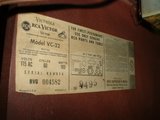
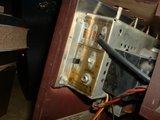
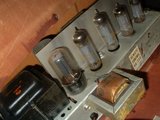

Cab (logo emblem says "voice of music")
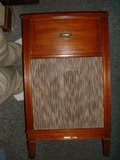
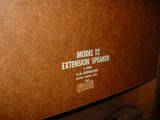
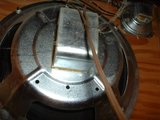
Cab (logo emblem says "voice of music")
- Feb 16, 2008
- 21,240
- 23,634
- Disclosures
- John K Custom Basses
Which input would be best to rig a phone jack for guitar on ? The phono or the tape ?
the TAPE. the phono input usually has an RIAA curve and would be unusable. this curve is to compensate for a stylus cartridge's freq response, so the bass is boosted a ton, with No high end.
the TAPE. the phono input usually has an RIAA curve and would be unusable. this curve is to compensate for a stylus cartridge's freq response, so the bass is boosted a ton, with No high end.
Ok, thanks John. btw, that OP transformer. What is the discoloring on there ? The person I bought this from said the tubes all lit up when he plugged it in, but he got no sound when he ran his finger across the stylus. He said he didn't hear any hum either.
Bad transformer perhaps ?
Ten years ago, I was building low power, rack mount, tube guitar power amps. My design used a two EL84 A/B output stage and did just over 10 watts. I forgot what plate voltage I was running. I think 380............I can't remember.
Turned all the way up, through a 4x12 with some Vintage 30's, they sound SWEET.
In Australia/New Zealand we had a company called Wasp. One of their amps was a twin 6CA7, wax poted OPT. Ran that thing flat out at small gigs with a 2 by 12" ported cabinet. So hot the wax dripped onto the case bottom and you could not touch the 1/4" plug on the front panel.....sounded superb! 3 hour gigs for years like that. About 50 Watts with nice distortion, that is the clue, what you find acceptable in sound when driving tubes hard.
BTW never lost a tube on that amp, Mullard or Philips 6CA7, have two other amps, 4 by 6CA7 at about 150Watt each. The OPT is big enough to run 200W and i do at times. Lost some tubes from bias failure on those amps.
Regards John

I have a Monoprice with 2 El84's and 3 -12AX7's this has 12 inch Celestion it is sold as a 15 Watt amplifier for guitar. I have a lot of old 60's Amps with 6V6, 6L6, 7591 power tubes. This is the first Amp that I have used with EL84 tubes. This small combo does not use a tube rectifier and has 2 small transformers of the same size. I think this amp is at least 15 Watts RMS. It seems more that 15 if you really push it more like 22 watts. Is that possible?

@Tubeblues do you realize that the post before yours was in 2009, nearly eight years ago?
ZOMBIE ALERT!
ZOMBIE ALERT!
I am not especially well versed in electronics, but common sense tells me, although I am sure there's an actual maximum limit, that it really depends in what context (circuit) they are used, what they are used for (their specific task in this circuit) and weather we are talking clean output or pushed into overdrive.
Also my best guess is that different brands and variations of the same basic tube types might vary a little regarding their capabilities.
I might be wrong though, as said I am not an electronic engineer or any kind of tube expert, on the other hand what i said would make much sense to me, based on the little knowledge and basic reasoning I do possess.
Also my best guess is that different brands and variations of the same basic tube types might vary a little regarding their capabilities.
I might be wrong though, as said I am not an electronic engineer or any kind of tube expert, on the other hand what i said would make much sense to me, based on the little knowledge and basic reasoning I do possess.
Last edited:

Yep, EL34 power tubes are often found in Marshall and Mesa amps and a pair can do 50 watts.
The EL84 are smaller lower power tubes found in amps like Fender Blues Jr, Carvin V16, and the 18 watt Marshall 1974x blues breaker. These put out up to 18 watts per pair.
They are often found in class A and class AB amps.
The EL84 are smaller lower power tubes found in amps like Fender Blues Jr, Carvin V16, and the 18 watt Marshall 1974x blues breaker. These put out up to 18 watts per pair.
They are often found in class A and class AB amps.
Yep, EL34 power tubes are often found in Marshall and Mesa amps and a pair can do 50 watts.
The EL84 are smaller lower power tubes found in amps like Fender Blues Jr, Carvin V16, and the 18 watt Marshall 1974x blues breaker. These put out up to 18 watts per pair.
They are often found in class A and class AB amps.
Makes sense since my recently acquired Dynacord Bass King is rated to 50 watt and indeed use a pair of EL34 tubes in the power amp section.
I'd still like to know if I am indeed right in my assumptions that it would depend on weather we are speaking clean watts or tubes pushed into overdrive territory and that you might gain slightly more or less watts out of the EL34 type tubes depending on what exact brand or variation of them you use, and also in what context and circuit they are used, how and with what specific task?
Edit!:
Looking at this Wikipedia article I just read, although I don't quite understand the technicalities fully, seems to back up my assumptions:
EL34 - Wikipedia
Among other things claiming that in a certain type of amp circuit a pair of El34 tubes can put out as much as 90W, also some information about a single El34 tube putting out up to 25W and 55W as a pair.
Also searching for facts about this I found, I don't have any verification on this though, someone on another forum claim, that overpowering the tubes with more volts than recommended will make the tubes capable of putting out more watts than rated, although shortening their lifetime some.
Further more I also found claims that support my assumption that the output from same type of tubes from different manufactures/variations vary a bit in max wattage output.
Last edited:
No I died 12 years ago!@Tubeblues do you realize that the post before yours was in 2009, nearly eight years ago?
ZOMBIE ALERT!

Matchless Thunder Man
2 x EL 34's
Propaganda sheet states 45 watts on current production model.
Carry on.
2 x EL 34's
Propaganda sheet states 45 watts on current production model.
Carry on.

Did I miss something? Was it not the EL84 we were discussing?
I missed that too and had to delete a post about Dynaco stereo 70's.


