• TalkBass has been independent since 1998. Add your voice.
    Create a free account to reply to discussions, view embedded media, and browse with fewer display ads.
    Join freeLog in
    Want zero display ads or expanded classifieds tools? Compare plans.

How much are bass guitars truly worth?

Getting back to basses, I recently acquired a Douglas six string for less than a hundred bucks. It sounded and played pretty decent, so I disassembled it and gave it to my drummer to have it painted. It came back utterly gorgeous!! The icing on the cake was that after I reassembled it and strung it with a new set of strings, it plays as good as the Ibanez SR I had and sounds fantastic. It has more than exceeded all of my expectations, and I get to actually play it instead of just putting it on display on a wall at my home. That, to me, is priceless.
 
Material cost aside, and you can go nuts spending money on wood and electronics, which fairly quickly reach a point of diminishing returns, though will have aesthetic appeal.

When it concerns slab type electric instruments, good solid electronics, well machined hardware and stabil woods make a great foundation. It's my opinion, based on experience building, that the single most important aspect becomes the skill and achitectual understanding of all aspects of the build and set up of the builder. Take the hand carved arch top jazz guitar Robert Benedetto made out of Home Depot Pine or the Dred built by Bob Taylor out of a scavenged oak pallet. An other significant factor is what the player's relationship with the instrument is.

I've played friends high end basses and no doubt they are great, but it would take me more than a few hours to really bond with them, others I can pick up and go "WOW", it's so subjective, another could pick up the bass I bonded with and give me a patronizing "It's a nice bass".

Years ago on rainy days, I would go down to a local guitar store and play boutique basses, basses I could never afford. One day I got a call from my guitar player, he told me to come down to his shop on my way home from work. He had this piece of Cuban Mahogany, he gave it to me and said "make a bass". He knew me better than I did. I've never made an instrument before, he was confident I would have no trouble at all. It took a few months, I can't do anything until I understand every aspect of the how and why. Jump to the end, I finished the bass with a nice mid level set of hardware, good US electronic components, and old P bass pickups I got off eBay. I built the bass for me, set it up the way I like, learning all of this as I progressed through the project. The day it was finished and strung up was a day I'll never forget. With out truly cognatant of my likes, dislikes, skills or intuition, I had made, for myself, the perfect bass. I could no longer take pleasure in rainy day trips to the boutique bass store, nothing measured up against the home made P. The first week it was completed, my buddy Albert Castiglia was hosting a blues jam at the Titanic in Coral Gables Fl. I took the new bass with me. That night I was offered $5,000.00 for it, I politely turned the guy down. I've learned much more since then.

I don't build a lot of instruments, but from time to time I cycle into making one or two new ones. I even enjoy taking really entry level instruments and hot rodding them. My most recent $149.00 Squier Bronco is one of these. I've been using it at gigs these last few months and I get a kick out the responses. It's a real sleeper. I upgraded the hardware, probably didn't need to change out the tuners but they were really second rate machines, bridge, strings and a Guild BiSonic pickup. It's 6 1/2 lbs, easy on the old shoulders, will it last forever, who cares, my major investment is the hardware and electronics and they can be recycled.

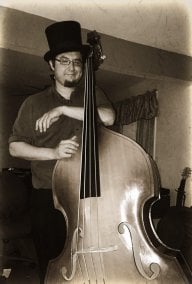
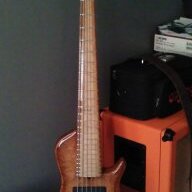
The Cuban, a little more road worn today than when this picture was taken.
4935_97230303770_6511299_n.jpg


The BiSonic Bronco with it's off-road 12 volt powered Rumble 40

73D2A72C-3D84-4369-AE4E-C4C21D3597B7.jpg


By the way, I am entering into a new bass building cycle, yesterday I pulled out a 16/4 by 6" by 10' mahogany board and a 8/4 by 10" by 4' pice of Black Walnut that was milled over a hundred years ago. This will be a semi hollow carved top 30" scale bass when I'm done.
 
Pretend I'm a well known builder for a second. Say you really like my basses and you haven't seen my prices yet, though you really want one. Then you figure out I charge $1300 for a bass. Great price right? (Remember, we're imagining here) I'm going to build you a custom made rosewood fingerboard P-Bass copy right before your eyes. Prices are pretty modest/middle of the road....


2 BFM Maple - $20
8 BFM Alder - $80
Pre-manufactured rosewood fingerboard - $40
Truss rod - $20
Schaller tuners - $75
Fret wire - $5
Strap buttons & string tree - $8
Standard bridge - $30
Neck plate - $10
Pickups - $50
Knobs - $10
Pickguard - $25
Pots & jacks - $15
Strings - $30
Dots & side markers - $5
Solid paint body finish & conversion varnish neck (this is a crap shoot - $50

(I've probably missed a few things, so let's just add $27 and call it an even $500 in materials alone.

I think this will take me 80 hours to complete (planning stage to a tuned instrument)... So you just got a $1300 custom made bass that went under great scrutiny and attention to detail...

From a guy that just built it for you for $10 per hour at my cost with 0% mark-up.... How degrading to myself or a REAL reputable builder would that be?!

Mass production is an entirely different situation, and I'm not sure what employees would get paid, though they would be designated to a department and not considered a "luthier". Apple's to oranges.
 
Last edited:
A bass is worth whatever anyone wants to pay for it....period! I plus this statement +3 times over.

Also it is the "implied thought of well it was made 20-30yrs ago it must be good", well not always.....if fact some of the new mid range priced basses...(300-600) are made and crafted better than they were back then.
Just my 1-1/2 cents.

Just for fun, when you have about 15 minutes to read, go to Gruhn Guitar website and read a little from this page: Guitar making on the Pacific Rim, from Japan to Korea to Indonesia to China Begin at "Many of the best . . . " or just go down to the last two paragraphs. Pricing a good bass or guitar is different now that how it was done 40 years ago, and probably will be a lot different in 20 years. FYI George Gruhn operates a business in Nashville that buys/sells vintage guitars and basses, and many other types of musical instruments. He travels a lot and has several posts on his website dealing with costing/pricing of old instruments. I'm not trying to hijack this thread, but often pricing of basses can have other factors that affect the cost and eventual price consumers will pay. A MIM Jazz might be less expensive than a MIA Jazz, but to this ear the MIM sounds and plays just as good - if not better.
 
Know why i like my benz? When i hold the wheel the car goes straight, i dont have to keep tilting it side to side like american cars. Also, when i close the door, you can feel the cabin pressure and hear a thunk, not caschhhhhhhhinkinkdkeebehejdjd like american cars. I also like that the transmission is super smooth, 6 speed, smoother than the 6 speed trans that my honda crv had.
I also like the awesome anti wheel spin, superior abs, and light clutch, things i never had on a MIJ or american car.
Bottom line, the germans are serious and take real pride in their work. Im not german either. My warwick german bass is superior to any bass ive ever played. I still own basses from esp, gibson, and peavey, and for good reason, they are built well. But the germans pride in their manufacturing are second to none.
When was the last time you drove an american car? The 50s? Opel russ builds thr exact same "malibu" that's build in kansas. And the gm detroit assembly builds opels. Vag builds cars in china and mexico. The "american" camaro is built in canada.

Anyway, country o origin doesnt mean anything these days, if only a different manuacturing cost.
 
I may have an unpopular opinion, but I am of the impression that nearly any bass can come out with defects or imperfections, it just depends on how likely or to what degree they affect usage.

If you buy a cheap Squier Affinity or VM/CV bass, you stand a chance to get a great instrument or a totally crappy one, it's a gamble. You go up to a Fender Standard or Am. Standard and the chances are progressively slimmer that you'll get a cruddy one. They do exist and people bring them up on here when they do. This is why there are some people who can say "I picked up an Am Std and it played worse than my Squier VM!" There can be other factors, but a good bass is a good bass, simple as that.

Now the QC checks on a boutique builder are going to be way more stringent and almost to ridiculous levels of detail, but the downside is you typically can't play before you pay. The gamble there is if you will like the tone and feel of the bass, not so much on quality. ANY purchase in my opinion is a gamble, be it build quality or if you will just plain like it. I hear Wal basses on records and youtube videos and they sound great, but at several thousands dollars, if the neck is uncomfy and the body is too heavy, it doesn't matter how good it sounds, I won't play it or feel it's worth the money (my experience with Warwick).

YMMV couldn't be more applicable, but I save myself a lot of money by doing electronics work and doing basic part installation (neck, tuners, bridge, etc) myself. To this day my overall best feeling bass is my franken-P. It was a labor of love, but I did everything but the nut filing and a basic setup (which I modified myself). Parts all in all probably cost me $650-700 (but I had a lot of parts "laying around") but I'd stack it up against an Am. Std Fender any day.
 
It's a complicated discussion that will not be of much help to people who have always been on the consumer side of things, and will always stay there.

Put it this way...

Company A buys a bunch of materials, and 2 guys working in a home based shop produce a very nice finished product that they sell in small volume online.

Company B buys the exact same materials from the exact same suppliers, but in higher volumes and lower prices. The have a 30,000 square foot facility with 50 employees, a bunch of leased equipment, lots of sales people getting a commission, etc... They sell the product to a distributor, who sells and ships the product to retailers.

It sounds like Company A should be able to sell the product for less, right?

Company B sells $20 million worth of their product every year. Their markup on top of labor and materials is close to 100%, so those 50 people are paid from $10 million. Average fixed product cost is $500 and selling price is $1000. The distributor sells it for $1150 and the retailer sells it at a $2300 list price, but usually for between $1700-1900.

Company A, with just 2 employees has a fixed cost that is $750 compared to $500, and they sell their product direct for the same $2300 list, with occasional sales or discounts. That sounds like a massive markup, but they sell only 200 pieces a year, so the company pays 2 people and any of their other costs from $150,000 (or so).

They could try to sell the product for less to increase volume, but then they would lose as many customers as they find, since they're in a business where the customers are a little snobby. After they spend $15K doing a trade show or two, another $10K handling warranty work or other shipping type issues, and always sitting on some inventory, and it's down to maybe $120K being split between 2 people.

$60K could be fairly comfortable if you live in a smaller town in some low tax state, but it's barely enough to survive if you live in a major city in a tax state. It's also less than you can make at a lot of decent jobs where you don't have to worry about all the business stuff like taxes, accounting, shipping, etc... If they wanted to lease a proper shop, that's another $20-30K a year, in all likelihood, at which point they could maybe hire another person or carry some more product, but with overseas factories now making great products that are sold for $1200, it gets harder to do.

That's assuming 200 pieces sold a year. A lot of these boutique builders don't sell 50 or 100 a year, so if the instrument is $3000, then they need to sell 2 pieces a month to earn a $3000 income, if the costs are in the $1500 range as Lonnybass has described (using quality woods and components for a boutique). If they sell one a month, it's really a hobby business.


I won't get into the costing formula we use, but I can say the following: NAMM cost us about $12,000 all in. If Hammersmith sells 120 basses this year, then $100 from the price of each one goes to NAMM. If we sell 240 basses this year, then it's $50 from each bass. 360 basses = $33 each. That's more than some of the components used, but it's a ressonable cost because if we didn't go to NAMM, our chances to grow and sell would have been much lower.

When you buy a $100 pair of Nike's, probably 1/3 of that goes to pay their endorsers like Lebron James, Tiger Woods, etc... When you buy a bass, a larger chunk than you might think is required just to pay for the branding, marketing and endorsements involved with being in the musical instrument business.

It's not just bits of wood, metal, plastic and wire. It's a lot more complicated than that, and the product itself is never, ever the sole consideration in the pricing structure.
.
 
Last edited:
I have an amazing wife who recently agreed to let me get a Brubaker. We were both blown away at the quality and beauty of the bass that I got. It's not just a bass guitar, it's a true work of art that's part of the decor of our home. Because it's out on display rather than cased under the bed (like my other basses) I pick it up and play everyday. So, everyday we're both enjoying the art aspect of it, and I have the opportunity to play a bass that I've dreamed of owning on an off over the last 15+ years. When I play this bass... it talks back to me and as a result my technique is improving. I would say it's worth what I paid for it.
 
Less expensive basses that seem similar to more expensive basses are a result of three major differences.

First is the cost of labor. The less expensive basses are produced in places where people make far less money per hour. This labor tends to be made up of non-musicians and non-luthiers who have been trained to perform one or two simple tasks as quickly as possible.
This is what Henry Ford did to put the entire nation in cars.
 
There are levels to everything that goes into a bass. The wood, paint, hardware, electronics, etc. Then there are the wide variations of labor costs. A guy in China costs pennies on the dollar what it would cost an American or German builder.
You also aren't paying for JUST materials. You are paying for the know how and equipment costs. Even if I had the desire to build a bass, it would take years and thousands of dollars to get the knowledge and machinery required to do it.
Something else to consider:

In first world nations, a massive amount of money goes into complying with government regulations and taxes. Everything from environnental, OSHA, ACA, ADA, and the list goes on. This stuff is so expensive that larger companies have entire departments devoted to handling all this stuff.

In second and third world countries, it's like the US in the 19th century. You throw up a building, hire a bunch of people, and start building stuff. Overhead is much less - and you pass the savings on to the customer.

This is one of the reasons I actually AVOID made in America.