• TalkBass has been independent since 1998. Add your voice.
    Create a free account to reply to discussions, view embedded media, and browse with fewer display ads.
    Join freeLog in
    Want zero display ads or expanded classifieds tools? Compare plans.

How much music theory do you really need to know?

I was in a band with one song written by the singer, who also played bass at home. She taught me the simple bassline by saying 'thickest string that fret' and so on. She didn't even know the names of the strings and freaked out when she saw me play the same notes on the A string - 'You're playing the wrong notes'.

That's interesting because if she was aiming for a specific timbre, or the way moving between notes makes the phrasing she wanted, then she'd be right despite being ignorant of many things. The best measure of this situation is how well she can explain her choices, or how well she can identify why yours won't do something she wants done.

An example is letting rip with the sea shanty 'Spanish Ladies' with a JJ Burnel-like tone, on the far ends of the strings. (Very satisfying, really it is). It's harder than playing it further up, and on fewer and lower strings, but that rant and roar can't be had the easy way. :) There's a rolling pattern, a legato phrasing, that also fails unless the low end of all strings is used. A player might get by using more of the neck, but then they'll not be playing to the natural strengths of the instrument as applied to that tune.
 
Last edited:
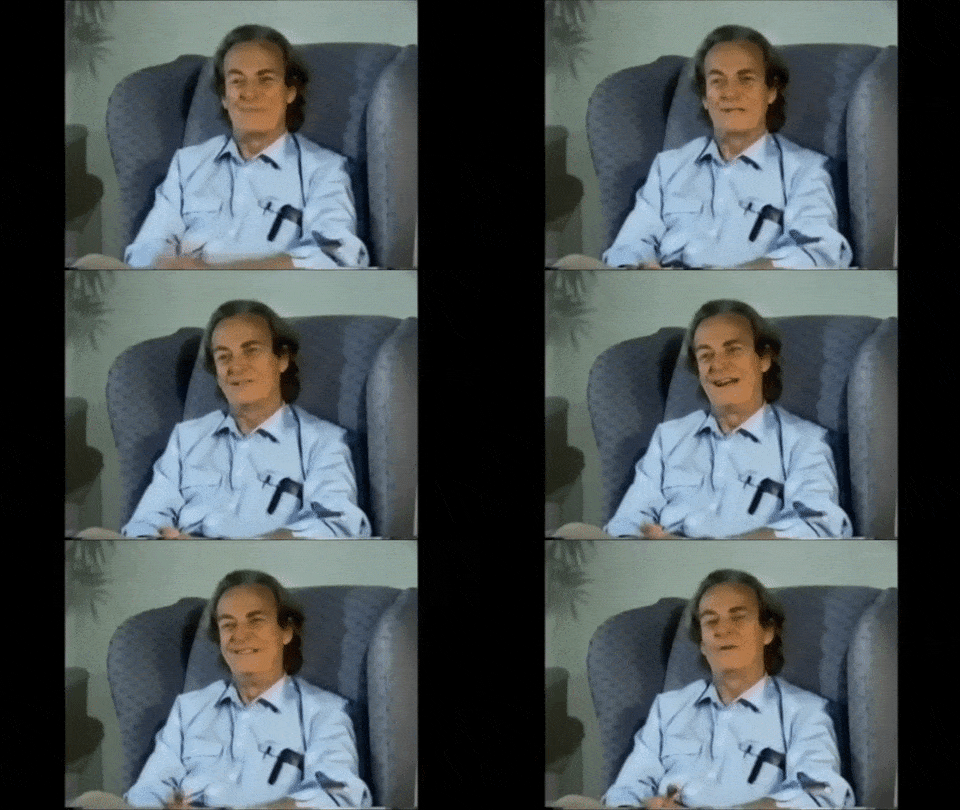
"It only adds. I don't understand how it subtracts."
giphy-downsized-large.gif
Well Richard, this isn't as simple as dunking plastic in ice water or quantum physics. As any bongo player knows, a pre conceived idea can take predominance in the conscious mind and take the place of feel and inspiration and can be a subtracting factor. In physics lab we call this Analysis-Paralysis. If analysis comes shortly AFTER feel and inspiration, then we have no problem. After many years the two can merge into one, but it may not involve words in the bongo player's mind, just an integrated knowledge.
 
  • Like
Reactions: IamGroot
“Need” is a loaded word. An experienced musician can generally ******** our way through most things an the audience doesn’t know. Musical theory knowledge is kind of like grandpa’s shotgun I keep under the bed. It’s just fine to have it and not need it but I’d never want to need it and not have it.

Of course it always comes down to what you want to do but it’s always better to have more tools at your disposal. Theory opens possibilities. Like I know people with college degrees earning a good living doing things they didn’t need a degree for. But I’ve NEVER heard one of them say they wish they didn’t have their education or degree.
 
As any bongo player knows, a pre conceived idea can take predominance in the conscious mind and take the place of feel and inspiration and can be a subtracting factor. In physics lab we call this Analysis-Paralysis. .

I'm not 100% sure if I understand what you are implying. It sounds like you are saying that knowing theory gives you a predetermined set of instructions on where to go.

That's not the case at all. Music theory is like having an entire map memorised in your head. It makes you aware of your options. Which road you follow or if you decide to go off-roading on your trip between A&B is up to you. The only difference is you know what you are doing and not guessing.

If you feel that what you learned in theory is forcing you to think a certain way you have misunderstood the application of it.
 
I know more theory than the majority of my 25 person church worship team. Well, at lest more theory that can be applied to the music style we play. We read from chord charts so theory is not strictly needed but knowing some allows me to:
  • More easily memorize songs since they make sense (predictable chord progressions)
  • Much more easily figure out new songs from recordings (predictable chord progressions)
  • Pick fills that fit with the current chord and scale (chord spellings, modes)
  • Transpose to new keys.
Yes others on the team are fine at reading the chord charts and playing the written chords but they have almost no skills for playing anything that isn't on the chart or in the recording.

Without theory, we are often reduced to being a music copy machine simply reproducing note for note what someone else created and captured in an audio recording.
 
That's not the case at all. Music theory is like having an entire map memorised in your head. It makes you aware of your options. Which road you follow or if you decide to go off-roading on your trip between A&B is up to you. The only difference is you know what you are doing and not guessing.
You totally left out the part of my post where I agree with what you just said, where it becomes integrated.

There are plenty of times before this happens where a writer tries things based on an idea of a substitute chord or devise (or lick they know) and nothing works until they get away from the "problem" and try inspiration, and then answer just comes. The roads you know may be too well used and I do recommend off-roading on occasion. "Knowing what you are doing" is a form of self consciousness. Too much self consciousnes and again we have paralysis. I've seen it! "I don't know what to do!!!" Well, do Something please, just to get the ball rolling...
 
Theory gives you another way to think about music and harmonic relationships AND a way to quickly talk to other musicians about the needs and direction of the music. It can save a lot of time and that alone will sometimes get you the job. It really depends what level of performance we are talking about. If you play rock in the pubs you probably only need the basics but as you get into higher levels you often need tools in which to frame music or map it out. But more than just knowledge HOW you apply theory is just as important. When to use it and when to let go is equally important. One could say it never hurts to have more understanding but I’ve seen some people tie themselves in knots with all their theory and lose their creativity a bit. Thinking of theory while playing is almost always easy to spot. That’s why so many people say learn it and then forget it. Internalization is the key.
 
To me; music is a language. Music theory is the grammar of that language.

Grammar alone won't make you a good speaker or story teller. But it surely helps a lot.
...
A pitfall I was warned about was to make theory your primary musical guide. If you do that, the music will sound correct but possibly lifeless - like grammatically perfect but meaningless random sentences. Emotion / story should be the guide, and theory should be the helper for a better projection.

Same here, I believe that's Victor Wooten's take on this topic as well.

To paraphrase him, I believe it's something akin to: You could have perfect spelling, grammar, and a huge vocabulary....but if you don't have something interesting to say, nobody is going to want to listen.

As someone who does amateur game development as a hobby, I can tell you right now I see that concept on a nearly daily basis. Masterfully efficient coding, great artwork....but an absolutely uninspired bore to play or read (when it's a story-based game).

Which is why teamwork (a band) is the best way to tell a story IMO ;)
 
I tell people the amount of theory you need to know -at a minimum - is what you need to get the job done. And that depends on what type of music you play and how good your ear is.

If you know what to play by ear, then music theory isnt critical. Nice to have, but not critical. Not too many have this talent, but I know of at least two musicians that dont even know the names of the chords and they kill it every time.

If you are going to do jazz, more theory is definitely better - (knowledge and ear recognition of scales, chords, their interrelationship, cadences,etc). Should know all the modes of the major scale cold and know where to use them, plus the Minor Pentatonic and their modes. Some of the Minor modesMelodic minor, diminished, augmented, etc..

If you are going to do 3 chord blues, you probably could get by knowing the notes in the 7 chords and the pentatonic minor scale plus a knowledge of of major vs minor , 6 vs b7, etc. Maybe the relative minor and the 251 cadence. You dont need to know what the Em7#9 chord is by name, but you need to be able to cover it. Knowing a dorian scale wouldnt hurt.

All the above is a great simplification and I personally like music theory and use it in my playing.

I would be interested in your opinions.
For me? Very minimal. I'm a weekend hacker!
 
  • Like
Reactions: IamGroot

Latest posts