• TalkBass has been independent since 1998. Add your voice.
    Create a free account to reply to discussions, view embedded media, and browse with fewer display ads.
    Join freeLog in
    Want zero display ads or expanded classifieds tools? Compare plans.

how to fix a floppy E string?

You said
will check again for buzzing but one thing i did notice was i was getting this annoying buzz when slapping the 3rd fret on the E string and no where else, but it could be the string as its from a really old set i had lying around and i only noticed it after i had changed that string


Hmmmm sounds like a kinked string.

-m

i guess the string was indeed kinked before i strung it up on the bass so i could blame the 3rd fret buzz to the old string i guess. but floppiness has been the same on the both the strings i have tried. will know for sure when i put on the new set next week

I'll say it one last time before this thread gets out of hand.

Why isn't everyone suggesting maybe he needs fretwork? If it only buzzez in a few spots he needs fretwork

maybe idk, the neck has'nt been played on too much already although its a 03-04 GL i think

 
The relationship between core size and winding wire size affects tension too. A Fodera .045" G, for example, actually feels noticably different that a .044" because one has a thicker core than the other. I think the .001" difference MUST be less than the tolerance to which the strings are manufactured....so the overall diameter would likely be totally negligable. I'm assuming there....

Maybe you could try some other brands of strings. That can make an enormous difference. Just the gauge of the string isn't what determines it's tension at pitch. Different manufacturers use different materials and construction methods, etc., so you should try many.

Or maybe you need more downbearing at the bridge. That can help make things feel a bit more stiff.

whats down bearing at the bridge?


their main benefit to me is that they let you put a detuner on a string other than a B.

that is a really cool idea! is there some kind of a easy mod for me to do something like that, like switch the B and E tuners so that i can put a Dtuner on the E instead? a string tree maybe?

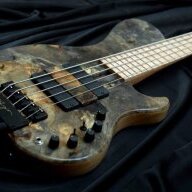
on a bass like this
[Invalid or Expired Link Removed]
 
boys the physics has been worked out on this for a looooooooooooong time. "the ideal string has zero mass and zero diameter" should sound familiar. we don't really have to to use the alternate keyboard setting for differential and integral calculus do we?

(i won't even mention how the extra force exerted by the tuner on a longer string means the tuner becomes more massive - :D)

String length beyond the contact points won't increase tension. A radical change in direction (such as tilt back headstock or suddenly going down through the rear of the body) will increase the pressure of the string on the contact point itself, but not on the tension of said string.

Get the bass looked at - you can always redo your part.
 
Has anybody got a bass that can be top loaded or strung through?

Try the string both ways, there will be no difference.

IIRC, Bryan, you tried this before, by swapping which tuners you were using for the B and E strings on your bass?
 
This is all good but it's all just reproving the same argument that any reasonable person should already accept.

The real question in my mind is, when extending the non-speaking length of a string, what other factors BESIDES actual tension at pitch can cause a string to subjectively FEEL tighter.

A string can feel floppy because it's too dead. Or because it's sound isn't consistent with the other strings on the bass. This doesn't have anything to do with tension in the mathematical sense. It has to do with the sonic response of the string. Changing the non-speaking length does change other factors like longitudinal vs. transverse vibration relationships and angle (downbearing) at the bridge or nut. Both of these have an overall effect on the sound and "feel" of the string.

I don't think you can just surgically separate sound and feel on a musical instrument. A bass with dead strings feels heavier to play. Hammers voiced too dark on a piano can make the action feel heavier than it really is.

The question is a subjective one with some quantifiable components and I'd like to know what ALL of those quantifiable components are.
 
whats down bearing at the bridge?

The force with which the string is pushing down on the bridge saddle and hence transfering vibration into the body.

I've done this and it works...

If the angle over the bridge is shallow, you can shim your neck (you can achieve the same thing by recessing your bridge) so that the bridge saddles have to be raised relative to the "tailpiece" or in the case of most basses the ball anchor point. This increases the downbearing and, IF THERE WAS INSUFFICIENT DOWNBEARING TO START WITH, can and probably will make the lower strings feel stiffer simply because it will remove some of the slop from the vibration, especially at the point of attack.

I've done this and I promise it's for real. The fatter strings are under less tension, so if that angle is really shallow the string is not necessarily very well terminated there and you really want it to be since it has a lot of mass and is capable of displacing itself and/or the saddle to some degree when it's struck hard unless it's a locking saddle like on some Foderas.

Downbearing is a HUGE issue in stretched string based instruments...particularly acoustic instruments...but solid instruments as well. People talk about "angle over the bridge" but really the critical component is downbearing.
 
The force with which the string is pushing down on the bridge saddle and hence transfering vibration into the body.

I've done this and it works...

If the angle over the bridge is shallow, you can shim your neck (you can achieve the same thing by recessing your bridge) so that the bridge saddles have to be raised relative to the "tailpiece" or in the case of most basses the ball anchor point. This increases the downbearing and, IF THERE WAS INSUFFICIENT DOWNBEARING TO START WITH, can and probably will make the lower strings feel stiffer simply because it will remove some of the slop from the vibration, especially at the point of attack.

I've done this and I promise it's for real. The fatter strings are under less tension, so if that angle is really shallow the string is not necessarily very well terminated there and you really want it to be since it has a lot of mass and is capable of displacing itself and/or the saddle to some degree when it's struck hard unless it's a locking saddle like on some Foderas.

Downbearing is a HUGE issue in stretched string based instruments...particularly acoustic instruments...but solid instruments as well. People talk about "angle over the bridge" but really the critical component is downbearing.

am sorry i read that a couple of times but didnt get it, what it is it that i need to do?
the bass has a badass bridge fyi
 
If you take off the neck and shim it....which is to say, put a thin piece of hardwood veneer or something similar in between the neck and body so the surface of the fingerboard sits a bit higher relative to the top of the body. Then you'll have to raise the height of the bridge saddles which will make a sharper angle over the bridge. IF THE ANGLE WASN'T SHARP ENOUGH IN THE FIRST PLACE, this can take some of the slop out of the strings and make tham "feel" a bit tighter. There is a point of diminishing returns for sure so I stress that if the angle (downbearing) is insufficent, it could be a source of what you're experiencing and doing what I suggest would solve it.