• TalkBass has been independent since 1998. Add your voice.
    Create a free account to reply to discussions, view embedded media, and browse with fewer display ads.
    Join freeLog in
    Want zero display ads or expanded classifieds tools? Compare plans.

How to reframe from playing so many notes and play just enough for the song?

I created a thread on what to learn as an intermediate bassist and when looking back I do realize that I tend to over play sometimes. I usually come up with simple lines that are sometimes melodic with occasional licks that outline the vocal lines. However, sometimes I try to add in fills that are not needed and I realize it more when looking back at a video or recording. I was wondering could I get some tips on how to play without creating unnecessary fills?
If it's fills, I think we are trained as bass players to throw a fill in at the end of chord changes, people expect that, so how are you overplaying?
That said, I tend to select notes for a fill that rhythmically follow a vocal line or reinforce the drum fill (the snare/cymbals/toms)
 
I only notice my overplaying when I hear a recording, and then it's cringe-time:sour:
What seemed tasty and groovy when I played it is often revealed on playback to be distracting or groove-killing or treading on the vocalist or soloist. Like I'm trying to talk over them, like those annoying people sitting behind you at the movie theater who are carrying on a conversation while you're trying to watch the movie. Or sort of stealth-showing off. That's when I cringe the most.:bag:

So, as others have suggested, recording yourself is the quickest way I know of. Record an entire practice and then listen to it over and over, and you'll soon get sick of your own pet fills and mannerisms being repeated over and over.

Limit yourself to using a particular lick only one time in a song, because the more you repeat it, the less it works and the more it starts to sound like an affectation, or like it's the only lick you know.

Limit yourself to only adding fills in a single verse or chorus. When you hear the playback you'll be most proud of the verse where you just lay down a solid foundation without any frills, creating a monster groove. Also, don't be adding fills when others are also adding fills. Usually bands work out who's supplying fills on which verse. Bass fills don't necessarily have to "scheduled" in the same way, but you must always yield to the designated fill-er. And of course to the vocalist or soloist. Don't risk pulling the listener's attention from them. That's not your job.

In the long run, it's a matter of maturity, which I guess it why I'm still struggling with it even though I'm 60 years old. I can't pretend that I don't like to rip off an "impressive" fill when I think I can get away with it. But on playback it almost always sounds gratuitous and selfish and cheesy.

One beer tastes better than 12 beers, yet I've drunk beers 2-12 trying to replicate the flavor of that first sip and regretted it later. Fills are often that way, too. One good one played once sounds better than 15 good ones in the same song.

Imagine how you would ask someone else to play the bass part if it was a song you'd written and you were the vocalist or soloist. What would you want them to focus on and what would you NOT want them to do. You don't want them to clutter it up or be constantly sneakily drawing attention to themselves, but to lay down a solid groove that you can work with--and sometimes against--to tell your story/weave your spell. The focus is on the story/spell, not on one member of the rhythm section trying to make the song his own vessel for personal expression or showing his chops/splendid harmonic sensibilities.

There are, of course, exceptions to be found everywhere, and the more chops/ideas you have, the more of a struggle it can be to not use and demonstrate them constantly. I'm still working at that mature restraint ("taste") and regularly going over the line.

One last thought--if your timing, including on the subdivisions of the beat, is not perfect, ANY fills will sound like overplaying. It's amazing to see how much playing some players (Jamerson, McCartney, Prestia, Jemmott, Rainey, etc) get away with at times because every note is rhythmically on the money, so it doesn't stick out like a sore thumb and kill the groove/break the spell. Come in late on a simple three quarter-note walkup from I to IV, and it suddenly sounds busy and cluttered.

Have fun. You'll figure it out. As others have said, the fact that you're aware of it says you've won 3/4 of the battle.
 
Straight out of college and jazz band I was playing in a country/classic rock cover band. They had a great guitarist who was very gruff and grumpy. He looked at me after a tune and said "You'd be a pretty good bass player if you'd stop playing so many #*&@% @*%#!= @#+** notes!" He was absolutely right and I've never forgotten that lesson.
RIP Matt
 
Context has been mentioned and that's always something to consider. What's inappropriately busy in one context might help make the song in another. It really depends on what the focus of the music is. A song like "Pow" by Graham Central Station is built around Larry Graham's bass line. Take away that line and the song loses a big part of what drives it and of what, ultimately, makes it interesting to listen to. "Lessons In Love" by Level 42 has a bass line that (rhythmically speaking at least) is very busy but, again, that chugging line drives the song (playing the role that rhythm guitar might in a more conventional band) and every other instrument fits around it. If you listen to Sheila E's "The Glamorous Life", well, there's no real bass line (just some synth bass playing notes here and there). The percussion, drums, synth and horns are what drive the instrumental part of the song. And the lack of bass may very well help Sheila E's percussion stand out that much more. Speaking of percussion, if you listen to go-go from D.C. you'll often hear bass lines that are quite sparse. With go-go the driving force, more than anything else, is the drums and percussion. Take away the bass and you still have go-go. Take away the percussion on the other hand...

So it really depends. Knowing what the focus of the music is, and keeping that focus in mind, can go a long way in informing you regarding an appropriate bass part.
 
  • Like
Reactions: LostJohnny
If you're overplaying, you may be loosing the focus or the purpose of the song. When you catch yourself doing it, move your focus to the main element of the tune or jam at that moment whether it be singing, melody or whatever. The more picky you are about what you play, the more you'll stand out.
I used to play lead bass in high school. Now I see it so differently, I rarely go that route. Mostly a change in my tastes I guess.
 
Last edited:
I was wondering could I get some tips on how to play without creating unnecessary fills?

Alot, I mean Billions and Billions and Billions of Musicians, and you know this, (who knew), tend to let their egos dominate the song. The need to show off period. A tendency to show off what you know, think you know or have recently learned. But don't worry as soon, this tendency, will magically just go away.

Some times a band is short a instrument and embellishment can fill that hole. Other times, the original composition is really lacking something, adding can help there also. As long as your not taking up somebody else's sonic space (stepping on toes) or competing with others to fill that space, it can sound good. Over playing during practice is part of learning what works and fails, and is good. Keep in mind that not playing notes, spaces that is, are a vital part of a song just as well.
 
I used to overplay until I get into reggae; that's when I started to play the rests rather than stopping my playing for a given number of beats. All the power in the instrument comes from playing rest. Think about it like driving; highway driving covers a lot of ground, but obscures details, while city driving is full of start and go that will make you pay closer attention. To put it another way, try considering rests as a type of note that you have up to this point underplayed.
 
  • Like
Reactions: Sascha Erni
I was wondering could I get some tips on how to play without creating unnecessary fills?
I hate to sound flippant, but really, you just do it. If you find yourself doing something you think is over playing, just don't do that anymore in that spot. Eventually, like anything you practice correctly, it'll become a part of your style without much thinking anymore.
 
  • Like
Reactions: Hambone70
play to compliment the song , ... not your ego ( it's not about showing off techniques - it's about the song/music )

i learned Live versions of old rock songs back in the day ... i figured if they played their own tracks like that Live , then i'd learn those licks = made me overplay for a few decades .. !! i think the last decade i've finally calmed done a bit .. sorta
 
When I practice with a recording my tendency is to find songs with interesting bass lines and copy them. A lot of times these are pretty busy bass lines and so lately I've been listening to music with simpler bass lines. Early Beatles (Paul McCartney) and the Talking Heads (Tina Weymouth) come to mind. The bass lines are far simpler than I tend to play and copying their playing has helped me to simplify my own playing. Hope this helps.
 
  • Like
Reactions: Jalen Fuller
Here's what I would do. Record yourself playing, listen back with a critical ear and figure out where you tend to overplay. Focus in on those phrases and rework them in a way that seems more musical and rhythmically sound to your ear, then repeat.

Often when people talk about overplaying what they really mean is playing without listening to how everything works as a whole, not so much just playing too many notes (though sometimes lots of notes are involved). You can play a simple three-note turnaround but if it's clashing with another part then it's overplaying. You could put eight notes in that same space and if it's musically tight with the instrumentation, it's not overplaying at all. You could also choose to just stay with root-five there. Lots of stuff might work.

This is a good thing to notice about your own playing, and a great challenge for you to take your musicality up to the next level. Have fun with it!
 
  • Like
Reactions: soulstew and JRA
Most tunes don't have signature bass lines. We kind of make them up adjusting for instruments on the recording and not in the live mix. So sometimes you play more, other times not so much.

I do know that about five years ago, maybe more, I heard recordings of my playing, live and I thought I could play less. Been on that course since, looking for the meat of the beat kinda thing. I play a lot of Funk and RnB so the genres lend themselves to holes.

Besides after Primus and Flea everyone starting playing too many notes imo.
 
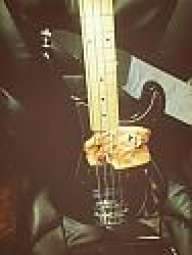
Hang this from your playing arm. It'll keep ya from playing too many notes.

6a879699-7b9f-406c-9143-275994af72c0.jpg
 

Latest posts