• TalkBass has been independent since 1998. Add your voice.
    Create a free account to reply to discussions, view embedded media, and browse with fewer display ads.
    Join freeLog in
    Want zero display ads or expanded classifieds tools? Compare plans.

How to walking bass properly (not the beginner formula)

So I didn't play much of walking bass but sometimes I do need it for like rock&roll and jazz or blues songs at church, Im always fine with the simplest formula or arpeggios.

But now that im getting better as a player i want to learn about how to actually build a real walking bass (not that of 5mintues instant walking bass, or easiest way to, or beginner friendly type of walking)

But i cannot seems to find anyone actually teaching how to do it in youtube (I know paid lessons will have it tho but yknow)

So can someone please help me to understand how to actually build a proper walking bass

IRealPro is an app that won’t teach you, but there are hundreds of downloadable files to practice with and many different styles as well.
 
  • Like
Reactions: PWolverine
No.

At the risk of shameless self-promotion, many folks have found this useful.

I finally took the plunge and ordered this book.
...

Likewise. For (former) EU customers the link is redirected automatically from Shen to Musicroom.com, which is cool. Musicroom via Amazon (which I use all the time) was £16.99 ($19.62), so even better. And in stock, so arriving tomorrow.
 
  • Like
Reactions: ProbablyTooLoud
And we're off...
20220904_211124.jpg
 
  • Like
Reactions: kobass
. The idea is to connect the next chord with the current chord in a scalar fashion, rather than simply go from one arpeggio to the next. Good walking involves being able to find a good penultimate note, the note that leads to the chord change..
+1.

Exactly: good walking walking bass should not only tell the listener where you are in the harmony, but also and most importantly, where you are going to.
Exactly.

OP - Look up Hal Galoer Forward Motion. He describes this very well.
TLDR: Just before a chord change, the notes should be leading you and pulling the listeners ear to the next chord
eg. Chords C | F
Bass play C C D E | F
Or C E G Gb | F
Or C Bb A G | F (if C7 to F ).

Learn song melodies. You want to learn the fundamentals of walking, for sure. But knowing melodies will allow you to take that to the next level - you can añlude to the melody with your lines, y9u can voice-lead the song, you can craft counterpoint, you can reharmonize. Learn melodies.
Very important. Even the most basic knowledge of melody will shape your bass lines to work alongside and support the rhythm or feel of the melody.
 
Everything I learned about walking bass I learned from two guys. Jim Stinnett and Todd Johnson who both are very similar in their approach and both have excellent instruction material available for purchase. I studied on line with Jim for several years and continue to take on-line lessons from Todd.

I don't do SBL but I believe Todd has quite a few saved seminars on his walking approach posted there.

Tim
 
I have started using Mike Richmond’s Modern Walking Bass Technique. It’s great for some great lines and progressions. Combine that with a good theory book like Ed Fuqua mentioned above and you have heaps of material to get you going. I use iReal Pro to practice, simply mute the bass and enter your chord progressions (I did the first three modern walking bass technique ones - but there are hundreds for free in the app) and practice is a lot of fun.
 
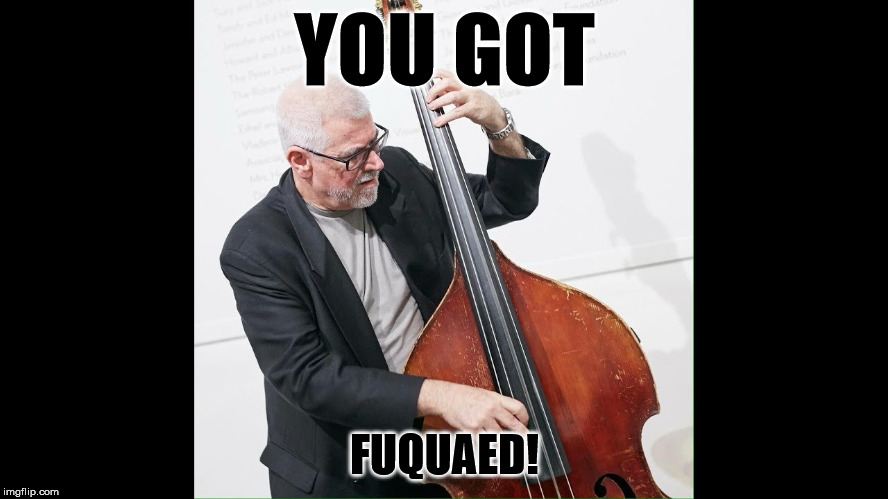
Most people are unaware , but this was the original artwork and title for Mr. Fuqua's book.


2rsvlq.jpg

Don't know if that's true or not - looks like an on-line meme generator to me, But, if true, I can imagine some vexed conversations between author and publisher over that one. Either way, I guess at least two of us got 'Fuquaed' this week!!