Well said, and thanks. And another way to look at lines: they make it easier for other bass players to see what you're doing


TalkBass has been independent since 1998. Add your voice.
Create a free account to reply to discussions, view embedded media, and browse with fewer display ads.
Join free Log in
Want zero display ads or expanded classifieds tools? Compare plans.
Well said, and thanks. And another way to look at lines: they make it easier for other bass players to see what you're doing

FWIW, I never recommend unlined ones to my many friends who ask even though I don't own any or usually enjoy playing them that much. Those who go unlined never seem to ask though, somehow...just for the record... being mostly a fretted player that sings, I vastly perfer lined...

I had about the most fun ever playing fretless behind Ed the other night...
Make me taller and call me Pino, lol I had a GWB 35? For a while, for tight bass patterns the lined fret board was crucial Listen to Everytime you go away by Paul Young you will not want lined fretsLined or unlined does not matter; it's the mwah that rules them all!

I had a blank plank as my #1 for a good many years . I rarely went mwah , I also play upright . I was often told that people had no idea I was playing a fretless bass .
Took that as a compliment ...

If you say you don't need the lines because you aren't looking, you shouldn't care if the lines are there, because you won't see them anyway.
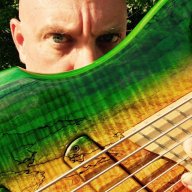
Ok monster plays with linned frettless jaco, Marcus ,Richard Bona,Hadrien Feraud,so what's the problem with lined?
I always prefer to stay in tune and don't care about the look of the fingerboard
So be in tune and happy
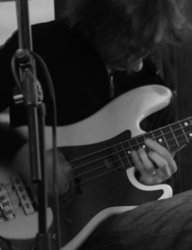
Yes also Gary willisI think about Mick Karn, who played a lined fretless Wal to great effect. Such a mindblowingly good player who was savant level oddball brilliant.
View attachment 3951835
Did you reposition the dots? It should be enough. (See my way too long post below.)I am so glad I bought the Glarry instead going in the deep end with a Tony Franklin. I can play unlined fretless and I can stay in tune, but frankly, I don't need the challenge of an unlined fingerboard. Lined or not, it is very easy to go out of tune playing fretless. The lines make it much easier for me to self correct. Your mileage may vary, but I have no shame in my game:we get no bonus points for difficulty of execution, so I am happy to have the help of lines.

Side dots (if correct) should be enough. Glancing down is better for your posture than leaning over. If you find yourself sliding around looking for notes once you are in position then there's a good chance your left hand (right for lefties) is undisciplined. Many bass guitarists haven't learned the "correct" way and play very well as long as they have frets. Learning to play 'in position' is absolutely mandatory for fretless. This is very difficult to correct if you've been playing for some time since unlearning is much harder than learning. It's probably more important to have lessons as a beginner more than any other time. I was lucky. Everybody I liked held than hand a certain way (Alphonso Johnson, Ralphe Armstrong, etc.) so I held my hand that way so when I began do study I was pretty cool.
Think bass guitar as 'bass' and 'guitar'. As a hybrid instrument, a combination of doublebass and (classical) guitar technique (more cello) should be employed.
I only need to look when I change positions on bass guitar. I never need to look on upright. Have you guys seen Rachel Flowers play bass? She can't look and I don't understand how she does it. Some have said that Art Tatum played really long lines as a way of connecting a keyboard he couldn't see. I would really like to hear your experiences in developing the kind of muscle memory she demonstrates. (Sorry about the length of this post).
Try this:I would really like to hear your experiences in developing the kind of muscle memory she demonstrates.
I use finger replacement to find my first note on upright. For instance to play C# on the G string, I can reliably find 4th position (D) with my 1st finger, replace it with my 2nd and the C# is just there. With bass guitar, I have to look. I don't have the same guideposts.Try this:
1. sit comfortably with your (fretless) bass as stable as possible in playing position.
2. close your eyes.
3. drop your left arm and relax it
4. play an open A
5. play a fingered A on the G string with your left index finger.
6. drop again your left arm.
7. play an open D.
8. play a fingered D on the G string with your left index finger.
Most likely you will fail miserably at steps 5 and 8 (your fingered A and D will be terribly out of tune).
Now loop steps 3 to 8 (with closed eyes), until you can play the fingered A and D in-tune (as controlled by your ear by comparing to the open A and D). You can achieve the fine-tuning by a rapid roll of the finger.
How long do you need to practice this in order to play the fingered A and D in tune?
Most people will nail it within a few minutes. Others may need to worker harder. Notice how active your ear is when doing this kind of exercise.
Muscle memory is really an amazing phenomenon, and, in combination with ear-training and months and years of practice, enable us to play in-tune violin, cello, double bass, fretless BG, ...
All this does not mean that visual cues are not a welcome asset.
It's been said doublebass is one of the easiest instruments in the orchestra to play passably well, but one of the most difficult to master.Thanks very much for that link. She is absolutely exceptional! At 7:03, she says, "it takes a lot of practice and memorization."
One memorable moment I had was attending (not playing) an Edgar Meyer Master Class at Central Michigan University some years back. There were a succession of the school's bass majors playing pieces and receiving input from Edgar. After the top student finished his (very nicely played) piece, Edgar asked him, "how many hours a day are you practicing?" The student's answer was 4 - 5 hrs per day. Edgar literally shook his head and responded, "Not nearly enough. Not even close. You have to be thinking 12 - 14 hrs per day, if you want to be competitive at the highest levels."
Clearly Ms Flowers has put the time in.
But, as with all things, the choices and decisions depend on the gigs you want to play and what battles you want to fight. Got to pick your battles in life. Most of my upright playing I do is in orchestra. As I'm sure you know, orchestral parts can be very demanding and challenging; but, they are wrote parts. As Ms Flowers states, they take a lot of practice and memorization. Things change a bit when you are confronted, for example, with a higher level Blues open mic situation. I'm not saying you can't do the latter with a blank board. It's just that the mastery required to imprint positional shifts for impromptu improvisation and soloing is pretty high up there. Situations like that were the ones that prompted my choice.
One other thing Edgar mentioned in that workshop was that he actually uses the dots on the fingerboard of his Gabrielli. Not so much in performance, but while working stuff up. His attitude was / is that we need all the help we can get. I tend to agree.
That's a very good point about ear training on fretless instruments. I've heard a lot of very confident playing with horrible intonation.Try this:
1. sit comfortably with your (fretless) bass as stable as possible in playing position.
2. close your eyes.
3. drop your left arm and relax it
4. play an open A
5. play a fingered A on the G string with your left index finger.
6. drop again your left arm.
7. play an open D.
8. play a fingered D on the G string with your left index finger.
Most likely you will fail miserably at steps 5 and 8 (your fingered A and D will be terribly out of tune).
Now loop steps 3 to 8 (with closed eyes), until you can play the fingered A and D in-tune (as controlled by your ear by comparing to the open A and D). You can achieve the fine-tuning by a rapid roll of the finger.
How long do you need to practice this in order to play the fingered A and D in tune?
Most people will nail it within a few minutes. Others may need to worker harder. Notice how active your ear is when doing this kind of exercise.
Muscle memory is really an amazing phenomenon, and, in combination with ear-training and months and years of practice, enable us to play in-tune violin, cello, double bass, fretless BG, ...
All this does not mean that visual cues are not a welcome asset.
Try this:
1. sit comfortably with your (fretless) bass as stable as possible in playing position.
2. close your eyes.
3. drop your left arm and relax it
4. play an open A
5. play a fingered A on the G string with your left index finger.
6. drop again your left arm.
7. play an open D.
8. play a fingered D on the G string with your left index finger.
Most likely you will fail miserably at steps 5 and 8 (your fingered A and D will be terribly out of tune).
Now loop steps 3 to 8 (with closed eyes), until you can play the fingered A and D in-tune (as controlled by your ear by comparing to the open A and D). You can achieve the fine-tuning by a rapid roll of the finger.
How long do you need to practice this in order to play the fingered A and D in tune?
Most people will nail it within a few minutes. Others may need to worker harder. Notice how active your ear is when doing this kind of exercise.
Muscle memory is really an amazing phenomenon, and, in combination with ear-training and months and years of practice, enable us to play in-tune violin, cello, double bass, fretless BG, ...
All this does not mean that visual cues are not a welcome asset.