• TalkBass has been independent since 1998. Add your voice.
    Create a free account to reply to discussions, view embedded media, and browse with fewer display ads.
    Join freeLog in
    Want zero display ads or expanded classifieds tools? Compare plans.

I think I've decided I'm more of a 4-string guy...

I have been playing bass for about 20 years. I have tried five string basses at least a half dozed times including as recently as a month ago. As much as I try I just can't get comfortable with them. After I traded this last five for another four (the BTB in my avatar), I decided I'm probably never going to get another five string.
 
  • Like
Reactions: Freez
I own both a Fender MIA P4 and an MIA P5. I very much enjoy the P5 when using standard tuning and we're covering a song that was recorded using 1/2 step down tuning. For example, Lie To Me by Johnny Lang, is recorded using 1/2 step down tuning. When playing this song using standard tuning you're in the key of A# instead of B. When playing in the key of B using standard tuning you have a fat sounding 4th using the open E string. Unless you consider a D# on the 6th fret of the A string a fat sounding 4th then playing the song in A# using standard tuning you don't have that fat sounding 4th with a 4-string. When using my P5, using standard tuning, in the key of A# I can access a fat sounding 4th using the D# on the 4th fret of the B string. Also, using my P5, I enjoy the deep notes I get while transitioning into another chord. Yes, playing my open B string does sound a bit awkward especially with out using palm muting and/or effective left hand fingering tecnique. However, when I apply what I consider effective B string technique my P5 sound very great.


That's b flat, one of the standard horn keys. Most of what my band plays is in e flat or b flat, good for horns and good for keyboards. I can see where it would be nice to have the octave, IV or V, on a low b string, but not necessary.
 
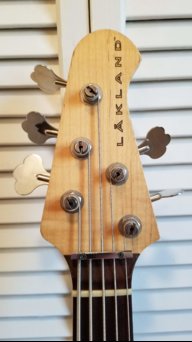
I started on 4 strings like most, but was curious about the fuss about 5 strings. After I bought my Lakland Dj5, it took probably 2 months before i was as comfortable on it as on my 4 string jazz. I've got small hands with short fingers, but the neck fits like a glove. Its also lighter than alot of 4 strings ive owned.

The 5 extra lower tones are great to have on hand to use here and there, but the other benefits like less shifting around on the neck are great too. Sometimes i will play higher on the b string instead of th e string because i want the slightly less 'focused' tone.

All that said, theres still nothing quite like a classic 4 string J!
 
  • Like
Reactions: Mr.Ace
Now, the world don't move to the beat of just one drum,
What might be right for you, may not be right for some.
A man is born, he's a man of means.
Then along come two, they got nothing but their genes.
But they got, Diff'rent Strokes.

I've played bass for 30 years. I had a 5 string G&L in '91...meh. I had a Schecter 5 in the early 2000's...meh. I have a Ibanez SR 305 now. Pretty cool. I have an Ibanez SR 406 now. Even cooler. I have 7 4 bangers. All are awesome. I play bass because I love bass. I only need the 4 strings I learned on. But, it's really neat to occasionally have an extra string or two. It really does not matter what you like what you do as long as it makes you happy.
 
It all depends on what style music you play. Some metal, gospel and R&B players would never get a gig if they didn't have AT LEAST an Eb, usually a C or B and maybe a Bb as well. Just picked up a 5'er after playing a 4 for 13 years and still adjusting to it after about 3 months of playing... I miss the feel of my 4 (which I did string BEAD and AEAD) because of the string spacing and balance, but 5 just opened up more possibilities. You have found what you like, stick with it OP!
 
  • Like
Reactions: FlatwoundFunk
I love my 4 string PJ and my 4 string J, and I'll reach for those most of the time if I'm playing for my own projects.

But I also regularly play a worship gig, and that means changing keys to match amateur singers at the drop of a hat. I'll grab my 5 every time in that scenario. I need to stay in a specific tonal space at that gig most times to avoid getting in the way of multiple guitars and synths, and the 5 allows me to keep the same voicings while just shifting my hand a fret or two either direction.
 
My understanding of the advent of the 5-string bass was to compensate for the introduction of keyboards into rock music, to better fill the low end due to the range of the keys.
It really depends on what kind of music your band is playing...For example, the band I joined recently has keys, and at first I played with my 5-string...but the material is more old-school punk oriented
and better served by the heavy growl of the p-style 4-string than a 5-string jazz bass, and so I switched up a couple weeks ago.
You wouldn't really want a 5-string for drop-D...you'd be likely better off tuning a 4-string's E string down a step along with the guitars. If I was gonna try playing that stuff with a 5-string, I'd toy with the
string gauge and tune the E down to D like the guitars and maybe put an A under it...or maybe even stack all five strings in 4ths rather than having the one 5th string-stack in the middle..which would be odd
but perhaps practical.
None the less, the 5-string has it's place...which is to get beneath the keys. If a classic rock band is playing in D or G with the keys in the low registers and you don't have that low string, the bottom can fall out.
 
  • Like
Reactions: FlatwoundFunk
So most 35" basses have weird G-strings. Many 34" basses have good to excellent B-strings. Plus, they only are 34"! Advantage: 34"

I wasn't so deep into four-string that I had huge muscle memory invested in it before giving fives a real try.

I LOVE being able to use the B-string for superior envelope control on what otherwise would be an open E. Advantage: 5-string.

I use those lower notes plenty - who wouldn't want some extra range so as to provide more variety in parts? Advantage: 5-string.

I also love being able to fatten the timbre by shifting down a string and up the neck - a killer resource. Advantage: 5-string

5-strings generally weigh a bit more. Advantage: 4-string

5-strings do require more attention to muting of open strings. Workable, but it's work. Advantage: 4-string.

4- strings "look" like rock and roll. Advantage: 4-string.

SO…consider which of these factors is important for you, and make your choice accordingly. But I have to note that when it comes to musical factors, the advantage generally lies with the 5.

For me, it's a no-brainer; a good 34" 5-string is pretty much my place in space.
 
I played only 4 strings for 35 YEARS and was reluctant to buy a 5 string, mostly because I was intimidated by the 5th string. I finally bought my first 5 string only 9 months ago - which is a Dingwall. Being able to visualize and play more linear due to the B string is HUGE. Ironically, I now find it more difficult to play a 4 string on most stuff. And that's only part of it. Playing sub-E notes on a 37" B string is orgasmic. Total game changer to add those notes, which I do frequently. Not just the open B. You also need the right amp and cabinet(s) to make those notes more usable and punchy - not just the right bass.
 
for a while I was playing with a few guitards that were using seven and eight string instruments.....I had to go to a fiver...

I got used to paying them really liked one in particular....

flash forward 5 years every time I brought out the five my current guitard got confused watching me play when he was trying to learn one of my songs....lol so I switched back to 4

eventually sold all the fivers...
 
  • Like
Reactions: FlatwoundFunk
Geez guys. Yes it's a free country/internetz. You can have whatever opinion you want. But what makes you think other people want to hear about what you don't like???

Great, you don't like 5-strings. Good for you. So what was your point?

And by the way, a good player can make a B string speak nicely. If you can't hear the difference between a low C and C#, something is wrong with either your rig or your technique.
 
I had a 5-string, and sometimes wish I still had it. Bought one in 1994, a EBMM Stingray-beautiful black with Maple neck/FB, dirt cheap. After playing it, whilst enjoying the foreign feel of it, I came to think of a fiver as being a bit superfluous, but an experience nonetheless. I sold it, regretfully, a year later (but at a profit). Every bassist should at least experiment with one. I am not currently GAS'ing for a 5-string, but if the right one comes along, I may give it another go.

Now that there are 4/5/6/7/8...-string basses in every conceivable price point, the world is your oyster. No reason not to try them out.
 
I'm all about playing what works for you and the music but I've gotta say, I think I'm going that route, too. Of the nine basses I've owned, two were 5ers. I currently own one that is 19mm string spacing and the flat, wide neck is like an aircraft carrier deck. The B on that bass is also garbage.

My other two basses are 4s and I love them. The necks on both are just marvelous and I wouldn't want anything else. Nothing against anyone who uses more strings; I've just found that I'm content with 4.
 
That's b flat, one of the standard horn keys. Most of what my band plays is in e flat or b flat, good for horns and good for keyboards. I can see where it would be nice to have the octave, IV or V, on a low b string, but not necessary.

Not necessary? What a celebration of limitation! It's not "necessary" that you play anything at all! But is is best? I've been playing bass for a VERY long time and most of those were on a 4 string bass. And a LOT of it was playing tunes in horn keys. So (since I actually started with piano lessons...check out the bass range on a piano) I started whining why do I have to go UP an octave to play an Eb? What kind of half-baked instrument is this anyway? Were I smart, I just would have tuned low E down to D and be done with it but nobody in those days down-tuned. So I suffered.

Personally I think a 4 string bass makes no sense. It's a historical artifact. It's simple as that. A bass with the low end range of a piano makes more sense (Which a 5er doesn't have, by the way). Once I got my first 5 string and later my first 6 string it was like "coming home"! No more having to jump up an octave. And playing across the neck make playing in any key a snap! Most of my use of the B string tends to not be those low notes that everyone thinks is the "only" reason you have a B string. And when I buy a bass the FIRST thing I check is how the notes on the B string compare to same notes on the E string. If they aren't indistinguishable I don't buy it. It's the same between open strings and fretted notes. Who would buy a bass where the character of the tone changes depending upon where you play it? It's like buying a bass that has dead spots and then whining about it.

Today it's like pulling teeth to get me to go back to a 4 string. Yech! The only one I put any miles on is my 8 string (doubled). One of these days I'll fork out for a 10 string and fix that problem too. There are certainly times when I don't need the range of my 6 stringers, and drop back to a 5. But to drop back to a 4 means you need to change how you play to deal with the limitations. And I for one don't want to do that now that I don't have to anymore!

I really don't understand how so many people have turned playing a 4 string bass into some kind of religion.
 
  • Like
Reactions: JustForSport
I really don't understand how so many people have turned playing a 4 string bass into some kind of religion.
It seems to be happening more and more on talk bass - 4 string bass, passive P, flats, first 5 frets, no fills, don't be noticed until you stop playing, knowledge of theory is bad, reading music is bad, originals are bad, etc.
It's a fetish for older simpler times I guess.
 
I'd think horn keys would be more of an historical artifact than the 4-string bass.

I played only 4 strings for 35 YEARS and was reluctant to buy a 5 string, mostly because I was intimidated by the 5th string. I finally bought my first 5 string only 9 months ago - which is a Dingwall. Being able to visualize and play more linear due to the B string is HUGE. Ironically, I now find it more difficult to play a 4 string on most stuff. And that's only part of it. Playing sub-E notes on a 37" B string is orgasmic. Total game changer to add those notes, which I do frequently. Not just the open B. You also need the right amp and cabinet(s) to make those notes more usable and punchy - not just the right bass.

This is pretty much how I feel. I guess I'm just naturally excluding Dingwall from the V category since it's so far above everyone else.
 
  • Like
Reactions: Gabbs