• TalkBass has been independent since 1998. Add your voice.
    Create a free account to reply to discussions, view embedded media, and browse with fewer display ads.
    Join freeLog in
    Want zero display ads or expanded classifieds tools? Compare plans.

Ibanez Portamento Club

The cavity appears to be painted with shielded paint but it's not very conductive (there's like 1.1 k ohms between the paint at two spots 1" apart).

It also doesn't seem to be grounded too well as there's 650 ohms between the strings/bridge and the output jack.

The cavity plate has foil tape on it, but there's nothing to ensure a good contact between it and the cavity paint other than the pressure of the screws holding it down. Has anyone added anything to help ensure a better connection, or better shielding/grounding?

With the complicated (and finicky) circuitry these seem to sometimes have, I don't want to add too much now in case there is a warranty claim within the next year.

I added a picture if anyone is curious to see it. Thanks!

9E181D59-E21C-487A-86B0-391719008F26.jpeg
 
The cavity appears to be painted with shielded paint but it's not very conductive (there's like 1.1 k ohms between the paint at two spots 1" apart).

It also doesn't seem to be grounded too well as there's 650 ohms between the strings/bridge and the output jack.

The cavity plate has foil tape on it, but there's nothing to ensure a good contact between it and the cavity paint other than the pressure of the screws holding it down. Has anyone added anything to help ensure a better connection, or better shielding/grounding?

With the complicated (and finicky) circuitry these seem to sometimes have, I don't want to add too much now in case there is a warranty claim within the next year.

I added a picture if anyone is curious to see it. Thanks!
706 (happiest) owner here.

always tricky judging when anyone else's hum is just a little hum, or a serious issue.

i for myself often hear fans whirring in bass amps like i was the last man on earth, while no one else seems to notice them... i mean, we mostly focus our attention to this or that (sonic) fault, depending on a number of factors.

having said this, i only study solo, and practice with pickups at a few inches from a whole dozen of dsp-based (digital) effects, and i'm obsessingly picky about noise, hum, uneven channels and non-linearity issues.

and, yes, my 706, too, has some residual, background noise.

i tend to finger it to pickups, for some reason: unlike other instruments of mine with humbuckers, turning sideways on my stool even a few degrees changes the spectrum of said hum, while playing at 90º off the effects table produces far less (or almost no) hum, although 90º orientation also means some 12-15" away from such effects.

but if all of your other instruments seem to hum anyway, as you seem quite dexter with a multimeter, before adding a filter of any sort, have you made sure that the grounding of your place's wiring system is functioning properly?

ashamed as i've been of myself, former sound engineer in my prime, always first to finger this or that piece of gear and all that jazz, it only took the proverbial electrician friend and his (blade) screwdriver to find out that the ac outlet powering my reference earstation had the earth screw loose... boo!

i felt every pound the absolute moron i'd been, and started to question each and every thing crossing my audio path (and the audio kit and path itself) since that episode of total, uncleansable sin and shame.

and, in the exercise, i found out that no piece in any kit, no matter how simple or complicate it is, no matter how expensive or exotic or plain cheap, no piece is ever a safe harbour, and nothing's a given truth (unless heard otherwise).

a true one happened to me, like it was something to be proud of, and it's just the opposite: a boutique amp, of the vacuum tube variety, and utterly expensive, bought brand new and made to order.

i returned because it hummed, and badly, albeit no other device was in sight, just instrument, cable, amp, and hum... its maker received it, plugged it in, tested it, said it was dead silent, and added you've wrapped the ac cable like new before shipping it back, no one ever does it, thank you.

to which i goes i didn't use the cable that came with it, no offence meant, but i have my own special ones, a really nasty python of a special ac cable... he said too bad, i'm sending you the amp back again, please plug the cable that's in its cardboard box before saying it's faulty...

and it was dead, dead silent, like a million-year old slab of granite, as was every possible device i plugged the "esoteric" 300 bucks cable with, even the cheapest ones, except that single super fancy amp, specifically. go figure.

at least in my setup, that 706's hum's negligible to my ear when i'm practising, and my 706 is so damn silky and responsive that i'd never put a sponge through its audio feed, for fear it took some of its grace away while soaking away some hum, because at 60Hz (or 50Hz where i'm based, there's plenty of bass tone happening, too).

...but that's just the old fatso of me speaking here, of course.

wish you can find the culprit, or a cure, or just find your own special reason to owe to your bass and love it as it is.
 
...or just find your own special reason to owe to your bass and love it as it is.
So true. I was dead-set on replacing the electronics and wishing it weren't so hard to make the piezos work with another system. Then I acquired another fretless and fell a bit out of love with my Porty and listed it on Reverb. Then after some time I picked up again and realized it's a special instrument just exactly as it was designed. I'm staying in the club!
 
Thanks @rbbrnck! I hadn't really thought of it before, but grounding may be the issue. Right now I only play through a USB Interface connected to my laptop, which goes through an adapter/transformer and then plugs in with a two-prong plug.

I really love the feel of the instrument and sound, I can dial the hum out by cutting the treble out of the magnetic pumps and use the piezo tone if I want some extra shimmer. It's not quite the same (not really getting the Jaco burp with it), butits fine. That's not really the sound I'm trying to coax with this bad boy anyway.

I may tinker with it a bit later, but right now, I'm pleased.
 
Thanks @rbbrnck! I hadn't really thought of it before, but grounding may be the issue. Right now I only play through a USB Interface connected to my laptop, which goes through an adapter/transformer and then plugs in with a two-prong plug.

I really love the feel of the instrument and sound, I can dial the hum out by cutting the treble out of the magnetic pumps and use the piezo tone if I want some extra shimmer.

i was for a long time disconnected, and only read your post today, @Matthew_84. two thoughts came with it, one dealing with the notion of hum, the other with the very nature of audio interfaces. which are indeed related, though i don't hold my writing in so high esteem to take for granted i can easily try to explain how.

i was wrongly interpreting the meaning of your "hum" description in its most germane sense, as in "60 cycles hum" (or 50, where i'm based); if you now describe how rolling treble pot off the mag pickups cures it, then it's not "hum" as in "60 cycles hum", and the likeliness of AC mains grounding issues in your home being the culprit might be totally off track.
"hum" is most often referred to a low frequency parasite noise centered around the AC mains frequency, i.e. 60 or 50 Hertz, and in a great number of instances due to the so-called "ground loop". if rolling the treble control off reduces its occurrence, than i was looking in the wrong direction, it's not at the lower end of the audio spectrum you're hearing it, it's at the higher.

but the matter with audio interface might have more ado with it, or at least it had in my experience, Portamento's behaviour aside.

i, too, run my rig at home through an audio interface, and today i believe that's quite a common scenario. i've made extensive use of a renowned USB interface which, although equipped with only 4x4 (analog) I/Os, is a worthy piece of (German) engineering; its maker claims it runs perfectly fine with only its own USB cable connected to my 2016 15" MacBook Pro.
and it's true, no need to wire up a separate AC psu, it works and sounds beautiful as it is.

that is, or was, until the moment in which i plugged in it a headphone/microphone piece of kit, the very model used on broadcast operations between camera operator and control.
which made it add a nasty high-frequency spurious noise, constant as hum would be, but in the high end of spectrum, sort-of "grainy" in character, like a "whining" sort-of background noise.

turns out the microphone on this headphone is unbalanced, in terms of electrical design, though it ain't mentioned in its specs sheet... and silly me i didn't think of it, as audio interface's maker is very clear in explaining how unbalanced sources must be wired [to balanced inputs] to avoid interference. so mine did this really pesky, nasty, high-pitched grinding whine.

which is when i feared something was messing up the grounding between laptop and interface, in a way i couldn't explain myself. so i bought the AC adapter that manufacter offers as an option, although again very clearly and honestly it claims "any good-quality one will do, provided it has exactly these specs". i bought the original one, and it's expensive, not to leave any stone unturned in my effort to tame the beast.

bang, gone. whirring noise disappeared. now, dead silent. heaven.

at which, i finally plugged back my fx setup on the (remaining) unbalanced pair of inputs, and it's quite a big tableful of digital stompboxes i have here, all powered through specialized PSU precisely to avoid grounding noise. and now, gosh, for the first time ever, they were horribly noisy, though they had never been before!

my luck was, i had gone through the process of adding the interface PSU only minutes before, so i had at least the advantage of being able to point the finger to the only box in the block-diagram scheme that had been changed, and focus my attention to observing the change.

i took the interface's PSU away from its inlet, and the stompbox chain was silent again, though the heaphone mic got noisy again... so it looked like an even/odd chance, choosing which one i wanted to live with, and the stompbox empire is much more of a daily tool for me, while vocal processing happens seldom... so i bought a different piece of headphone/mic anyway, with a balanced mic, which didn't scream "grrrrounding" issue.

but i can't easily live with faults in my audio chain, for it's been my job and obsession for this entire lifetime, and i kept searching for a reason to explain it, and kill it, possibly. and got to finally close the case on the MBP's power supply, which was plugged into the power strip with its 2-pronged adapter, and as such had it been for all its life without an issue.

i used then the real thing, the 3-pronged AC plug that's wired to the Apple PSU, which comes in its very box, but which i had left there since day one because it's bulky... and plugged the "old" headphone/mic intercom piece into the interface. and it was finally perfect, dead silent as it was ever meant to be (if you wired it according to the interface's manufacturer instructions), with or without the external interface PSU, with or without the stompbox empire plugged in 3+4 inputs, with or without the laptop switched on.

took me months, though this doesn't speak greatly of my effort, because i work a day job and i struggle to practice my playing in what few spare moments i'm left with, while troubleshooting audio issues is still first nature to me, although it's no longer allowed in my lifestyle on top of my priority list.

and i don't know how this would have turned out if the laptop hadn't had the two different PSU options like all Macs have... but it's also fair to say that maybe it wouldn't have happened with a sturdy, solid and bulky brick-sized PSU like those that powered business-grade HP laptop PCs in the first instance, though.

how do you turn this full-length rant into something useful to cure the issue that's taking some pleasure off your SRF705?

my 5 pennies of advice are offered for free, today: change each and every piece of your kit along its way, no matter how meaningless it may seem to you in audio terms, but only do it gradually, one by one, assessing the outcome for as long as you can, days or weeks, before turning the next cable or connector replaced with a different one.

i'm getting old and i need all the help i can get, so i now keep all changes logged onto an exercise book, which allows me to get back to the previous "version" when my recollection fades out. i now mark cables with a number, for this exact purpose, otherwise i wouldn't know which is which after a while... but i can tell you, i have set aside some USB cables that "hum" merrily with this or that interface or performance controller or stompbox, as i have USB hubs that either take that "hum" away (at the expense of some added latency) or add it to what else.

which is, in a way, reassuring for the old self of mine: everything audio was analog, in my prime, the only thing digital was the alarm clock on the bedstand, and audio wasn't tamed easily (unless you knew your way around your hardware); when everything turned digital, it came advertised as the triumph over the evil forces of signal degradation, no more distortion, no more hum, no more diseases. which isn't true, of course, but which serves the purposes of speeding up the adoption curve of any new gizmo that comes our way, newest is always best and all. which isn't necessarily true, as we often find out in audio, and musical instruments, too.

and now, to welcome the new year knocking on my door, i've just elected the day to cutting a new ebony nut for my SRF706, in order to replace the cheap, plastic one that comes stock with it. and, maybe, to find out that the cheap, plastic one that comes stock with it may sound better than the new one i'm about to cut with that piece of ebony i've kept in store for the last five or six years, stashed in my "you never know" drawer. along with (unmarked) USB cables yet to try out! :-)
 
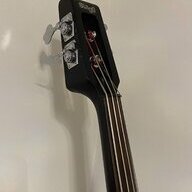
20190118_013954.jpg


I've had her since October. I've removed the bridge pickup. Put black strap locks on with a nice Levy's strap. I mounted the strap button on the bridge side of the neck pickup as a thumb rest.

I've just got a set of round wounds to replace the stock flats. The strings took a loooong time to stabilize. But, it does seem to be relaxing, so I think I will hold off on swapping to rounds for now.

The right hand string spacing is a little tight, but, overall it's super playable.

I'm still dialing in the sound, hence the purchase of the rounds. I dig it, though. It has such a drastically different tone with my thumb positioned on the neck edge compared to the strap button side.

Really enjoyable to play.

Cheers, Supadope.
 
  • Like
Reactions: rbbrnck
I just bought a SRF705 from Sweetwater. It's my first 5 string and my first fretless (after 45 years of playing 4 string fretted). It seems that the neck p/u and the bridge p/u have good strong volumes individually but when I try to turn the volume up on both the volume goes down. The tech at Sweetwater said that since they're humbuckers wired in series that it's normal behavior. BS or not?
 
That's not bs in my experience. On my basses with V/V knobs, I usually get the best sound with the neck pickup up all the way, and I back off the volume of the bridge pickup to avoid that cancelation area.

Same thing with Vol/Blend. I never have the blend in the center. I always have it blended to the neck side just a bit.

Sweeter tone and better volume.
 
  • Like
Reactions: cyshift
That looks like a nice one. One thing that strikes me about yours is that the body wings look to be 1 piece per side. Mine is clearly 2 pieces on both the top and bottom. My sticker is covering an ugly line where the grains do not match up.
 
That looks like a nice one. One thing that strikes me about yours is that the body wings look to be 1 piece per side. Mine is clearly 2 pieces on both the top and bottom. My sticker is covering an ugly line where the grains do not match up.

As far as I can tell they are 1 each. Sweetwater had two and that one did not look to have multiple pieces. The other one looked more pieced together. I would think construction would be similar since that would be part of quality control. Even though the wood might be a little different, hope yours is a pleasure to play.
 
Hello rickster4003, #54 is yours.


Ibanez Portamento Club

1. vmabus #0
2. tellheryousawme #1
3. Jazzbrew #2
4. PaulNYC #18
5. aproud1 #4
6. Idle Plucker #5
7. Awesome Sauce #7
8. ransombass #8
9. Gee Phil #9
10. Ibby #10
11. Marcel66 #66
12. hiredlenz #12
13. Grand Moff Tim #13
14. brossmac #14
15. steelbed45 #15
16. audionut36 #16
17. MethodsofDance #17
18. Kico #19
19. Stellvia #20
20. Bassconbeatz #21
21. Dum Bass #22
22. bherman #23
23. Flabzilla #24
24. gary m #25
25. slap2much #26
26. cchorney #27
27. Aidil #28
28. BassJuju #29
29. Jezza #30
30. thirtyhz #31
31. Christoph #32
32. Coriolis #33
33. Guittarman10 #34
34. Dana R Gregory #35
35. web824 #36
36. mike4bass #37
37. kirkdickinson #6
38. newb #38
39. raphaeld #39
40. Hunter34 #40
41. sinewavemattic #41
42. Michael Jewels #42
43. xshawk #43
44. Adam Blaknovski #11
45. B-Mac #45
46. animus.terry005 #46
47. Spblat #47
48. BritFunk #48
49. Todd McIntosh #49
50. JCKA #50
51. rbbrnck #51
52. EnVico379 #52
53. GlueKill #53
54. rickster4003 #54
 
  • Like
Reactions: rickster4003
Hello Guys.
I own a 6 string Portamento recently bough (1 month) here in Chile and have a problem that maybe you can help me figure out.

Neck is pretty flat, no buzz, no dead notes, action very low. Good sound on pickups and piezo.

The problem is that I can't get the intonation setup done right.
If a tune all the open strings in standard tunning then when I press the 12th "fret" all notes are way flat.
For example if I want to get a D on the 4th string 5th fret I have to move my finger to the 6th fret, unacceptable.

I've tried the tutorial from Gary Willis web to set intonation but when I move the saddle to shorten the string, nothing happens, nothing.

Please help me with your experience. It is that hard to setup intonation?

Kind regards.-
 
Hello Guys.
I own a 6 string Portamento recently bough (1 month) here in Chile and have a problem that maybe you can help me figure out.

Neck is pretty flat, no buzz, no dead notes, action very low. Good sound on pickups and piezo.

The problem is that I can't get the intonation setup done right.
If a tune all the open strings in standard tunning then when I press the 12th "fret" all notes are way flat.
For example if I want to get a D on the 4th string 5th fret I have to move my finger to the 6th fret, unacceptable.

I've tried the tutorial from Gary Willis web to set intonation but when I move the saddle to shorten the string, nothing happens, nothing.

Please help me with your experience. It is that hard to setup intonation?

Kind regards.-
Intonation setup hasn't been a problem on my 705. You might need to apply a little light pressure to the adjustment screw to make sure it's flush with the back of the bridge, to push the bridge piece forward after slackening off.
Hope this helps.
 
Hello Guys.
I own a 6 string Portamento recently bough (1 month) here in Chile and have a problem that maybe you can help me figure out.

Neck is pretty flat, no buzz, no dead notes, action very low. Good sound on pickups and piezo.

The problem is that I can't get the intonation setup done right.
If a tune all the open strings in standard tunning then when I press the 12th "fret" all notes are way flat.
For example if I want to get a D on the 4th string 5th fret I have to move my finger to the 6th fret, unacceptable.

I've tried the tutorial from Gary Willis web to set intonation but when I move the saddle to shorten the string, nothing happens, nothing.

Please help me with your experience. It is that hard to setup intonation?

Kind regards.-

A full fret off! That is huge. My 705 came set up pretty much on the money. Just to be sure, you are putting your finger on the fret line itself, right? I added markers on my 3,5,7,9,12...

1ADB6FCC-A2FB-4FB3-91B7-001BC9C84E19.jpeg
 
  • Like
Reactions: comatosedragon
Hello Guys.
I own a 6 string Portamento recently bough (1 month) here in Chile and have a problem that maybe you can help me figure out.

Neck is pretty flat, no buzz, no dead notes, action very low. Good sound on pickups and piezo.

The problem is that I can't get the intonation setup done right.
If a tune all the open strings in standard tunning then when I press the 12th "fret" all notes are way flat.
For example if I want to get a D on the 4th string 5th fret I have to move my finger to the 6th fret, unacceptable.

I've tried the tutorial from Gary Willis web to set intonation but when I move the saddle to shorten the string, nothing happens, nothing.

Please help me with your experience. It is that hard to setup intonation?

Kind regards.-

A whole fret off? I don't think that is even possible. To move a note that far at that location on the neck would require a huge increase in scale length. Not just a little tweaking on intonation.

I assume by 4th string you are counting from high to low, C-G-D-A? 4th string=A string?

Is this your first fretless?

I have a SRF 706. I can take some measurements and show where my intonation is set. Yours can't be off from mine more than just fractions of an inch to account for spring type and slight differences.
 
Last edited:
  • Like
Reactions: tfer
Hello Guys.
For example if I want to get a D on the 4th string 5th fret I have to move my finger to the 6th fret, unacceptable.

I assume you mean play a D on the A string? If your A string sounds a D at the 6th fret position, you are tuned wrong, you have a different scaled instrument, or you are having issues with an unlined fretless.

I popped onto stewmac.com and used their fret position calculator. On a 34" scale instrument the 5th fret would be at 8.529" and the 6th fret would be at 9.958". The fret positions are all math. If you are getting a D at the 6th fret on a string properly tuned to A string, then your bass has to have a 39.697" scale length. That length is into doublebass territory.

Please measure from the nut to your 5th fret. 8.529", I did the conversion to metric because you probably use that nut to 5th fret is 216.731mm.

Please report back. :)
 
Last edited:

Latest posts