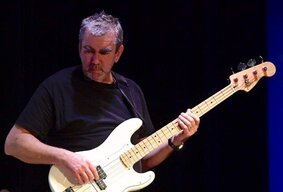
It is fairly normal to set auxes pre EQ. The idea is channel EQ should be used to make the house mix sound good. This means the sound of your bass coming back to you in your mix is flat. Not everyone finds flat desirable.
As indicated you have global EQ for the mix, this can help but it does not allow you to use any sort of frequency slotting. You should be able to use your SansAmp Para Driver, or some other sort of preamp, to dial in a sound for your bass. As suggested, don't go too crazy boosting the lows. In fact, if possible have the audio tech pick off your IEM signal post HPF, to limit how much sub bass is coming through your IEMs. IMHO most, if not all channel sends should be set up post HPF, otherwise the lows can bleed through open mics and degrade clarity in all of the mixes.
A frequent and often effective recommendation to improve clarity of the bass is boost the mids. Which frequency to boost depends on what you like to hear. The Para Driver has sweepable mids, so experiment to find the frequency range you like.
Although, it may not be appropriate for you use a noticeably distorted tone, you may find that pushing the Drive up just below the point of saturation helps you hear better.
A strategy that I use when I run the house mix and monitors, is to set up the board for a balanced house mix when all faders are at the same position. The advantage of this is it gives me a visual reference to quickly set up and manage the monitor mixes.
I build a custom monitor mix for everyone before sound check starts. I find that most people want to be about 6-10dB louder than other elements in their mix. So if someone sings and plays and instrument, I give them a balanced mix, and then bump their vocal and instrument channel by 6-10dB. This provides a really good starting point for most people. Some are totally satisfied, while others ask for adjustments that are often relatively minor.
You may not necessarily want or need to hear every sound source. If there are non-critical channels, dial them down about 10dB. For non-critical sound sources that bleed through other channels, consider muting them. For example if the drum set is fully mic'ed, you probably don't need to hear every single mic on the drum set.
A stereo IEM mix can be a great improvement over mono. With a mono mix, everything is in the center and the mix tends to get cluttered and incoherent. A stereo mix spreads out the different sound sources, which makes it easier to distinguish between them.
Here is the strategy I use to build a stereo mix. The lowest instruments and snare go dead center. Then each person's sound sources goes center or near center. Everything else is mixed either left or right in 3 to 5dB intervals. The idea is to try and create a mix that sounds natural. Most sound sources should not be panned more than about 15-20dB.
If possible mixing in some sort of ambient effect like a good stereo reverb can help make the space seem a more authentic/realistic. Also, a good reverb can help singers with intonation.
Stereo reverbs are the one possible exception to the panning rule. Stereo reverb may be panned 20dB or more. Hard panning a reverb may still leave sort of a hole in the middle, but you can try it and decide for yourself. Optimum panning can vary with the characteristics of the reverb.
Compression on monitor mixes can be problematic. If a singer is compressed in their mix, it tends to make them feel disconnected from their voice. This can lead to over singing, which may cause them to blow out their voice.
Compression can also cause problems for instrumentalists. Compression lops of the transient peaks and limits dynamic range; so you may have trouble hearing on the loud parts of songs. When you can't hear well enough, you tend to overplay. This can tire out your hand or result in injuries such as blisters.
For the record, I don't compress my bass sound on stage, but when I mix, I use compression on many sound sources.