• TalkBass has been independent since 1998. Add your voice.
    Create a free account to reply to discussions, view embedded media, and browse with fewer display ads.
    Join freeLog in
    Want zero display ads or expanded classifieds tools? Compare plans.

If a tree falls in the forrest do pickups actually make a difference

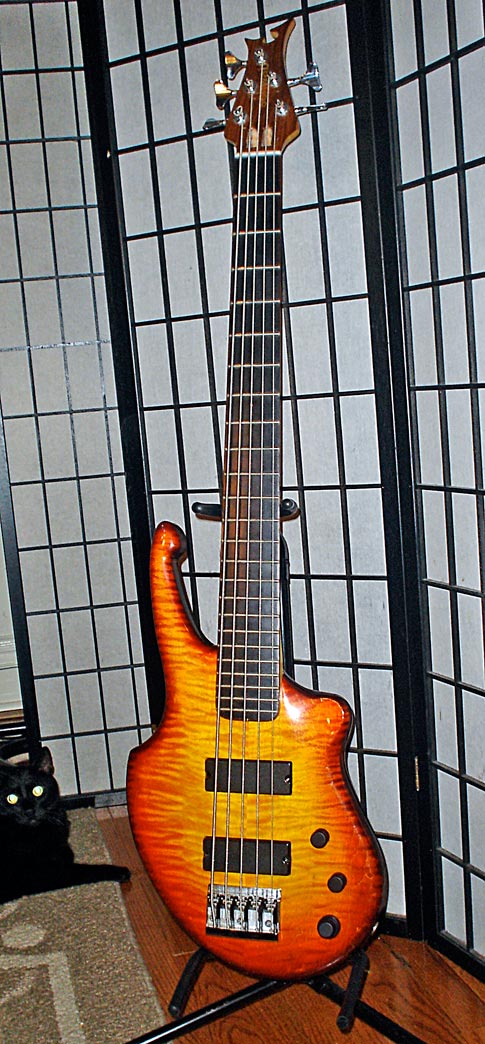
From real life experience; my '87 Ibanez SR-885LE—basswood body, 3 piece bolt on maple neck with Indian rosewood FB—sounds very different than my SGD Scorpio bolt on—cherry body, curly maple top, 7 piece maple/walnut neck, phenolic fingerboard, 2 truss rods and graphite, using the same strings and pickups. The Ibanez has my Jazzbuckers, but I have also tested on them on the Scorpio, but in different cases (narrow aperture neos):
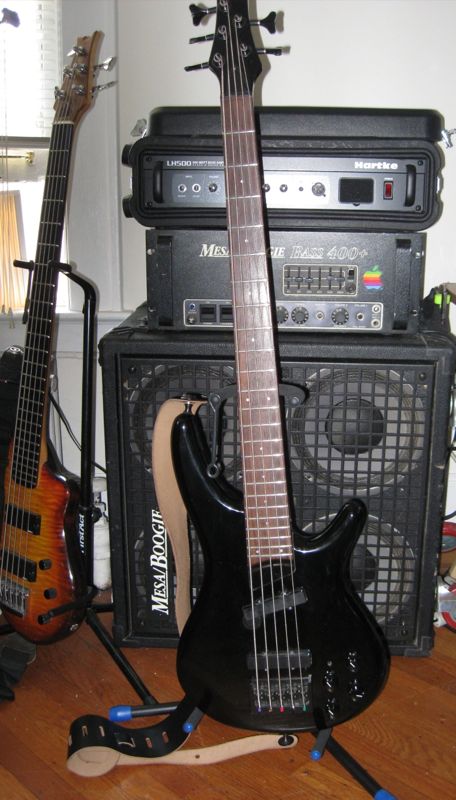
87_sr885_le_mesa.jpg
S5_new2.jpg


Then you have these two basses, which are made from the same wood, from the same boards, but have different tops:
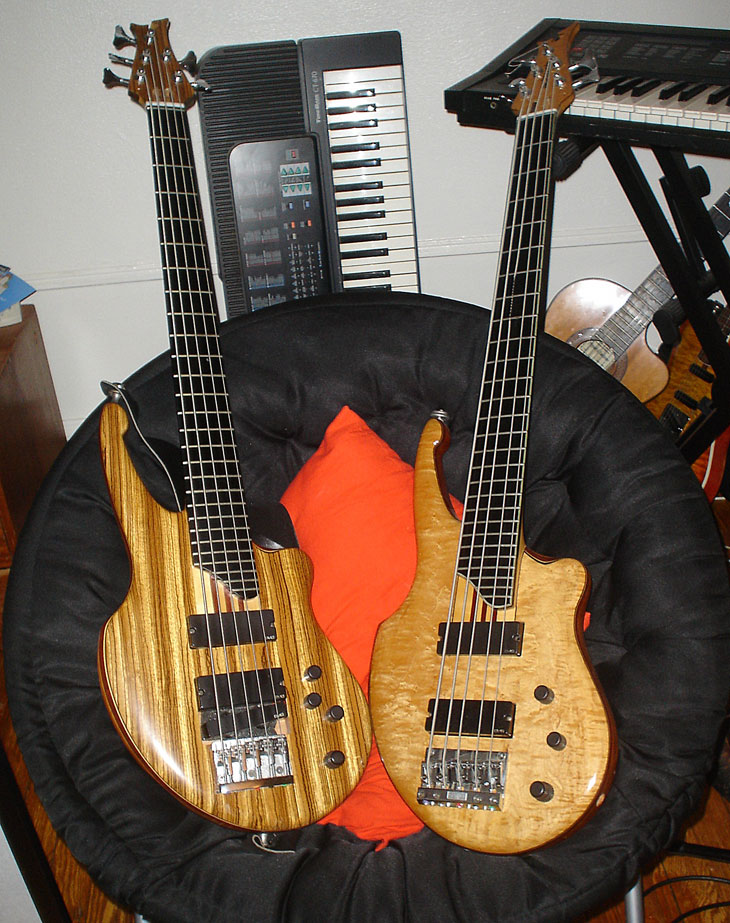
SGD_Scorpios_front.jpg


This is an old photo of them, but later, both sporting Hipshot bridges, and my pickups, the zebrawood bass is darker sounding than the maple top bass. Even when unplugged.

Back view:
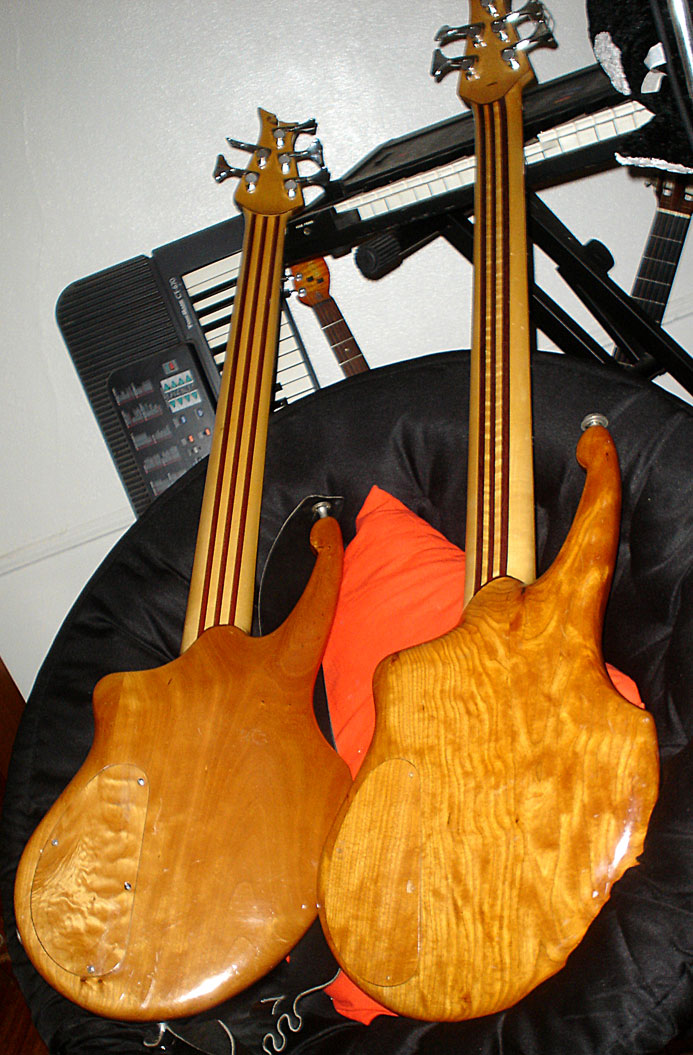
SGD_Scorpios_back.jpg


So, every part of the bass affects the tone somewhat. It's all a big stew that mixes together to get the end result.

Are the pickups in the same place? Are they the same exact pickups? Same EQ you're using on the tone knob? Not saying wood doesn't have an effect, but there's a lot of confounding variables in your accusation.
 
Well, it depends what you mean by General Consensus. If you take a vote of people who post here on TB, you might get a majority who say that the body can be made out of any kind of wood, and it won't make any difference. It doesn't matter that the evidence against that is overwhelming, it's a cult thing here on TB. That's what they want to believe. It's some kind of a religion, I think.

If you ask us Luthiers, we will strongly disagree with that "Wood Doesn't Matter" stuff. We'll list charts of examples, write pages of technical dissertation, or even cover a blackboard with equations. But it doesn't matter. Most of the class isn't listening, and they view us with contempt. That's why very few of us even bother to answer posts like this any more.

If you want to get an answer to a technical question by taking a popular vote, then I can't help you.
 
Well, it depends what you mean by General Consensus. If you take a vote of people who post here on TB, you might get a majority who say that the body can be made out of any kind of wood, and it won't make any difference. It doesn't matter that the evidence against that is overwhelming, it's a cult thing here on TB. That's what they want to believe. It's some kind of a religion, I think.

If you ask us Luthiers, we will strongly disagree with that "Wood Doesn't Matter" stuff. We'll list charts of examples, write pages of technical dissertation, or even cover a blackboard with equations. But it doesn't matter. Most of the class isn't listening, and they view us with contempt. That's why very few of us even bother to answer posts like this any more.

If you want to get an answer to a technical question by taking a popular vote, then I can't help you.

I have read through thousands of these does wood matter arguments, I have yet to see any evidence given in either case. Your overwhelming evidence is the opinion of Luthiers, not all of them share your opinion btw, who can profit from people believing the tonal characteristics of wood are real and ever present.
 
I go back and forth on this wood topic. When I started out, I really didn't care what wood was used. I either liked a bass or I didn't. Then I got a couple of basses made by the same builders that used the same woods but different body shapes, hardware, and string count (a 5 and a 4). Acoustically they couldn't sound more different, but they had the same pickups, and when plugged in they sounded identical. I'd also go play P and J basses made of different woods at stores, and as long as they had the same pickups, I really couldn't tell much difference at all.

Then I bought a 95 P Lyte with a basswood body. The original pickups sucked ass, so I replaced them with a couple vintage style pickups, one of which resided on this PJ copy I built out of parts and sounded awesome on it, and on the Lyte it sounded weak and thin. Had to switch to overwounds to get any balls, and now it has EMG PJ's on it and it's got serious balls.

So I believe it's not the wood itself that matters but its density. And I've also come to the conclusion that I was right all along, that all that matters is you get a bass you like and not worry about what it's made of, and obsessing about it is pointless.
 
I have read through thousands of these does wood matter arguments, I have yet to see any evidence given in either case. Your overwhelming evidence is the opinion of Luthiers, not all of them share your opinion btw, who can profit from people believing the tonal characteristics of wood are real and ever present.

How is it any different from a company profiting by using mfd or poplar to cut costs? Those companies would be perfectly happy not debating the merits of one wood over the other. I think part of it is some self justification for someone that owns a bass made of cheap wood or particle board to say wood doesn't matter. I also think the same applies to someone with 17 layers of Macassar ebony, bubinga and spalted fairy farts. Everyone's gotta feel good about what they have and the arguments do that for them.
 
How is it any different from a company profiting by using mfd or poplar to cut costs? Those companies would be perfectly happy not debating the merits of one wood over the other. I think part of it is some self justification for someone that owns a bass made of cheap wood or particle board to say wood doesn't matter. I also think the same applies to someone with 17 layers of Macassar ebony, bubinga and spalted fairy farts. Everyone's gotta feel good about what they have and the arguments do that for them.

Because they can charge way more than they spend on exotic woods, and would make more than they would save on cheap stuff. If anyone is being honest, they would just say that a burl or quilt top is purely for aesthetics, and the wood chosen for the core of the body is a good color match for the top wood.
 
Because they can charge way more than they spend on exotic woods, and would make more than they would save on cheap stuff. If anyone is being honest, they would just say that a burl or quilt top is purely for aesthetics, and the wood chosen for the core of the body is a good color match for the top wood.

And if Squier were being honest, they wouldn't be painting over their Affinity models? I'd wager the profit margins are fairly close, respectively.
 
I have read through thousands of these does wood matter arguments, I have yet to see any evidence given in either case. Your overwhelming evidence is the opinion of Luthiers, not all of them share your opinion btw, who can profit from people believing the tonal characteristics of wood are real and ever present.

I've read thru thousands of these posts as well and have yet to see any concrete or scientific evidence given to support or refute wood matters claims. So what we have left is personal experience and prevailing thoughts on the issue from those actually constructing the instruments.

I'd guess that for every one luthier that feels wood doesnt matter to the sound of a bass there are thousands of luthiers that feel it does. In fact I'm hard pressed to even come up with a single luthier that feels wood does not impact the tone of a bass. Even Dan felt that different neck woods could impact tone if the wood difference is drastic enough.

So prevailing thoughts by the professionals making the instruments say wood plays a role in the sound of a bass and so does my personal experience. That's good enough for me right now.

However, if your point is that the impact is so small it would never be noticed in a mix then I think you have a valid point under the vast majority of "mixes" that include a bass. But the same could also be said for hitting an occasional flat note by accident, and I'm not about to go out on a limb and claim tuners don't matter or accurate fretting doesn't matter. They both do, just as wood does.
 
I've read thru thousands of these posts as well and have yet to see any concrete or scientific evidence given to support or refute wood matters claims. So what we have left is personal experience and prevailing thoughts on the issue from those actually constructing the instruments.

I'd guess that for every one luthier that feels wood doesnt matter to the sound of a bass there are thousands of luthiers that feel it does. In fact I'm hard pressed to even come up with a single luthier that feels wood does not impact the tone of a bass. Even Dan felt that different neck woods could impact tone if the wood difference is drastic enough.

So prevailing thoughts by the professionals making the instruments say wood plays a role in the sound of a bass and so does my personal experience. That's good enough for me right now.

However, if your point is that the impact is so small it would never be noticed in a mix then I think you have a valid point under the vast majority of "mixes" that include a bass. But the same could also be said for hitting an occasional flat note by accident, and I'm not about to go out on a limb and claim tuners don't matter or accurate fretting doesn't matter. They both do, just as wood does.

I never said it doesn't have its effect, well at least fretboard wood, like Dan says. I am arguing against the notion that pickups just amplify and color the natural tone of the wood, and that the wood is the primary contributor to the tone of an instrument.
 
How is it any different from a company profiting by using mfd or poplar to cut costs? Those companies would be perfectly happy not debating the merits of one wood over the other. I think part of it is some self justification for someone that owns a bass made of cheap wood or particle board to say wood doesn't matter. I also think the same applies to someone with 17 layers of Macassar ebony, bubinga and spalted fairy farts. Everyone's gotta feel good about what they have and the arguments do that for them.
MDF is not wood.

MDF is really thick paper.
 
Interestingly, I started this post because like JimmyM I have a fender p lyte that is amazing to play but sucks when plugged in. I loaded it with SD quarter pounds...and it still sounded thin. As you all know quarter pounds in most basses do not sound thin.

So next I replaced the preamp with SD pre...and ordered some proactives to put in. if this still sounds thin we can safely say their is another element at play (and I have owned the bass for 15 years and tried every string known to man...and some that are not...).

So next variable becomes either the body or neck. Despite different pickups I can always hear the colour the neck adds to the tone...but I do not believe the neck is causing the underlying thinness.

Needless to say I will be getting a 6x10 ampeg in november, which will go well with my tube custom made and hot rodded head. Ampeg will fix everything lol.
 
On what planet?
Invalid Link Removed

Ok a body blank is generally around 4.5 board feet, in a body blank. This is assuming its a bolt on neck slab body. We are using pricing from the second website you posted as the first doesn't offer 8/4 Alder, and the third doesn't even sell lumber.

At $3.00 a board foot for Alder, 4.67 board feet comes out to an even $14.00 for the body blank.

At $2.25 a board foot for Poplar it comes out to $10.25 for the body blank. For a whopping difference of $3.75 difference between the two. So for all intents and purposes they are the same price.

You are talking to a person who has built guitars from both types of lumber. Poplar is fine, but its stringy and gets furry when sanding and finishing it, so I prefer alder. But on a solid color instrument I will use either.
 
Ok a body blank is generally around 4.5 board feet, in a body blank. This is assuming its a bolt on neck slab body. We are using pricing from the second website you posted as the first doesn't offer 8/4 Alder, and the third doesn't even sell lumber.

At $3.00 a board foot for Alder, 4.67 board feet comes out to an even $14.00 for the body blank.

At $2.25 a board foot for Poplar it comes out to $10.25 for the body blank. For a whopping difference of $3.75 difference between the two. So for all intents and purposes they are the same price.

You are talking to a person who has built guitars from both types of lumber. Poplar is fine, but its stringy and gets furry when sanding and finishing it, so I prefer alder. But on a solid color instrument I will use either.

Not to hijack any further, but a difference of $3.75 adds up for a company buying raw lumber. A $3.75 difference between two gas stations would make the choice pretty clear if you drove 10mi to work every day, wouldn't it?
 
Not to hijack any further, but a difference of $3.75 adds up for a company buying raw lumber. A $3.75 difference between two gas stations would make the choice pretty clear if you drove 10mi to work every day, wouldn't it?

If a tank of gas at one station was $3.75 more a gallon at one station, then another, then I would go to the one that was closer to me. If one was 3.75 a gallon more than the other one, then that would be a huge difference on a full tank, and that station wouldn't sell much gas.

You cant be dense enough to actually believe that a $3.75 difference between two body blanks will have any kind of meaningful impact on the final price of an instrument. There are more than $3.75 worth of screws in a bass. So its a nominal difference to a small builder. A large company buying large quantities of lumber in bulk, will pay much less for their lumber than a small builder, so the price difference will get even smaller.
 
I loaded it with SD quarter pounds...and it still sounded thin.

That doesn't sound right.

I'd look at two things first.

1) cap value
If it's a .022uF or .047uF you could temporarily clip/twist an additional cap to increase the value. That will knock off some of the high end.

2) pickup - height and wiring
1/16" increments in pickup height will have a noticeable effect on tone. Try raising and lowering it (take measurements) and see if it improves.
Also, if you didn't get it new, it could be wired wrong. Are the coils wired in series RW/RP as usual for a P bass?
 
If a tank of gas at one station was $3.75 more a gallon at one station, then another, then I would go to the one that was closer to me. If one was 3.75 a gallon more than the other one, then that would be a huge difference on a full tank, and that station wouldn't sell much gas.

You cant be dense enough to actually believe that a $3.75 difference between two body blanks will have any kind of meaningful impact on the final price of an instrument. There are more than $3.75 worth of screws in a bass. So its a nominal difference to a small builder. A large company buying large quantities of lumber in bulk, will pay much less for their lumber than a small builder, so the price difference will get even smaller.

I guess I'm dense then. All this time I thought Fender wasn't using alder or ash on their Squier line because there were cheaper woods available. What was I thinking?
 

Latest posts