• TalkBass has been independent since 1998. Add your voice.
    Create a free account to reply to discussions, view embedded media, and browse with fewer display ads.
    Join freeLog in
    Want zero display ads or expanded classifieds tools? Compare plans.

If a tree falls in the forrest do pickups actually make a difference

I think it would be more accurate to say they magnetically induce the current to flow in the coil. But yeah, they are variable reluctance transducers. :)

They don't put anything out that isn't there, and they actually remove some of the sound of the strings. Pickups are kind of like low pass filters, with a resonant peak right before the drop off. Some also start to get a band pass response, with less low end, but that's not as common. More often the upper midrange overshadows the low end and makes the pickup sound very bright. Passive setups can only take away from the sound.

Now the important thing here is that the structure of the bass affects the way the strings vibrate, and that in turn affects what the pickups "hear".

Then the pickup further filters that result, with some sounding brighter or deeper, etc. The aperture, or width of the string sensing area affects what high frequency harmonics are reproduced, and at what level.

So high impedance pickups can be thought of as a microphone with built in EQ. Low impedance, or piezo pickups will produce the full range of sound the strings/bass is making, and with less deviations to the response. And also note that most active pickups, like EMGs, are not low impedance coils, but they have a low impedance output.
 
Okay, I'll play the "percentage" game.

STRINGS: Produce 100% of the frequencies available
STRUCTURE: Damps out maybe 10-25% of those frequencies in the string's vibration.
PICKUPS : Transduce magnetically a portion of the remaining frequencies

Pre-amp and amp: Get to play with whatever's left.

This I'll completely agree with!
And different strings will sound different but still produce 100% of the frequencies.
And different pickups will sound different but still only deliver a portion of the frequencies that the bass body/neck wood and construction method hasn't dampened out.

If using this logic one could assume an ultra light basswood body with a single piece bolt on maple neck will dampen string vibrations differently than an ultra heavy Macassar ebony body with a multilam maple/ebony/purple hart neck thru construction. The former dampening closer to the 25% end of the range and the latter dampening out closer to the 10% end of the range. Is that a correct assumption?

PS - I understand the percentages are arbitrary but directionally I agree with them.
 
If using this logic one could assume an ultra light basswood body with a single piece bolt on maple neck will dampen string vibrations differently than an ultra heavy Macassar ebony body with a multilam maple/ebony/purple hart neck thru construction. The former dampening closer to the 25% end of the range and the latter dampening out closer to the 10% end of the range. Is that a correct assumption?

From real life experience; my '87 Ibanez SR-885LE—basswood body, 3 piece bolt on maple neck with Indian rosewood FB—sounds very different than my SGD Scorpio bolt on—cherry body, curly maple top, 7 piece maple/walnut neck, phenolic fingerboard, 2 truss rods and graphite, using the same strings and pickups. The Ibanez has my Jazzbuckers, but I have also tested on them on the Scorpio, but in different cases (narrow aperture neos):

87_sr885_le_mesa.jpg
S5_new2.jpg


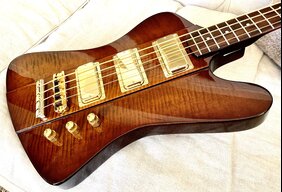
Then you have these two basses, which are made from the same wood, from the same boards, but have different tops:

SGD_Scorpios_front.jpg


This is an old photo of them, but later, both sporting Hipshot bridges, and my pickups, the zebrawood bass is darker sounding than the maple top bass. Even when unplugged.

Back view:

SGD_Scorpios_back.jpg


So, every part of the bass affects the tone somewhat. It's all a big stew that mixes together to get the end result.
 
GBassNorth... That's pretty much what I was thinking.
The percentages are just a guess, but you certainly got the idea. It's a mostly subtractive process.

That's exactly my experience as well on the few bass builds I've done.
Great post and excellent insight on how best to capture the true impact wood has on a bass build.

SGD - that's some fine looking bass builds you have there and I'll second your earlier comment about dead spots. I have a number of basses with them and a number without them. I've always felt that a good luthier plans their construction and selects their wood carefully if they want to eliminate the potential for dead spots. Looks like you are one of those luthiers that does it right! Keep up the great work and post more photos:smug:
 
"Don't forget that the pickups also move."-
Correct, but how much relative to the strings?
In my experience, replacing a single unit multi-string bridge with single-string bridges (on more than one bass) made a noticable difference due to less sympathetic vibration from adjacent strings.
Any vibration felt in the bass body moves the pickups- as you stated-, adding content,
and as a result, it also potentially cancels out some content.
Would be difficult to measure the relative affect, but would have interesting results.
That could show the affects of diff constructs, for sure.
 

Latest posts