Hi, and thank for immersing into this lenghty post.
I’ve been practising slow vibrato on 3 octave scales (bowing). The excersise goes very slow, I usually play a single scale once up and down for perhaps 20 minutes. During the excersise I often lose my intonation, as the tones are very long, somewhat smeared by vibrato, and tiring. So I developed a range of intonation dummies based on harmonics, which I use to verify my intonation. Most are obvious, some perhaps not.
I wanted to ask what method of strenghtening intonation feel on very long tones others use, and whether the dummies I use might contain some errors. For example, dummies 9 (f#2) and 11 (b2) should theoretically sound a bit lower than right tempered intonation, but to my ears they are accurate more than any other method of intonation control I can think of.
I don’t want to use drones or even look at tuners, I think I’m past that stage. I don’t have intonation problems when playing into other sounds; I’m trying to develop a solo intonation feel and find these scale excersises very effective.
I’m also curious whether non bowing players use any range of intonation dummies of similar kind.
The example is B harmonic minor from Rabbath 3; it’s not important, any scale works, some offering more dummies, some less. However, Rabbath scales often prefer higher positions on lower strings, likely for pedagogical reasons. From what I hear, on lower strings the impact of bowing technique on intonation is higher. I wouldn’t be surprised if someone told me that low strings harmonics (like b on E string) might be out of tune due to impact of bow.
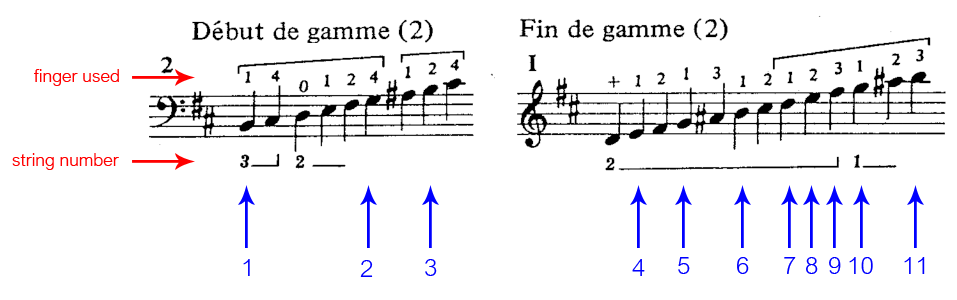
My intonation dummies:
1 (B) = 5th to open E string, compared melodically
2 (g) = open g
3 (b) = 5th to natural harmonic on e on A string (sounding e1)
- (d1) = octave harmonic d1 on d string (so obvious I forgot to show it)
4 (e1) = 5th to natural harmonic on a on A sting (sounding a)
5 (g1) = natural harmonic on g on g string (sounding g1)
6 (b1) = 5th to natural harmonic on e1 on A string (sounding e1)
7 (d2) = natural harmonic on the same spot (sounding d2)
8 (e2) = 5th to natural harmonic a1 on A string (sounding a1)
9 (f#2) = natural harmonic on the same spot (sounding few cents lower than f#2)
10 (g2) = natural harmonic on the same spot (sounding g2)
11 (b2) = natural harmonic on the same spot (sounding few cents lower than b2)
Pitch descriptions: I’m using german (?) way of describing octaves: B means great octave (B2), b small octave (B3), b1 1-line octave (B4), etc. All octaves are described as written, thus sounding an octave lower.
I’ve been practising slow vibrato on 3 octave scales (bowing). The excersise goes very slow, I usually play a single scale once up and down for perhaps 20 minutes. During the excersise I often lose my intonation, as the tones are very long, somewhat smeared by vibrato, and tiring. So I developed a range of intonation dummies based on harmonics, which I use to verify my intonation. Most are obvious, some perhaps not.
I wanted to ask what method of strenghtening intonation feel on very long tones others use, and whether the dummies I use might contain some errors. For example, dummies 9 (f#2) and 11 (b2) should theoretically sound a bit lower than right tempered intonation, but to my ears they are accurate more than any other method of intonation control I can think of.
I don’t want to use drones or even look at tuners, I think I’m past that stage. I don’t have intonation problems when playing into other sounds; I’m trying to develop a solo intonation feel and find these scale excersises very effective.
I’m also curious whether non bowing players use any range of intonation dummies of similar kind.
The example is B harmonic minor from Rabbath 3; it’s not important, any scale works, some offering more dummies, some less. However, Rabbath scales often prefer higher positions on lower strings, likely for pedagogical reasons. From what I hear, on lower strings the impact of bowing technique on intonation is higher. I wouldn’t be surprised if someone told me that low strings harmonics (like b on E string) might be out of tune due to impact of bow.
My intonation dummies:
1 (B) = 5th to open E string, compared melodically
2 (g) = open g
3 (b) = 5th to natural harmonic on e on A string (sounding e1)
- (d1) = octave harmonic d1 on d string (so obvious I forgot to show it)
4 (e1) = 5th to natural harmonic on a on A sting (sounding a)
5 (g1) = natural harmonic on g on g string (sounding g1)
6 (b1) = 5th to natural harmonic on e1 on A string (sounding e1)
7 (d2) = natural harmonic on the same spot (sounding d2)
8 (e2) = 5th to natural harmonic a1 on A string (sounding a1)
9 (f#2) = natural harmonic on the same spot (sounding few cents lower than f#2)
10 (g2) = natural harmonic on the same spot (sounding g2)
11 (b2) = natural harmonic on the same spot (sounding few cents lower than b2)
Pitch descriptions: I’m using german (?) way of describing octaves: B means great octave (B2), b small octave (B3), b1 1-line octave (B4), etc. All octaves are described as written, thus sounding an octave lower.