• TalkBass has been independent since 1998. Add your voice.
    Create a free account to reply to discussions, view embedded media, and browse with fewer display ads.
    Join freeLog in
    Want zero display ads or expanded classifieds tools? Compare plans.

Intonation of a fretless

Status
Not open for further replies.
Hello TB.

Ok, so a little background, then the topic of the post.

By way of background I'll say I've been playing bass since around the early 1980's. Since 2008 I've been playing 3 services a week plus a practice on a worship team in a small church with no rotation of members. We improvise over changes, play in tons of styles, and do a good bit of improvisation including for extended periods at times. I got my first fretless back around 2012. Since the Fall of 2018 I've been playing my only other fretless (my beloved Clement #346) exclusively - wanting to climb what or me if the pretty tall mountain of getting sufficiently competent on unlined fretless. It's been a lot of good hard work but my playing on the fretless has gotten clean and confident. Hooray! :) I'm self-taught, never had a lesson, and have always done the basic work on my instruments (cleaning, simple set up stuff, simple repairs, etc.).

So here's what I'm posting about. Over the years from the time I got the Clement until now I've noticed that the bass has seemingly settled in, and the intonation has slowly changed. My ear has improved, and so have my hands, playing only fretless - improvements I never anticipated. At the 9th stop or so, and below, the intonation is pretty good. And of course the lower you go the better. I can work with it no problem. But around the 10th and higher I notice the intonation is out more and more the higher I go. The change is noticeable compared to when it was new. I've kept the same set of flats on it for all these years.

I usually over think stuff, and am pretty cautious. I noticed some small scratchy sounds in the tone pot. I have contact cleaner and could do that myself. But I decided to use that as an excuse to take it to a very good luthier in the area who we have used before and does good work. He called me today and said, "The note says you want the intonation fixed. Well, on a fretless, you intonate with your hands." He then held silence. I was pretty surprised. I said, "Well, my ears and hands tell me that the pitch at the 12th stop and higher has slowly become different from when I got the instrument. It's a very good instrument. Is it the strings stretching, the wood settling, or what? I don't know. I just figured I'd have someone who knows what they are doing look at the bridge saddles and get the pitch at the 12th reasonably closer." He then said he had already taken it upon himself to pull the saddles all the way back, tune to pitch, and see what he could do at the 12th. He said he got each string closer, including at the 3rd and 5th. I told him I'm cool with that. He then closed the ticket with my agreement and the call ended naturally.

Over thinking, I'm concerned when I pick it up all the saddles will be all the way back. From what he said that shouldn't be the case, but we shall see.

On the call he seemed to correct me, and be slightly condescending, in saying what he did about me suggesting a fretless needs intonation, because that is "in your hands". And strongly suggesting there is no such thing as intonating a fretless.

Ok, TB, I wonder what you will have to say. He's a guitar tech who probably doesn't see a lot of basses by comparison. Is that it? Feel free to educate this dedicated amateur. He didn't hurt my feelings, and knowing this is TB I'm ready for anything (I think). :)
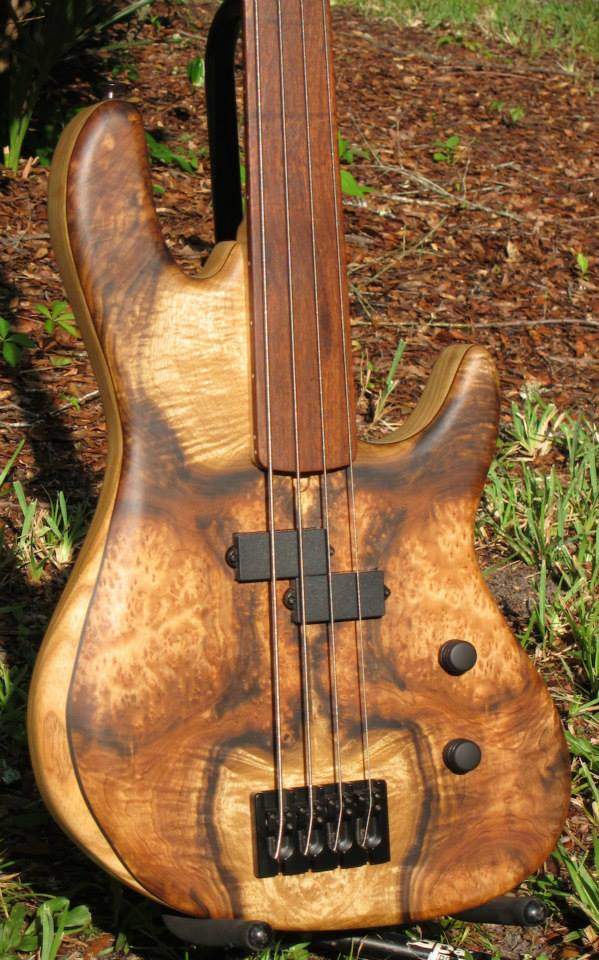
346 done front.jpg


PS: I LOVE this bass! Tom Clement did me right! :)
 
A fretless needs proper intonation. Period. Find another tech.

I do my own intonation on my fretted basses and my fretless basses.

And remember, a fretless needs some relief on it's neck also.

I have four fretless basses, one 3/4 Upright, and one stick upright (the type that mounts onto a stand. And all of them except the upright needs intonation and adjustment.

And you may need a new set of strings.
 
Here's an easy way to "intonate" your fretless that is proven to work (Michael Pedulla method). It's similar to adjusting intonation on a fretted bass. Always start with a fresh set of strings, especially if your intonation points seem to have "changed," or tuning seems less stable.

1. Adjust truss rod to liking (usually relatively flat)
2. Adjust fingerboard string height (usually relatively low) at bridge saddle
3. Play harmonic at 12th fret
4. Tune harmonic to applicable string tonality
5. Place a credit card edge at the 12th fret marker of that string
6. Push the string to the fingerboard with the card edge, directly over the 12th fret marker
7. Adjust bridge saddle (back or forward) so depressed 12th fret note matches harmonic
8. Fine tune string heights as needed

Enjoy playing your intonated fretless using your greatest intonation tools: your ears and technique!
 
Last edited:
Setting intonation on your fretless will not remove the need to still use your ears to play in tune. But it will make your fingering more consistent across all the strings. So set it using the steps listed above.

I can't imagine anyone who plays bass paying someone to set intonation. Compare the 12th fret harmonic to the stopped note. The harmonic is an exact octave above the open string unless the string is bad, so that is your reference. If the stopped note is sharp compared to the reference note the string is too short from the 12th fret/stop so you make it longer by moving the saddle away from.the nut. So if the stopped note is flat compared to the reference note, the string is too long between the stop and the bridge so you need to move the saddle closer to the nut. Retune the reference each time you move the saddle, use a good tuner (my experience is based on doing this professionally up to 30 years ago so there are likely new units that are good)- I use my Peterson stone for setting intonation. The Boss TU-2 works OK, the Electro Harmonix is also Ok but a little less accurate. The Snark doesn't work for me for setting intonation.

It takes some time to get used to doing it, but it's not hard to do. And you generally don't need to reset it as long as you maintain the other aspects of set up (string type and gauge, action, relief).
 
Assuming there are some kind of markings on your neck (e.g. side dots) OF COURSE your fretless needs to be intonated.

To be fair, the final pitch IS determined by your hands and ears, but you can't just ignore string length.

Beautiful bass BTW. (Post another pic in three years when you add a bridge pickup.)
 
Assuming there are some kind of markings on your neck (e.g. side dots) OF COURSE your fretless needs to be intonated.

To be fair, the final pitch IS determined by your hands and ears, but you can't just ignore string length.

Beautiful bass BTW. (Post another pic in three years when you add a bridge pickup.)
It does depend on finger position, of course, but how can you find the right finger positions if the dots don't properly match the pitches? It's actually more important on fretless!
 
IME, intonation changes almost on a daily basis. And I am talking "fretted bass". Of course, it doesn't change so much that I need to re-intonate all the time.

Of course your fretless needs to be intonated at the saddles!

Measure off the exact 12th fret mark. You can use a piece of masking tape for a temporary mark across the neck. As best as you can, use your finger nail to note off @ #12. Look at your tuner meter and adjust the saddles accordingly. You should do this yourself instead of taking it to a $75 an hour luthier!

Intonation on a fretless is important and even more so on a fretted bass. It is literally impossible to hit absolute perfect notes on a fretless.

On a 34" or 35" fretless bass, off notes will be easily heard above #9ish.

IMHO
 
  • Like
Reactions: staccatogrowl
I have always considered fret markers (lines or dots) a general indicator with the ear being the proper judge. I understand getting the markers as close as you can but tuning can change as you play (strings can go flat etc.). So get it as close as you can (and you shouldn't need a tech) and play by ear and feel.
 
It used to be OK. Now it's not. Something has changed. If the setup is the same, the only thing that seems to have changed is that the strings got older.
I have four fretless basses, one 3/4 Upright, and one stick upright (the type that mounts onto a stand. And all of them except the upright needs intonation and adjustment.
How come the upright doesn't need intonation but the others do? All the same physics apply.
 
Last edited:
  • Like
Reactions: TomB and RSBBass
It used to be OK. Now it's not. Something has changed. If the setup is the same, the only thing

How come the upright doesn't need intonation but the others do? All the same physics apply.
My upright can have some minor adjustment of the bridge if necessary, albeit much harder to do. I've got gut strings on it. But there is no way to move the neck, without major expense.
 
  • Like
Reactions: staccatogrowl
As others have mentioned…. Setup the bass to your liking and then intonate on the same string closed octave with the edge of a credit card. Intonate appropriately. Voila. Consistent finger positioning across all strings has now been achieved.

I do agree that you’re responsible for maintaining intonation as the player, but having a bass that is consistent from string to string is so much easier to play.
 
Last edited:
  • Like
Reactions: JRA
My upright can have some minor adjustment of the bridge if necessary, albeit much harder to do. I've got gut strings on it. But there is no way to move the neck, without major expense.
So, although there is no way to intonate the upright, and I assume you can play it in tune, there is still a need to intonate the other basses. Why is that?
 
  • Like
Reactions: RSBBass
So, although there is no way to intonate the upright, and I assume you can play it in tune, there is still a need to intonate the other basses. Why is that?

Beats me. To each his own.
But I can move the bridge on my upright slightly forward or back and even tilt, I can adjust height by shimming or sanding. But that's just me.

No need to keep
dead-horse-beating-a-dead-horse.gif
 
  • Like
Reactions: staccatogrowl
Tilting the bridge on an upright isn't a good idea. It makes it more likely the bridge will slip and fall. It also can cause warping.
I think he meant angling, not tilting. But you sure can't do much on a double bass. And anything you do to physically change the intonation of the instrument will affect the overtones coming from the afterlength from bridge to tailpiece. So you learn to intonate with your fingers. And one would do well to do the same when playing a fretless electric.
 
  • Like
Reactions: RSBBass
I have found that using different strings can sometimes change the intonation on all my basses. Meaning going to different style string and / or different gauge string.

All of my basses (fretted and fretless) have an intonation adjustable bridge, except for my double bass.

Maybe I'm crazy, but those adjustments do get used when necessary. But typically when replacing with the exact same size, style, and brand string, generally no intonation is required.
 
Hello TB.

Ok, so a little background, then the topic of the post.

By way of background I'll say I've been playing bass since around the early 1980's. Since 2008 I've been playing 3 services a week plus a practice on a worship team in a small church with no rotation of members. We improvise over changes, play in tons of styles, and do a good bit of improvisation including for extended periods at times. I got my first fretless back around 2012. Since the Fall of 2018 I've been playing my only other fretless (my beloved Clement #346) exclusively - wanting to climb what or me if the pretty tall mountain of getting sufficiently competent on unlined fretless. It's been a lot of good hard work but my playing on the fretless has gotten clean and confident. Hooray! :) I'm self-taught, never had a lesson, and have always done the basic work on my instruments (cleaning, simple set up stuff, simple repairs, etc.).

So here's what I'm posting about. Over the years from the time I got the Clement until now I've noticed that the bass has seemingly settled in, and the intonation has slowly changed. My ear has improved, and so have my hands, playing only fretless - improvements I never anticipated. At the 9th stop or so, and below, the intonation is pretty good. And of course the lower you go the better. I can work with it no problem. But around the 10th and higher I notice the intonation is out more and more the higher I go. The change is noticeable compared to when it was new. I've kept the same set of flats on it for all these years.

I usually over think stuff, and am pretty cautious. I noticed some small scratchy sounds in the tone pot. I have contact cleaner and could do that myself. But I decided to use that as an excuse to take it to a very good luthier in the area who we have used before and does good work. He called me today and said, "The note says you want the intonation fixed. Well, on a fretless, you intonate with your hands." He then held silence. I was pretty surprised. I said, "Well, my ears and hands tell me that the pitch at the 12th stop and higher has slowly become different from when I got the instrument. It's a very good instrument. Is it the strings stretching, the wood settling, or what? I don't know. I just figured I'd have someone who knows what they are doing look at the bridge saddles and get the pitch at the 12th reasonably closer." He then said he had already taken it upon himself to pull the saddles all the way back, tune to pitch, and see what he could do at the 12th. He said he got each string closer, including at the 3rd and 5th. I told him I'm cool with that. He then closed the ticket with my agreement and the call ended naturally.

Over thinking, I'm concerned when I pick it up all the saddles will be all the way back. From what he said that shouldn't be the case, but we shall see.

On the call he seemed to correct me, and be slightly condescending, in saying what he did about me suggesting a fretless needs intonation, because that is "in your hands". And strongly suggesting there is no such thing as intonating a fretless.

Ok, TB, I wonder what you will have to say. He's a guitar tech who probably doesn't see a lot of basses by comparison. Is that it? Feel free to educate this dedicated amateur. He didn't hurt my feelings, and knowing this is TB I'm ready for anything (I think). :)

View attachment 4437515

PS: I LOVE this bass! Tom Clement did me right! :)

He was right; it's not the bass that changed, it was you. You got better at intonation, so the relative positions of the notes on the board up there look like they have changed along with.

Contrary to popular belief, FL's, even lined ones, don't need to be intonated.

No, they don't.
No, they don't.
No, they don't.

Here's why: even those who claim the basses do need it, can't tell when a fretless bass is "out of intonation" to begin with. Which is why the instruments virtually always get pulled right out of the case and played for years and years with no troubles long before any fiddling with the bridge ever begins. The difficulties only start when they finally read somewhere/someone tells them they need to "intonate" their fretless bass. Then all of a sudden all hell breaks loose and the bass is unplayable above the 7th "fret". Until that someone who claimed it needed it "intonates" it for them, even though they have no idea where to actually set it, or what they're even doing. After a couple hours of fiddling with a tuner and the nodes "look about like they're in the right place", the bass is returned to the player, with "set intonation" scrawled across the bill and all is right with the world again.

Remember guys: unlike on the fretted bass, the thickness of that finger and the contact area on the board is enormously wide compared to any possible difference 1/16" or even 1/8" of saddle movement could make to the player. If the intonation does move, that's well within the range of initial intonation error of even very good FL players and they intonate the note to suit with their fingers and ears, just like they always did.

The moral of the story is - Leave That Thing Alone. Trying to intonate your fretless bass like your fretted basses leads to the Rubber Room. Don't worry about your bridge saddles and play/enjoy your fretless bass.

L
 
Last edited:
  • Like
Reactions: SLO Surfer
Status
Not open for further replies.

Latest posts