I went to an Intermediate Theory class at Jazz Port Townsend Workshop today where the teacher, sitting at the piano, referred to Pythagorean ratios to explain consonance and dissonance without even mentioning equal temperament!

Enjoy the benefits of a premium membership!
Upgrade Account
-
TalkBass has been independent since 1998. Add your voice.
Create a free account to reply to discussions, view embedded media, and browse with fewer display ads.
Join free Log in
Want zero display ads or expanded classifieds tools? Compare plans.
You are using an out of date browser. It may not display this or other websites correctly.
You should upgrade or use an alternative browser.
You should upgrade or use an alternative browser.
Double Bass Intonation
- Thread starter Chris Fitzgerald
- Start date
More options
Who Replied?

Earl
Supporting Member
Mindlessness is really the key to the whole thing. It is why I drank for most of my career, to 'get out of my head' in a sense. Since I quit drinking five years ago I am finding different ways to get there.I think this is related to the topic at hand. I recently made ( on sibelius [notation program]) a score for playback of a piano, playing back diatonic scales in 12 keys. Quarter note scales (eg in E) E F# G# A B C# D# E . one octave up E F# G# A B C# D# E. Then broken scales E G#, F# A, G# B , A C#? B D# C# E, D# F# E etc....and one octave up. And so on in 12 keys. The ear makes the "tuning" of the scale irrelevent, because the ear easily predicts the next notes' pitches . When I have played (arco) with the playback matching the pitches (sometimes in octaves) my intonation has improved noticably, and quickly. The mindless predictability makes the hands mindlessly play the pitches accurately. Maybe not for everyone, but the mindlessness of the practice is its asset. Mileage may vary. And for me mindlessness is often a real musical asset.

Good for you! (and those around you too.Mindlessness is really the key to the whole thing. It is why I drank for most of my career, to 'get out of my head' in a sense. Since I quit drinking five years ago I am finding different ways to get there.
I think this is related to the topic at hand. I recently made ( on sibelius [notation program]) a score for playback of a piano, playing back diatonic scales in 12 keys. Quarter note scales (eg in E) E F# G# A B C# D# E . one octave up E F# G# A B C# D# E. Then broken scales E G#, F# A, G# B , A C#? B D# C# E, D# F# E etc....and one octave up. And so on in 12 keys. The ear makes the "tuning" of the scale irrelevent, because the ear easily predicts the next notes' pitches . When I have played (arco) with the playback matching the pitches (sometimes in octaves) my intonation has improved noticably, and quickly. The mindless predictability makes the hands mindlessly play the pitches accurately. Maybe not for everyone, but the mindlessness of the practice is its asset. Mileage may vary. And for me mindlessness is often a real musical asset.
Think this is fine, although I would characterize it as mindful rather than mindless. The simple fact that you went to all the trouble to set all that up speaks to a desire to work on acclimating to an external source, which is the overall goal.
I just want to say that this was an excellent four days of jazz theory from Randy Halberstadt. Intonation was definitely beyond the scope of the class.I went to an Intermediate Theory class at Jazz Port Townsend Workshop today where the teacher, sitting at the piano, referred to Pythagorean ratios to explain consonance and dissonance without even mentioning equal temperament!
I am just wrapping up the first installment this week. Happy with the way it is turning out and grateful for the input from the TBDB braintrust. Will start working on Part 2 in the coming week.
Several things jump out at me after this week:
First, that Just intonation is more of a melodic/intervallic go-to. Playing a chord progression that modulates any significant distance across the circle of 5ths on a Just tempered keyboard is just a nauseating experience. In spite of this, absent an equal tempered accompaniment, those interval ratios are what my ear gravitates toward. This dichotomy is interesting, especially since 90% of my gigs are with a tempered instrument.
Second, that learning to hear the spectrum of pitch where the beating between the primary two notes resides is paramount. It is where you hear the crucial parts either come to peace, or remain at war. Going deeper into the interval ratios of the primary 5-6 consonances has confirmed this in my mind. Delving deeper into the polyrhythms that constitute the essence of these intervals has resonated in way that has strengthened my concept of the “sweet spot” for each interval.
Third, this subject is a never ending rabbit hole! But I am more convinced than ever that when we play with a tempered instrument, most of the time our brains are naturally drawn toward the simplest, most rational connection. So that it is possible to play with an ear towards Just intonation even when playing with a tempered instrument…it’s just a matter of priorities and where we focus our aural attention. Interesting stuff, and I’m glad my summer is taking this little detour at this time.
One request for Part 3 of the series: I’m in search of a recorded arco long note with no vibrato for an experiment that I want to record for the third installment haveing to do with the difference between pizz and arco intonation. Don’t want to say more that that, but if anyone wants to post a link to such a thing, it would be helpful. Thanks!
Several things jump out at me after this week:
First, that Just intonation is more of a melodic/intervallic go-to. Playing a chord progression that modulates any significant distance across the circle of 5ths on a Just tempered keyboard is just a nauseating experience. In spite of this, absent an equal tempered accompaniment, those interval ratios are what my ear gravitates toward. This dichotomy is interesting, especially since 90% of my gigs are with a tempered instrument.
Second, that learning to hear the spectrum of pitch where the beating between the primary two notes resides is paramount. It is where you hear the crucial parts either come to peace, or remain at war. Going deeper into the interval ratios of the primary 5-6 consonances has confirmed this in my mind. Delving deeper into the polyrhythms that constitute the essence of these intervals has resonated in way that has strengthened my concept of the “sweet spot” for each interval.
Third, this subject is a never ending rabbit hole! But I am more convinced than ever that when we play with a tempered instrument, most of the time our brains are naturally drawn toward the simplest, most rational connection. So that it is possible to play with an ear towards Just intonation even when playing with a tempered instrument…it’s just a matter of priorities and where we focus our aural attention. Interesting stuff, and I’m glad my summer is taking this little detour at this time.
One request for Part 3 of the series: I’m in search of a recorded arco long note with no vibrato for an experiment that I want to record for the third installment haveing to do with the difference between pizz and arco intonation. Don’t want to say more that that, but if anyone wants to post a link to such a thing, it would be helpful. Thanks!
That's a very interesting point. When you listen to a top-notch performance of a piano quintet it's pretty amazing how well skilled musicians can negotiate it.But I am more convinced than ever that when we play with a tempered instrument, most of the time our brains are naturally drawn toward the simplest, most rational connection. So that it is possible to play with an ear towards Just intonation even when playing with a tempered instrument
I don't know if you've heard this, and a bit off-topic, but this is a wonderful record and really cool application of just intonation to jazz. No bass though!
Anna Webber -- Shimmer WInce
and the first tune live:
Anna Webber -- Shimmer WInce
and the first tune live:
Last edited:

I'm not sure a 'Just' keyboard is the way to explore the topic, unless it can be retuned 'on the fly' every time the tonic moves. This should come as no surprise, since the whole point of equal temperament was to solve exactly this problem. The thing with Just Intonation and modulation is that you have to modify/adjust according to the new tonic, at which point the natural harmonic beauty is restored. Even then, if you follow through any circle you don't end up where you started.First, that Just intonation is more of a melodic/intervallic go-to. Playing a chord progression that modulates any significant distance across the circle of 5ths on a Just tempered keyboard is just a nauseating experience
I'm not sure a 'Just' keyboard is the way to explore the topic, unless it can be retuned 'on the fly' every time the tonic moves. This should come as no surprise, since the whole point of equal temperament was to solve exactly this problem. The thing with Just Intonation and modulation is that you have to modify/adjust according to the new tonic, at which point the natural harmonic beauty is restored. Even then, if you follow through any circle you don't end up where you started.
I also have no use for a Just keyboard. But in the third video, I plan to set one to that system and play a progression through the cycle just to make a point about that system’s limitations.
My belief is that we as double (or fretless- fretted BG’s are obviously tempered) bassists (and any non tempered instrument) tend to be drawn to just intervals, but hierarchically so. When we are playing against a single reference note, we are drawn to the just version of that interval. When we are playing against multiple reference notes, our brains automatically divert us to the simplest ratio. So if we were playing an E against only a C, we would play a just 3rd against the C. But if we were playing along with an external C and A, we would play a just 5th against the A, which would be a derivation of a certain number of cents versus the previous E we played. We do this because the ratio of a 5th is simpler than the interval of a 3rd.
This works the same way when we play with a tempered instrument, which most of my performance situations involve. I actually tested this with a guitarist friend recently. If he plays a C5 sound (just root and 5th of C, either singly or doubled in the voicing) and I play the 3rd, I’ll instinctively play a just Major 3rd. But when he changes his voicing to include the 3rd on his instrument, my ear will adjust my E sharper (by about 14 cents) to match his, because now I’m playing a just unison or 8ve against the E he is playing, and it overrides the previous reference to the C. It’s automatic, like magnetic hearing….it just snaps into place.
So my understanding is, we are using Just intonation even when we play with tempered instruments, but we are drawn to the simplest solution, the simplest ratio, automatically.
I also think that is the case, as illustrated by my point earlier about D flat being sharper than C# in some scenarios, I think the trick, if there is one, is to accept that tonics, as you modulate, have to remain within an equal-tempered framework relative to each other. Of course all the time we remain in a given key the universe and beauty of just intonation is only a few mm away. So when that ii becomes II7 to function as V of V we can afford to play the 3rd (#4) a little flat then allow it to sharpen as it becomes the leading tone of the new key, whilst all the time keeping it flatter than it's equal-tempered counterpart. In all likelihood, few in the audience will really notice, but we will know. On the other hand, if we don't hit the new tonic in line with our equal-tempered partners only the deaf will miss it!So my understanding is, we are using Just intonation even when we play with tempered instruments, but we are drawn to the simplest solution, the simplest ratio, automatically.
Well, tonics are the same in all systems of intonations: 1X, 2X, 4X, etc. So they'll definitely be in tune.I also think that is the case, as illustrated by my point earlier about D flat being sharper than C# in some scenarios, I think the trick, if there is one, is to accept that tonics, as you modulate, have to remain within an equal-tempered framework relative to each other. Of course all the time we remain in a given key the universe and beauty of just intonation is only a few mm away. So when that ii becomes II7 to function as V of V we can afford to play the 3rd (#4) a little flat then allow it to sharpen as it becomes the leading tone of the new key, whilst all the time keeping it flatter than it's equal-tempered counterpart. In all likelihood, few in the audience will really notice, but we will know. On the other hand, if we don't hit the new tonic in line with our equal-tempered partners only the deaf will miss it!
Except they are not - if you start in the key of C then modulate through say a circle of 'Just' (not TET) 4ths, 5ths, or minor 3rds , the C you end up coming back to is not the same pitch as the one you start from:Well, tonics are the same in all systems of intonations: 1X, 2X, 4X, etc. So they'll definitely be in tune.
See the full article here: https://www.abcd.org.uk/storage/Cho...0/Influences_on_pitching_Howard_and_Overy.pdf
OK, I see you were talking about modulating through a cycle. Yeah, you won't end up where you were, which is why equal temperament was developed.Except they are not - if you start in the key of C then modulate through say a circle of 'Just' (not TET) 4ths, 5ths, or minor 3rds , the C you end up coming back to is not the same pitch as the one you start from:
View attachment 7010726
See the full article here: https://www.abcd.org.uk/storage/Cho...0/Influences_on_pitching_Howard_and_Overy.pdf
Honestly, I don't hear all these supposed clashes in equal temperament that still, 300 years later, drive a few people to try to wedge variants of just temperament back into music. Maybe I was just raised on too much dissonance (I grew up as a little boy with the Rite of Spring as one of the standard things on my mother's stereo).
I think we've got a good thing here with the twelfth root of two and at least for me I'm satisfied not to re-litigate the temperament battles. But y'all knock yourselves out.
The fun really starts when the ensemble of whatever type has no fixed-pitch instrument. The reference is theoretically supposed to come from the bottom up,generally being the bass, but different players will have their own ideas. Finding consensus can be an interesting exercise. Equal temperament in these situations, even if it were attainable, would not work. You need more freedom to make adjustments depending on overtones, etc. to make the ears happy. Just, Pythagorean, or whatever, "in tune" is often a moving target.
Last edited:

For the most part I would agree with you, but as players of 'continuous pitch' instruments we have infinite ways of getting it wrong. As such I think we owe it to ourselves (at least I think I owe it to myself) to have as much understanding of pitch and intonation (and related options) as possible. It informs my practice and has practical application in actual music.OK, I see you were talking about modulating through a cycle. Yeah, you won't end up where you were, which is why equal temperament was developed.
Honestly, I don't hear all these supposed clashes in equal temperament that still, 300 years later, drive a few people to try to wedge variants of just temperament back into music. Maybe I was just raised on too much dissonance (I grew up as a little boy with the Rite of Spring as one of the standard things on my mother's stereo).
I think we've got a good thing here with the twelfth root of two and at least for me I'm satisfied not to re-litigate the temperament battles. But y'all knock yourselves out.

Pure thirds and sixths also just sound better than tempered thirds and sixths, and while in a situation where you’re playing with piano, guitar, harp, etc. you kind of have to defer your intonation to them, when playing with non-fixed pitched instruments it does make quite a bit of difference. Also if for some reason you’re ever playing solo bass, it’s very helpful to be able to be in tune with the 1st, 3rd, and 5th partials of the open strings to maximize things like resonance.For the most part I would agree with you, but as players of 'continuous pitch' instruments we have infinite ways of getting it wrong. As such I think we owe it to ourselves (at least I think I owe it to myself) to have as much understanding of pitch and intonation (and related options) as possible. It informs my practice and has practical application in actual music.
I've been playing bass duets with my students for years, but lately I've been using them to explain and demonstrate how the different tunings work and how we use them in different circumstances. It gives the concept of "playing in tune" more hands-on relevance in addition to the other aspects of listening and performing in group situations in general.
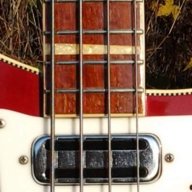
As a player of both fretless and fretted bass guitar, playing with equal tempered instruments, I've become annoyingly aware of clashes - my fretted bass, even when tuned accurately (with an equal-tempered electronic tuner) can have a few notes that just don't sound as sweet as my fretless can (when I manage to play it accuratelyI don't hear all these supposed clashes in equal temperament that still, 300 years later, drive a few people to try to wedge variants of just temperament back into music
 ).
).Major thirds are the worst offenders - an equal tempered major third is almost 14 cents sharp of a 5/4 ratio major third. If I'm playing an open D string and F# at the 11th fret of the G string, I've learned I need to "push" the fretted string towards the bridge to flatten it. My tuner says that equal-tempered F# is exactly right, but my ear disagrees.
I've been following the discussion in this thread with interest. I've developed an ear for what sounds right - some of the comments here help me understand why it sounds right.


