
Enjoy the benefits of a premium membership!
Upgrade Account
-
TalkBass has been independent since 1998. Add your voice.
Create a free account to reply to discussions, view embedded media, and browse with fewer display ads.
Join free Log in
Want zero display ads or expanded classifieds tools? Compare plans.
You are using an out of date browser. It may not display this or other websites correctly.
You should upgrade or use an alternative browser.
You should upgrade or use an alternative browser.
More options
Who Replied?I don't get the BEAD thing. Why would you want to play in what is essentially a different tuning as opposed to just using a 5 string? The additional notes I need are in the low register, but i don't want to give up my G string to get them. I know some guys are uncomfortable with the feel and mechanics of a 5 so they do the BEAD thing, but I found the switch fairly easy.
School me...what is the attraction of that approach?
Thanks.
No, you should have a 5 string as usual, not BEAD tuning. Go try one of these fanned frets basses out first, and then come back here. Dingwall may be hard to get your hands on, but definitely LTD, Ibanez, Rondo/Brice and even Carvins Kiesel models should be around for trying out. It's not a string thing. It's a scale thing. If you want to keep the high G and the low B, a "regular" 5 er is what you're after. And then you need a scale for the low B that at least starts at 36" and then just goes up, otherwise it all turns flubby, wobbly, and whatnot. The fundamentals are way better, and the harmonics aren't out of tune. I e you can even tune to natural harmonics by comparing the 5th fret harmonic, and 7th fret harmonic of the next strings since there are almost NO deviance in cents between the two. On a regular scale instrument, there is. If you lean in and whack the low B string at 37" it doesn't go up in pitch first and then settles. That's what I use as a tell tale if a bass is not performing the best.

Yeah, personally if I have to go to something like a 36" scale or fanned frets that's a deal breaker for me. I play with a lot of old school acts and even bringing something that doesn't say Fender on the headstock (like my beloved Lakland 44-01's) arouses suspicion
Old school acts had a low B? Since when? Not in the 60s, for sure...then why hunting for a low B since no old school acts had anyone anyway?
And if you should find one, you bet that it sounded way flubby, and unbalanced to all the other strings. The earliest example of 5 string with a low B, was an Alembic in the late 70s.
And if you get suspicion of not having a Fender, you should raise eybrows with showing up with ANY 5 string anyway...but what's wrong with this one?

So what I'm gleaning from the discussion so far is that scale is less important than the gauge of the B string, and bigger is better...right?
I typically play 45-15 sets so maybe what I need to do is find a set with a big fat B string, like .130 or more.
No, you should hunt down for strings which has THICKER inner core. The core to wrap ratio is what is important. Remember one thing: String tension comes ONLY from the inner core as it is the only thing wrapped around the ball end. Now, if you just hunt down a .130 gauge, it doesn't tell you at all how thick or thin the inner core is. It can be a thicker gauge wrap wrapped around it, and a thinner wrapped around a thicker core and the end result is that same .130 gauge. Very few ones lists inner core diameter, or that the inner core goes up in gauge just as well as the total gauge of the strings. D'addario and Kalium are the only ones listing this as a special tension, but they still don't list the inner core gauge at all. On guitar strings, the plain strings are what they are, so it's only when it comes to wounded bass string such things makes sense.
Chances are with extremely thick strings that you can't put the saddle bridge down enough to make a balanced string height. Hence the use of tapered and open core strings.
I feel that, if you're not interested in trying out a Dingwall, say that Super J and P of 32" to 35" you have to live with your problems. The reason they shortened the scale on that one, is that they used the other strings to get in balance with the b-string. If the b-string is kind of no sustain, poppy, and short in duration, well then, let's make the other strings follow that one, instead of the other way around. The low B-string may turn out flubby at 35" on those basses, but so are the other strings too, so ... you have at least a balance between all strings on that particular bass. They are all "equally flubby" if they are flubby at all.
Hmmm...I'm going to throw something out that five string lovers will find inflammatory
You know that commercial where they basically say your house smells but you have gone "nose blind" to it? I have had numerous encounters with bassists who tell me about the killer B string on their basses, then they play it and the B string SOUNDS NOTHING LIKE THE OTHER 4 STRINGS. It sounds GOOD, but it definitely doesn't sound the SAME as the E, A, D, and G strings. It's like a totally different instrument when they drop that low B.
They don't hear it though. I think you get accustomed to that huge frequency drop and after a while it sounds normal to you.
I want a great sounding B of course, but that's never been the issue for me. I'm trying to get to where I can move between the A, E, and B strings and it all sounds balanced and blended. I guess I need to find a 5 string that feels really good to me and then experiment a lot more with strings.
I really appreciate all the feedback here, very helpful.
You should do your tests in a well equipped studio and just direct line your bass into the board, and listen to the bass, and low B through audiophile headphones. It's the only one that can track low B properly at listening levels. It's the studio engineers that swears by fanned frets basses, especially low B. Because then you haven't put into the bin, the idiosyncrasies of amps, combos and speaker cabinets, and subwoofers. They can put havoc on anything too, even if you play a posh Dingwall fanned fret through it. Such low frequencies aren't really heard but felt. AKG headphones K7 and the like, the regular studio cans should be enough to judge evenness and balance through at FR FR system amp wise (FRFR = Full Frequency, Flat Response). Low B is at 32 Hz or something and the first and second harmonic are brought up for real, on those low B at 37".

My 1998 Warwick Fortress One 5-string has beautiful balance between all strings, including the low B. The Warwick bridge requires a step-wound, or tapered, string at the ball end of the B-string to fit over the bridge saddle. Maybe it's the string taper? Maybe it's the bass? I don't know but I've always loved how balanced the low B sounds on this bass compared to a lot of other basses I've tried.
I have that issue with my sixer. The low B is significantly louder than the other strings. I had to do some major adjustments with only modest success. However, I've not had that issue with any of my fivers or any fiver I've noodled on in a music store. Your ears may be more sensitive than mine.In what seems to be an annual event, I have a string of gigs where a 5 string bass would make a lot of sense and save me from jumping all over the fretboard with my 4 string Jazz Basses. So then I start looking around at fivers and always come to the same conclusion: I love the versatility of them, but I just HATE the sound of that B string. It never matches the other 4 strings and to my ears it just doesn't sound natural. It's always so much boomier and massive sounding compared to the higher strings.
I have owned a number of fivers, among them: Lakland 55-01 and 55-02, Carvin Bunny Brunel, and an older model Fender Jazz 5. I have also experimented with different strings to see if that could balance things out, but no luck to date. I always end up dumping them.
I'm a Jazz Bass guy, so that makes the most sense for me, but is there a bass out there that truly gets the balance thing right? Is it a scale thing, like 34 vs 35", or an active vs passive thing? Are there strings that will make that B blend better with the others?
Looking for guidance from my TB brothers!

I don't have time to read the entire thread. I have Rob Allen 35", Cliff Bordwell 34" and 32", Conklin 35", and Peavey USA 35" scale basses. They all sound great in the low B department.
All other things being equal, scale length helps. When are all other things equal??
I feel that most of this resides with the bass. Scale length seems to be the most obvious factor, but witness angle at the headstock and/or bridge, and neck rigidity is most of it. Luthiers are worth their salt when it comes to reinforcing the neck. Many stock basses simply widened the neck. I'll put my 32" scale CB against any stock 34" or 35" scale bass.
Nothing particularly special about my bass strings. The Rob Allens use LaBella tape wound strings. My 32" scale Cliff Bordwell utilizes Curt Mangan custom strings because the B and E string needs a taper to fit into the tuner. My 34" scale CB uses TI Jazz Flats.
Setup comes into play. A bad setup on a good bass will simulate the flop/rattle of a cheapo.
Technique is part of the equation. I use a somewhat lighter touch, which seems to be a little more forgiving with the B string. Playing hard will bring out the differences in timbre.
All other things being equal, scale length helps. When are all other things equal??
I feel that most of this resides with the bass. Scale length seems to be the most obvious factor, but witness angle at the headstock and/or bridge, and neck rigidity is most of it. Luthiers are worth their salt when it comes to reinforcing the neck. Many stock basses simply widened the neck. I'll put my 32" scale CB against any stock 34" or 35" scale bass.
Nothing particularly special about my bass strings. The Rob Allens use LaBella tape wound strings. My 32" scale Cliff Bordwell utilizes Curt Mangan custom strings because the B and E string needs a taper to fit into the tuner. My 34" scale CB uses TI Jazz Flats.
Setup comes into play. A bad setup on a good bass will simulate the flop/rattle of a cheapo.
Technique is part of the equation. I use a somewhat lighter touch, which seems to be a little more forgiving with the B string. Playing hard will bring out the differences in timbre.

You don't need special cabs for a low B. I've seen bands that go down to low C or low A play through regular old Ampeg 810s and sound great.Low B. it's low, so a lot of cabs don't actually offer you the fundamental. That can be a hang up. And some basses just don't ring down that low. It's can be an instrument/wood thing. Brass vs Aluminum bridges also makes a difference.
But most commonly, finding the right strings for the instrument helps most. That can be expensive and time consuming, but it can prevent you from trading basses, which is also expensive and time consuming.
I myself play through a cab built in the late 60s when nobody had a low B.
It sounds fantastic (though I have upgraded the drivers to ones that handle more power and have more excursion...)
Fact is that if you record, or play through a PA at all, soundperson is probably going to HPF your signal at above even the fundamental frequency of the low E. Chasing the fundamental is a losing game. The bass doesn't put out much of it, most cabs are only going to produce it very quietly, the soundperson is probably going to cut it out to make room for the kick drum, and our ears aren't that good at hearing those frequencies.
Amplifying a good low B is more about its harmonics than about the fundamental. If the cab has good response at 60hz, it'll likely sound good.

I never thought of this as a problem until I started posting here a decade or so ago and read everyone else's complaints. I still don't really notice it. I think our ears may be so well-trained to understand the normal range of a bass guitar that the lower notes on a 5-string tend to jump out in our perception. That is one reason I like them.
I did a video review for a bass that Pete Skjold built for me, which is also in my Avatar. It has a very distinct tone personality, but I think it also sounds very consistent across strings. Here is the review:
I did a video review for a bass that Pete Skjold built for me, which is also in my Avatar. It has a very distinct tone personality, but I think it also sounds very consistent across strings. Here is the review:

I might be late at adding in comments to this thread.......but I'll at least answer the question:
Is there a 5 string whose B actually matches the other strings?
Yes, there definitely is and I know exactly what the OP means about this.
I believe he's referring to the "perceived volume" of the B string with respect to the other strings.
Bolt-ons in general will provide more harmonic content and overtones and therefore are your loudest option, if "loud" or possibly "more even" is what you're looking for. There are plenty of set neck or neck through basses out there that will produce decent output, but some of them will be more compressed and as a result of the neck construction, more of the fundamental is being produced with less overtones, so the perceived volume is far less.
You must consider all the factors related to why the B string isn't producing the same effect as the other strings.
I've played 4 strings with crappy E strings too. And they suffer from the same problem as a 5 with a poor B.
Brand wise, it doesn't matter. Any bass can have a poor B regardless of how well it's built. Why is this?
It's called the natural compression of the woods. We are talking about fundamental frequencies of 30 and 40 Hz here.
Below 20 Hz you feel. Not only is this tough to produce by the bass itself, it's even worse on the whole signal chain whether it be through an amp into a cabinet or through a preamp into a recording console and out to reference level monitors. All of these elements CHANGE the sound. Whether drastic or not. It's basically like a combination safe.
Once you crack the combination, all the tumblers align and everything works.
Some 5 strings won't produce a decent B as will some 4's with poor E strings.
So, what is my recommendation then? As many others have likely eluded to.......try changing some parts of the signal path which includes the bass. It could simply take you a few minutes to years to find a 5 string that produces an amazing B that is to your liking. I've played some Korean made Laklands that have excellent sounding B strings in comparisons to a few Foderas that I have owned.
In the end, you just have to continue playing basses until you the right one that you like. Look up some interesting brands on this site and as always demo as much as you can whether it be at home, at a music shop, or especially live with a band. I have played 5 strings with great sounding B strings that were buried alive in the mix.
Is there a 5 string whose B actually matches the other strings?
Yes, there definitely is and I know exactly what the OP means about this.
I believe he's referring to the "perceived volume" of the B string with respect to the other strings.
Bolt-ons in general will provide more harmonic content and overtones and therefore are your loudest option, if "loud" or possibly "more even" is what you're looking for. There are plenty of set neck or neck through basses out there that will produce decent output, but some of them will be more compressed and as a result of the neck construction, more of the fundamental is being produced with less overtones, so the perceived volume is far less.
You must consider all the factors related to why the B string isn't producing the same effect as the other strings.
I've played 4 strings with crappy E strings too. And they suffer from the same problem as a 5 with a poor B.
Brand wise, it doesn't matter. Any bass can have a poor B regardless of how well it's built. Why is this?
It's called the natural compression of the woods. We are talking about fundamental frequencies of 30 and 40 Hz here.
Below 20 Hz you feel. Not only is this tough to produce by the bass itself, it's even worse on the whole signal chain whether it be through an amp into a cabinet or through a preamp into a recording console and out to reference level monitors. All of these elements CHANGE the sound. Whether drastic or not. It's basically like a combination safe.
Once you crack the combination, all the tumblers align and everything works.
Some 5 strings won't produce a decent B as will some 4's with poor E strings.
So, what is my recommendation then? As many others have likely eluded to.......try changing some parts of the signal path which includes the bass. It could simply take you a few minutes to years to find a 5 string that produces an amazing B that is to your liking. I've played some Korean made Laklands that have excellent sounding B strings in comparisons to a few Foderas that I have owned.
In the end, you just have to continue playing basses until you the right one that you like. Look up some interesting brands on this site and as always demo as much as you can whether it be at home, at a music shop, or especially live with a band. I have played 5 strings with great sounding B strings that were buried alive in the mix.
D'Addario nickel XLs. Nothing special. 130, 100, 80, 60.What strings do you use?
In what seems to be an annual event, I have a string of gigs where a 5 string bass would make a lot of sense and save me from jumping all over the fretboard with my 4 string Jazz Basses. So then I start looking around at fivers and always come to the same conclusion: I love the versatility of them, but I just HATE the sound of that B string. It never matches the other 4 strings and to my ears it just doesn't sound natural. It's always so much boomier and massive sounding compared to the higher strings.
I have owned a number of fivers, among them: Lakland 55-01 and 55-02, Carvin Bunny Brunel, and an older model Fender Jazz 5. I have also experimented with different strings to see if that could balance things out, but no luck to date. I always end up dumping them.
I'm a Jazz Bass guy, so that makes the most sense for me, but is there a bass out there that truly gets the balance thing right? Is it a scale thing, like 34 vs 35", or an active vs passive thing? Are there strings that will make that B blend better with the others?
Looking for guidance from my TB brothers!
I had some success getting a better sounding B string by using a .120 taper wound string. It's very light gauge for a low B but it works. The taper winding brightens it up a bit and seems to tighten the string feel up a little.
There are some builders that use 125s or 127s for a low B because the lower string mass makes it feel a bit tighter, even though the tension is actually lower.
At any rate, I converted a Fender P bass to BEAD by using a .120 taperwound and even though this bass didn't have any fancy design elements to tighten up or brighten up that low B string, that string still helped the B sound less muddy.
Last edited:
no one strings sound the same as each other to me
even the G which is 40 from the same set does not sound the same as a 42 or any similar to whole another string which is a D 60 or 65 from the same set
but if you want a low B which does not suck then dingwall is a great example
even the G which is 40 from the same set does not sound the same as a 42 or any similar to whole another string which is a D 60 or 65 from the same set
but if you want a low B which does not suck then dingwall is a great example
I'm fairly new to bass - and I have only ever played one 5 string bass. But I've done a lot of reading old archives here on TB and I always see people asking about how to get a decent B string. And because I'm new to bass - I don't know if I just got lucky or if I just am not good enough, yet, to discern what the problem is. And I'm not sure what it is, specifically, that you guys find lacking in most B strings. Is it the way a note on the B string sounds compared to the same note played on the E string? Or is it the way the lowest notes B-Eb) sound on the B string? Or is it the feel of plucking the B string (difference in tension)?
Now ... when I bought my 5 string (an '84 Yamaha BB5000 - the first production 5 string) the previous owner had installed EMG pickups and warned me that the B string was useless and claimed it was because it was an early 5 string and Yamaha didn't know what they were doing yet. And that explanation fit right in with all the posts I'd read indicating that there is some mysterious magic to getting a usable B. (body/neck woods? Scale Length? How the string was made?)
But when I got my hands on the bass, I checked where the magnets were and discovered that the EMG P pickup had not been installed correctly and there was no magnet under the B string (and two magnets under the A string). I repositioned the pickup correctly (the EMG 5 string P has one half with longer magnet for three strings and the other half with shorter magnet for 2 strings - but the body of the pickup halves are identical in size).
Now the B string sounds great - an 5th fret E on the B string sounds about the same amount of difference to an open E string as an A on the E string is to an open A. I find it totally usable and much less of a noticeable transition crossing from the B string to E than I hear on most crossing from D to G string (that change in timbre when I go to the G string has been a real challenge for me to get sounding smooth).
Now ... when I bought my 5 string (an '84 Yamaha BB5000 - the first production 5 string) the previous owner had installed EMG pickups and warned me that the B string was useless and claimed it was because it was an early 5 string and Yamaha didn't know what they were doing yet. And that explanation fit right in with all the posts I'd read indicating that there is some mysterious magic to getting a usable B. (body/neck woods? Scale Length? How the string was made?)
But when I got my hands on the bass, I checked where the magnets were and discovered that the EMG P pickup had not been installed correctly and there was no magnet under the B string (and two magnets under the A string). I repositioned the pickup correctly (the EMG 5 string P has one half with longer magnet for three strings and the other half with shorter magnet for 2 strings - but the body of the pickup halves are identical in size).
Now the B string sounds great - an 5th fret E on the B string sounds about the same amount of difference to an open E string as an A on the E string is to an open A. I find it totally usable and much less of a noticeable transition crossing from the B string to E than I hear on most crossing from D to G string (that change in timbre when I go to the G string has been a real challenge for me to get sounding smooth).
Last edited:

Yes there is, and fanned frets -- along with balanced string tension -- are a consistently reliable way that evenness of sound and feel is achieved.
I went through a LOT of 5-string basses before I got my first Dingwall in 2003.
I haven't bothered with anyone else's 5-string since...
I went through a LOT of 5-string basses before I got my first Dingwall in 2003.
I haven't bothered with anyone else's 5-string since...
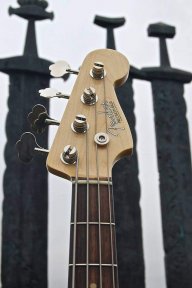
I like the B-string on my Sadowsky Vintage 5, it's sounds and feels integrated with the other strings. I use D'Addario 45-135 XLs.

- Apr 20, 2009
- 2,620
- 4,666
- Disclosures
- Endorsements: your name could be here, Mr. Sadowsky!
I think you're right, but I also think there's a similar difference between the E and the A string, and the A and the D, etc. that you ignore as well because you've become accustomed to it and adjust to it. Different strings sound and feel different, and to your ear the low B's you've heard don't sound right. I agree with you, and a lot of other folks do too, hence the market for longer scale basses, fanned frets, and balanced tension strings. I never heard a B string that sounded right until I played a good bass (in my case, Fodera, Smith and Rob Allen) together with an amp and cabinet that could reproduce the sound properly. I haven't tried the balanced strings but that's next on my list, that's more of a feel thing than a hearing thing (IMO).I have had numerous encounters with bassists who tell me about the killer B string on their basses, then they play it and the B string SOUNDS NOTHING LIKE THE OTHER 4 STRINGS. It sounds GOOD, but it definitely doesn't sound the SAME as the E, A, D, and G strings. It's like a totally different instrument when they drop that low B.


