• TalkBass has been independent since 1998. Add your voice.
    Create a free account to reply to discussions, view embedded media, and browse with fewer display ads.
    Join freeLog in
    Want zero display ads or expanded classifieds tools? Compare plans.

Is there a logic behind where exactly pickups go?

How about a different question:

Is there any pickup placement to avoid for any reason?

I strongly dislike pickups jammed right up next to the bridge. They just don’t have enough fundamental for my taste. But that’s just my opinion; it’s neither right nor wrong.
 
...Pickup location impacts tone, but the relationship between tone and position is just a smooth curve. Towards the neck and there's more emphasis on bass frequencies. Towards the bridge and there's less emphasis on bass frequencies. Slide a pickup from the neck to the bridge in small increments and you get correspondingly small and very predictable changes in tone.
There is a reason why Roscoe LG's are famous for slanted pickups.
And why a few people prefer the "reverse slanted" pickup placement, while still others favor the perpendicular placement.
And why there are basses with multiple pickups, and blend controls...
 
Correct, so do you want to emphasize harmonics or fundamental? ;) Besides the Physics getting basically impossible, it's also entirely subjective what sounds "best". So back to it being black magic rather than Science. :)

Just in case one wanted to emphasise the harmonics on bass 1, and the fndamental on bass 2; Where would you place the pickup on either. Starting with the open string(obviously?);)
 
Closer the pickup is to the bridge the less The string vibrates
that said, closer the pickup is to the bridge you Get less dynamics
That is because, the pickup generates less AC Current
More Consistent or dynamic Currents generated, these are your flavors...
 
Last edited:
Closer the pickup is to the bridge the less The string vibrates
that said, closer the pickup is to the bridge you Get less dynamics
That is because, the pickup generates less AC Current
More Consistent or dynamic Currents generated, these are your flavors...
Has anyone been talking about dynamics here?
Harmonics and fundamentals...wasen't these , we were talking about? :)
I can play as dynamic close to the bridge as I can closer to the neck. If anything, it gets easier to really control th estring as I get closer to the bridge. YMMV
 
Last edited:
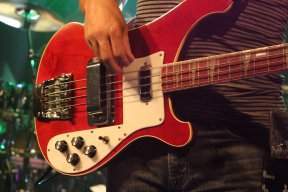
When studying a Ric 4003 for a clone build, I realized that the pickups for a 1" spacing at the neck fall almost perfectly on theoretical 24th and 36th fret locations, which cant have been accidental. How much that positioning contributes to the classic Ric tone is a mystery. The older Ric basses had 1/2" pup spacing at the neck, which aligns with nothing, go figure. A few TB'ers have built "mules" with sliding pickup locators as test beds, but as said, as soon as you fret the note, its all out the window. You could probably use a mule to ballpark it to where it generally sounds best, Im guessing thats what Leo Fender did. I have no idea what metric other modern builders are using, probably ballparking it too. Any mule builders out there, how well does it work?
 
Last edited:
  • Like
Reactions: cnltb
Diagrams that show harmonics as fixed standing waves like that are extremely misleading. The harmonic wavelengths don't just "sit" nicely in place in their fraction of the string. These diagrams imply that there are nodes where certain harmonics are essentially not present, which isn't true in practice. The actual movement of the string is essentially a slightly out of phase sum of all of the harmonics, which basically results in one slightly wonky wave that moves up and down the length of the string. The entire signal is present along the whole length, albeit in different amplitudes - lower frequencies are reduced in amplitude near the ends of the string, which is why bass frequencies tend to roll off as the pickup is moved towards the bridge.

Watch this:


Isn't it lower and upper frequencies? This is why a bridge pickup sounds choked. The string vibration moves along it's whole path so where the vibration is at it's greatest trajectory it expands across a greater frequency range.