• TalkBass has been independent since 1998. Add your voice.
    Create a free account to reply to discussions, view embedded media, and browse with fewer display ads.
    Join freeLog in
    Want zero display ads or expanded classifieds tools? Compare plans.

Double Bass Is there a way to shorten scale length?

I think the best thing would be to buy an inexpensive short scale and see if you like it.
Or for the time being get a capo and try it on different frets to see if it helps.
You know you're in the Double Bass section, and we don't have frets, and we don't use capos, and our "short" scale is about 40" mensure, and an "inexpensive short scale" would be a fractional size student instrument that costs maybe $1500-$2000, right?
 
  • Like
Reactions: SteveCS
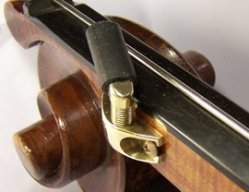
DoubleMidi, I think you might be right. If the bridge remains in the same position the mensure is measured from that point. An extended nut shortens the mensure towards the bridge. Using a new mensure of say 40 1/2" the D harmonic above octave G will be 1/2" closer to the bridge, the octave G harmonic will move 3/4" and the D at the base of the neck will move 1'' higher.

The whole purpose of this exercise for notchuck is to reduce the spans required for a whole tone in Half and !st Positions. Can anyone calculate, not guess, how much these will reduce?
 
DoubleMidi, I think you might be right. If the bridge remains in the same position the mensure is measured from that point. An extended nut shortens the mensure towards the bridge. Using a new mensure of say 40 1/2" the D harmonic above octave G will be 1/2" closer to the bridge, the octave G harmonic will move 3/4" and the D at the base of the neck will move 1'' higher.

The whole purpose of this exercise for notchuck is to reduce the spans required for a whole tone in Half and !st Positions. Can anyone calculate, not guess, how much these will reduce?

Even without a calculator, if you shorten to 1/2 position then the new 1/2 position is where 1 used to be, so you can see it and feel it without doing anything other than detuning a semitone then playing everything a 1/2 position higher.
 
  • Like
Reactions: robobass
You know you're in the Double Bass section, and we don't have frets, and we don't use capos, and our "short" scale is about 40" mensure, and an "inexpensive short scale" would be a fractional size student instrument that costs maybe $1500-$2000, right?

Sorry, didn't look. But this question comes up so often in the EB section I just looked at it without looking where it was.
 
  • Like
Reactions: Remyd
...
Can anyone calculate, not guess, how much these will reduce?

Since no-one else seems willing...

For a 42" scale, shortening by 1/2 position (2.357") will reduce the span F>F# by 0.132". Leaving the bridge in situ the 2nd harmonic moves towards the bridge by 2.357/2 = 1.1785".
  • For a 40" scale, shortening by 1/2 position (2.245") will reduce the span F>F# by 0.119". Leaving the bridge in situ the 2nd harmonic moves towards the bridge by 1.1225".
IMO, these reductions could be viewed as a lot of potentially expensive bother for very little gain. As always, YMMV
 
  • Like
Reactions: Don Kasper
It's a matter of technique and training.
I have rather short fingers but have no problem playing my 110 cm 4/4 5-string bass, if needed even with 4-finger-system with some tricks (and no double stops).
Playing a shorter scale instrument is really easy then.
It took some time to find a technique to do the 4-finger system on the long scale because stretching my fingers that much was not possible, but pivoting around the front end of the thumb even gave me one half tone more with a stretched index finger (like on cello). And I don't use that technique all the time, but I could if it makes sense.

I think it makes more sense to get used to the slightly longer scale and feel easy if you need to play a shorter one than to get used to the shorter scale and constantly complain if you need to play a slightly longer one.
 
Since no-one else seems willing...

For a 42" scale, shortening by 1/2 position (2.357") will reduce the span F>F# by 0.132". Leaving the bridge in situ the 2nd harmonic moves towards the bridge by 2.357/2 = 1.1785".
  • For a 40" scale, shortening by 1/2 position (2.245") will reduce the span F>F# by 0.119". Leaving the bridge in situ the 2nd harmonic moves towards the bridge by 1.1225".
IMO, these reductions could be viewed as a lot of potentially expensive bother for very little gain. As always, YMMV

Thanks for doing the Math.
I agree. The actual, measurable differences that result are not 'game-changing', IMO.
 
  • Like
Reactions: SteveCS