• TalkBass has been independent since 1998. Add your voice.
    Create a free account to reply to discussions, view embedded media, and browse with fewer display ads.
    Join freeLog in
    Want zero display ads or expanded classifieds tools? Compare plans.

Double Bass Is there a way to shorten scale length?

I keep thinking that if I had a smaller 1/2 position stretch then I'd be able to play faster. I've got small hands, and it's always been a struggle, but my max hand stretch is the 1/2 position. Would it be possible to keep my D neck with a modification like that? ...not sure, seems unlikely.

I think I saw something about a longer nut somewhere on the internet, but is that a real solution?

Playing an Englehardt. I'm thinking about shopping for a new bass, but I'm guessing whatever I'd spend on a new bass is going to be tons more than an extended nut, if that's the solution.
 
I keep thinking that if I had a smaller 1/2 position stretch then I'd be able to play faster. I've got small hands, and it's always been a struggle, but my max hand stretch is the 1/2 position. Would it be possible to keep my D neck with a modification like that? ...not sure, seems unlikely.

I think I saw something about a longer nut somewhere on the internet, but is that a real solution?

Playing an Englehardt. I'm thinking about shopping for a new bass, but I'm guessing whatever I'd spend on a new bass is going to be tons more than an extended nut, if that's the solution.

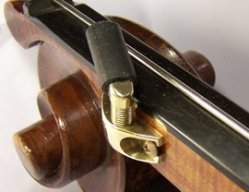
A false nut is by far the easiest way to shorten the scale length. Nothing wrong with doing that. It would move the D in relation to the heel though.
 
I'm considering having a false nut installed on my Czech bass. [...] My local luthier showed my a few ways it could be done and gave me some leather strips to experiment with

and

You can try a false nut to see if you like it!
Put a plastic cable-tie around the neck under the strings at the point you want to try the new nut. Doesn't have to be too tight!

Then tie another cable-tie OVER the strings, just above the first one.

I think I'll try these two ideas and see what happens with the feel...
 
  • Like
Reactions: Chris Fitzgerald
It was an Eb neck with a scale like a 7/8 bass. As I recall it was about 42.5. It wound up as a D neck with about a 41. The nut was done at the same time as a new ebony board to replace the rosewood board, and it looks completely original, not at all weird, and it plays great at this length.
 
The D on the G string at the base of the neck is 1/3rd the total open string length. It follows that if your false nut shortens the string by 1 1/2' the D will move 1/2" closer to the bridge.

What I call a D neck others may describe as E flat. My "D neck" has the index finger comfortably playing D when my thumb is about opposite E flat. If my D is opposite my thumb I would call this an Eflat neck. The neck is then tending towards short and my pinkie will find the F - C - G line of notes gradually harder to reach. The strategy then is to play these notes with the 3rd (ring) finger. Of course if you have a "long" necked bass then shortening the stop is moving towards comfort, not away from it.

Best wishes, DP
 
Another thing to bear in mind is string tension. If you shorten the scale by 1/2 position you will need to detune by a semitone. Go further and your strings might become unacceptably floppy. I would experiment with a leather or plastic strap around the neck (between strings and fingerboard - perhaps a couple of wide cable ties would work) at various positions first before committing to major surgery.
From my albeit limited experience with Cello I would be a bit leary of moving the bridge and soundpost too far out of alignment with the f-holes and the bass-bar.
Just a 0.02 from the BG side.
 
  • Like
Reactions: robobass
Once you shorten the mensure, then there are things you can do to offset the effects of lost tension. Heavier strings, taller bridge, then a fingerboard shim or neck reset to keep the string height you had before... It can get expensive really quickly. Just going from 42 to 41.5 shouldn't cause havoc though.
 
Yeah I'm planning on doing something with leather and/or cable ties, and see what happens. Detuning by a semitone though? I imagine a G would still be a G at the false nut, I would just have different string tension or something.

Yes and sorry - looking back my post could have been clearer. What I was getting at is if you install what is essentially a fret (!) at, say 1/2 position, what was E becomes F, A>Bb etc, so you then need to tune back down which will reduce the tension. Remove the 'fret' and your open string will be Eb, Ab, Db Gb - down a semitone.
You know us BG lot - always ready to muddy the waters :-)
 
Don't forget that when you move the nut alone, you move the D position at the neck heel by 2/3 of this distance in the same direction.

If you don't want that, you need to move the bridge by twice the distance towards the fingerboard. Since this is a lot, you might want to reduce the nut to a third of the total string length difference and leave 2/3 to the bridge movement.

For testing of string tension just shorten the string with your finger for the new total length (full difference, not 1/3) and tune down the string until the fingered note has the correct pitch.
 
I'm thinking about shopping for a new bass, but I'm guessing whatever I'd spend on a new bass is going to be tons more than an extended nut, if that's the solution.
Surely you can make the scale a little bit shorter, try what suits you with the zip-ties trick. But if you want anything significantly shorter, the proportions get to be wrong & the bridge & SP are really at the wrong place (or alternatively leave those in place & accept a C# neck). If you want something smaller, best buy something smaller.
 

Latest posts