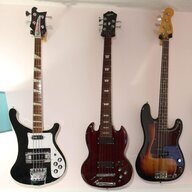
If you mean an animal without working digits, then yes =)It's a soundfont midi track bass. Nikki Sixx is an animal on bass.

TalkBass has been independent since 1998. Add your voice.
Create a free account to reply to discussions, view embedded media, and browse with fewer display ads.
Join free Log in
Want zero display ads or expanded classifieds tools? Compare plans.
If you mean an animal without working digits, then yes =)It's a soundfont midi track bass. Nikki Sixx is an animal on bass.

I remove everything over 1000hz, completely.... well maximum cut depending on the amp. -12 to -15 db, it gets the sound I like and it isn´t so dark.mostly mids and low mids and plenty of "growl"....you're using a high shelf cut at 1kHz?
How many dB?
You are totally correct in that higher frequencies can get hidden in the context of the mix, but that's a REALLY low frequency to set a shelf cut.
I usually don't set an LPF any lower than 5kHz when mixing, unless I'm going for a VERY dark bass tone.

Just curious... what type of speakers/headphones were you using when you listened to those thin-sounding bass tracks?
I agree about with the others about alot of them being ripped from files and not truly isolated master tracks, however, there have been a few Ive come across where the playing has been an eye opener. Sloppy and just not good, but it sounds fine in the mix. I wont name names but some bigger players have disappointed me. *cough* *cough*

By the studio or the artist hiring you? Yeah, in a hired gun situation, I would do what they want. That's happened maybe twice in my life.Why would you hand out money to a studio if you are the hired gun to lay down the bass-track?
Usually you'll get paid by the studio, which means they control the end-result of your sound.

I've always suspected this.My first question when hearing a YouTube isolated bass track is what was the source? I refuse to believe that all these people had access to the master tapes, and even if they did, older recordings were sometimes to four- or eight-track machines and giving the bass its own track wasn't always possible. This leads me to wonder if the tracks are created through some creative filtering which, if that's the case, I'm sure the result isn't exactly how the track originally sounded.

I remove everything over 1000hz, completely.... well maximum cut depending on the amp. -12 to -15 db, it gets the sound I like and it isn´t so dark.mostly mids and low mids and plenty of "growl".
Maybe this has already been said, but the surprise for me is just how much fret buzz there is in these tracks. I can't speak to whether they are real or not, but that much fret buzz makes me crazy. I am currently on a 12 step program to learn to live with more fret buzz and thus faster action.
....


This one sounds pretty phat to me. A little distortion on the busy chorus part also a couple of tiny flubs that I have never noticed in the mix.

Maybe this has already been said, but the surprise for me is just how much fret buzz there is in these tracks. I can't speak to whether they are real or not, but that much fret buzz makes me crazy. I am currently on a 12 step program to learn to live with more fret buzz and thus faster action.
All in all, the best thing about the isolated tracks I've heard, is that I feel much better about my abilities. At least from a playing perspective. There is nothing related to the creative aspect involved.
^^^^Exactly this^^^^ If someone else is writing the checks do your best give them what they want. If you are signing the checks give them what you want and work with your engineer to get there. I will say that I've had better luck communicating my wants and needs to studio engineers than live sound guys though. Not really sure why that is and of course ymmv.Tone Priorities Simplified
Your idea of good bass tone:
You->$$$$$$->>>>>Producer
Their idea of good bass tone:
You<<<<<-$$$$$$<-Producer
Ok, so 'splain to me - how does someone take a recording and "isolate" the bass track - I mean, some of these are JUST bass, with hardly a hint of any of the original song - how do they do that? Is there some super accurate software that can find and pick out only a single instrument and filter out everything else? I've never heard of such a thing (but then, I don't get out much these days!)
So then these come from the actual, original multitrack recordings? I would not have thought something like that would be so widespread. I wonder if some really aren't but are someone doing their own "cover" of a part and claiming it's the isolated track from the original.