other than the cost of engineering this...there must be a reason this didn't take off big with Fender or other big instrument co. this seems ideal for working musicians who deal with multiple factors.
Licensing, exclusivity maybe? Since original Steinbergers have a titanically strong neck that probably helped with overall pitch stability and playability, especially when tuning UP.
Steinberger World has a treasure trove of info on all-things-vintage-Ned, and I'll borrow a bit from them (and post a link below) on just the thinking around strings for a TT, bass or guitar:
What does the term "calibrated" mean?
When Ned originally designed the TT he had to establish some basic rules of operation. The first of these was that the double-ball end strings needed to be an exact length. This would position the larger ball end at a precise location within the bridge assembly, and provide the ideal rotational angle point (or more accurately the distance of movement) to transpose.
This is the scientific basis for how the TransTrem works. If you'll notice, the pivot points of the bridge are asymmetrical. This makes the bridge rotate at an angle (rather than directly parallel to the strings like on most other trems) when engaged. This slight angle stretches each string a different distance, which results in a varying rate of tension change for each one (more for the low E, less for the high E). This provides the transposing. There were obviously a lot of equations (and trials & errors) in figuring this stuff out. There were attempts thoughout the years to build trems that transposed (it's not a new idea), though none locked in place in the various keys. Ned's overall approach was radical and inspired genius.
This precise transposing action requires exacting specs on the string length. If the strings are too long the transposed notes are flat - too short and they're sharp. The farther you go out from the center unlocked position the worse it gets. Because tension on each string varies (due to construction, gauge & frequency differences) the ideal length of each string is also different for each manufacturer
Ned chose the term "calibrated" to define strings that are the precise length needed to transpose properly. A calibrated string is technically within 1/16" of his specification when tuned; that is within .0625" of it's ideal length. Any more than that and the string won't transpose. Ned did build a "fudge factor" into his bridge - the fine transposing tuners allow you to compensate for any minor, real-world variations in actual length. This term "calibrated" is not trademarked nor proprietary. Ned intentionally shared it to allow any manufacturer to use the term (and the underlying processes to determine it). His hope was that it would offer the widest variety of options to his customers.
Understand that not all double-ball strings are calibrated. The process of determining the calibration spec is different for each maker, depending on their construction techniques. There is an exacting process (usually including lots of testing) to measure. But once the calibration is set for a specific string, the manufacturer can then make thousands of them to that precise length. As long as they don't change any major factors (type of metal, core diameter, wrap diameter, # or wraps, etc.) the spec remains constant.
Ned actually made a custom headpiece that he could use to quickly check the lengths of the strings and tell how far in/out of spec they were. For a time the company regularly tested each manufacturers strings. Once Gibson bought the company this process slowly went away and hasn't been done for many years. Ned still has that headpiece, and just recently has started helping us by testing strings and working with the manufacturers again (most notably D'Addario). Mind you he doesn't get a dime for this - he does it to help those who've come to buy and enjoy his namesakes.
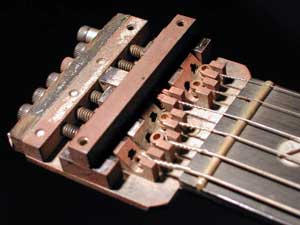
A close-up photo of Ned's custom calibrating headpiece. It was not a production piece, so the steel was never coated (hence the rust).
When Ned originally designed the TT he had to establish some basic rules of operation. The first of these was that the double-ball end strings needed to be an exact length. This would position the larger ball end at a precise location within the bridge assembly, and provide the ideal rotational angle point (or more accurately the distance of movement) to transpose.
This is the scientific basis for how the TransTrem works. If you'll notice, the pivot points of the bridge are asymmetrical. This makes the bridge rotate at an angle (rather than directly parallel to the strings like on most other trems) when engaged. This slight angle stretches each string a different distance, which results in a varying rate of tension change for each one (more for the low E, less for the high E). This provides the transposing. There were obviously a lot of equations (and trials & errors) in figuring this stuff out. There were attempts thoughout the years to build trems that transposed (it's not a new idea), though none locked in place in the various keys. Ned's overall approach was radical and inspired genius.
This precise transposing action requires exacting specs on the string length. If the strings are too long the transposed notes are flat - too short and they're sharp. The farther you go out from the center unlocked position the worse it gets. Because tension on each string varies (due to construction, gauge & frequency differences) the ideal length of each string is also different for each manufacturer
Ned chose the term "calibrated" to define strings that are the precise length needed to transpose properly. A calibrated string is technically within 1/16" of his specification when tuned; that is within .0625" of it's ideal length. Any more than that and the string won't transpose. Ned did build a "fudge factor" into his bridge - the fine transposing tuners allow you to compensate for any minor, real-world variations in actual length. This term "calibrated" is not trademarked nor proprietary. Ned intentionally shared it to allow any manufacturer to use the term (and the underlying processes to determine it). His hope was that it would offer the widest variety of options to his customers.
Understand that not all double-ball strings are calibrated. The process of determining the calibration spec is different for each maker, depending on their construction techniques. There is an exacting process (usually including lots of testing) to measure. But once the calibration is set for a specific string, the manufacturer can then make thousands of them to that precise length. As long as they don't change any major factors (type of metal, core diameter, wrap diameter, # or wraps, etc.) the spec remains constant.
Ned actually made a custom headpiece that he could use to quickly check the lengths of the strings and tell how far in/out of spec they were. For a time the company regularly tested each manufacturers strings. Once Gibson bought the company this process slowly went away and hasn't been done for many years. Ned still has that headpiece, and just recently has started helping us by testing strings and working with the manufacturers again (most notably D'Addario). Mind you he doesn't get a dime for this - he does it to help those who've come to buy and enjoy his namesakes.
A close-up photo of Ned's custom calibrating headpiece. It was not a production piece, so the steel was never coated (hence the rust).
Link: TransTrem Tips