• TalkBass has been independent since 1998. Add your voice.
    Create a free account to reply to discussions, view embedded media, and browse with fewer display ads.
    Join freeLog in
    Want zero display ads or expanded classifieds tools? Compare plans.

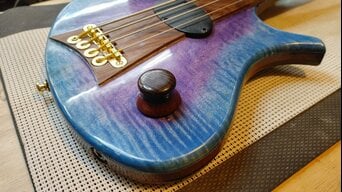
Laguna burger build

One other trick for using LMI glue for gluing frets: Before installing the frets, I seal up the fingerboard surface with a coat or two of Stew-Mac's Fingerboard Oil. If I apply the LMI glue to the slots neatly, there usually won't be any squeeze out when I press the frets in. But when some does, I let it dry as a blop. Resist the urge to wipe it while it's wet; that just makes more of a mess. The dried blop pops right off clean with a fingernail or a small plastic edge.
 
For filling the fret slots on the side, where the tangs were cut back,... Should I pack it with dust first and then a drop of thin CA? Is that standard procedure?
Seems whenever I use wood glue and fill with dust, it always shrinks and never matches.

That sawdust and glue trick has never worked for me either. To fill the ends of fret slots, I like colored glue. For maple, LMI glue by itself dries to a nearly maple color. It fills the gap, dries hard, and can be filed and sanded.

For rosewood, I use epoxy tinted brown. Ebony, epoxy tinted black.
 
I glue my frets in with LMI Instrument Maker's Glue, which is a variant of Titebond. The purpose of the glue isn't to help hold the frets in. It's to completely fill the gap in the slot around the fret tang and seal up the wood against moisture. Pressing /hammering the fret in forces the glue into the end grain on the side walls of the slot.

Moisture seeping in around the frets and sinking into the end grain in the slots causes the wood to swell. That pressure, applied against all the frets along the neck, is the biggest cause of necks bending when the humidity goes up. Short term instability, truss rod adjustments, etc. And when that wood next to the fret swells, it also tends to push the fret up. And when the weather dries up again, the frets are raised up and loose.

So, in a roundabout way, gluing the frets in helps keep the frets down and tight.

Like Beej said, the glue also helps lubricate the slots and the frets go in easier and seat better.
That ^^^ makes sense.
 
I woke up at 4:30 here (not on purpose) and couldn't fall back asleep.
I normally have trouble falling asleep at a reasonable hour, but once I'm out, I'm about in a coma and it takes a parade to wake me up in the morning.
But this waking early and staying up is getting more frequent. I guess it's just one of those old guy things to look forward to.
I will say, I like the peace and quiet and having the house to myself for a couple hours.
Sorry about the insomnia. That's horrible. That's the kinda thing that will make you nuts and start doing weird stuff like build guitars.
 
I'm going to invent and sell fret glue.
The ingredients will not be listed on the bottle.
It will cost $39.99.
I will be rich.
The end.

I'm kind of surprised that Stewmac doesn't already sell a purpose-marketed fret glue!

I use thick CA. I've forgotten the brand of glue I use, but it's one of the "thick CA" products that is thick, but not suuuper thick to the point that it's like a immovable gel. I think it's Bob Smith or one of the white label brands that use their stuff. It still runs a tiiiiny bit. This helps with my technique. I tilt the bottle tip down so the glue runs down to the tip, then literally just drag it across the bottom of the tang. No squeeze, just drag. Capillary action helps the glue run out and it leaves a very small bead of glue right down the bottom edge of the tang. Then I set the fret in place and hammer it in. There's enough glue that it totally fills the slot but not enough that it squeezes out onto the fretboard surface - most of the time! If I get heavy handed and cause some squeeze out, I just wipe it off. Happens once or twice a fretboard. For darker wood fretboards, I finish them with stewmac's fretboard finishing oil, which is oily enough when it's fresh that super glue wipes off totally cleanly. For lighter woods like maple, I put a hard finish on after fretting (usually wipe on poly), and any tiny amount of glue squeeze out just sucks down into the bare wood and disappears under the finish. No problemo.

I used to not glue my frets, when I was slotting fretboards by hand. I didn't think I needed to and it seemed like an extra step. When I switched to the power fret slotting saw, I was experimenting with slightly different slot widths to find the perfect fit for the fretwire I liked and I decided to start gluing them. It's one of those little details that may not make a super obvious or super immediate difference, but I do feel it can be important - or, at least, there's a chance that it's important - to the extent that I'm happy to do it.
 
Just a quick note about color matching for filling the ends of your slots where you cut your tangs back. Starbond makes a "Brown", a "Dark Brown" and a "Black" CA glue in various different viscosities. Check into it, one of them might work better than trying to tint epoxy.

Also, if you're smart, you'll visit a few different woodturner's YouTube pages, or even that bald headed tattooed YouTube guitar builder with the cool accent and grab a discount code before you place your order. Lots of them have a 10% off code, a few have 15% off. Look around and see who has the good code. ;)
 
West Systems epoxy is very easy to tint to opaque colors. My favorite pigments to add to epoxies are Smooth-On's So-Strong series. One drop of So-Strong Black in a small cup of epoxy will turn it solid black. That's how I patch holes and cracks in ebony fingerboards. For rosewood, So-Strong Brown is pretty close, but you may want to adjust the color to match with a tiny bit of black or red.

SO-Strong™, Color Tints for Urethane

There are also many competing brands of pigments available; look under Hobbies & Crafts; epoxy colorants.
 
I'm going to invent and sell fret glue.
The ingredients will not be listed on the bottle.
It will cost $39.99.
I will be rich.
The end.
I'm going to trademark Tone Fret Glue and you'll be out of business in a week. At which point I'll buy up your old stock for pennies on the dollar and add the word tone with a Sharpie. It's a dog eat dog business, or in this case mouse eat squirrel.

When I first started doing frets in the late '80s I saw an article (possibly from Dan Erlewine) that suggested using a dental burr in a dremel to open the slots wide enough that a fret can be gently pushed in place where it will be held solely by thick CA. I still have some guitars done that way 30 years ago but I don't do fret jobs like that anymore and I'm certainly not recommending it.