
• TalkBass has been independent since 1998. Add your voice.
    Create a free account to reply to discussions, view embedded media, and browse with fewer display ads.
    Join freeLog in
    Want zero display ads or expanded classifieds tools? Compare plans.
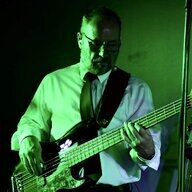
Last gig with an amp!

Congrats!! Just keep in mind the IEM process is like the process of finding an amp/cab combo. It takes a while. Getting to right buds and the right fit and the right pedal board/DI etc etc etc.

But lugging a fridge vs lugging a 3 oz pair of IEM’s?? Fuggetabowdit. When ampless my gig rig is two basses and a small pedalboard. Done. Sounds huge through the FOH.


So the popular adage goes with age comes lighter gear. I turn 65 next month, what is wrong with me? View attachment 5366754 I took this out last weekend. It was a beautiful outdoor gig. I did it partly to prove to myself that I could still load and unload it. It was awesome! We recently upgraded our PA from passive sub/mains to a LD linear array system. The sad thing is that I now have a music room full of amps that I no longer need. We’re on IEMs so we’ll be amp-less on stage. I was using various amps to help fill in the low mids and low end depending on the venue. With the frequency response and power of the new system, it’s not required even at big outdoor venues. I’ll hold onto my stuff for awhile and rotate them as practice amps. From now on, just DI from the pedal board! :)

 
As has been said earlier, one downside with IEM’S is the lack of “feeling” the bass. I’ve only played a couple of ampless gigs although we have all used IEM’s for some time now. I’ve still been using my combo as well but it is not run at ‘normal’ playing volume, it gives that bit of ambience and feel to the sound.

My main concern about going ampless at the moment is not hearing my Taurus pedals properly, through IEM’s alone they sound much weaker and ‘watered down’ from them not being played through my amp, even if they are at a reduced stage volume. The only ampless gigs I’ve done so far have also been without the Taurus pedals. I’m not entirely convinced that our sound guy will give enough Taurus through FOH, with my backline amp I know they are at a reasonable volume level to be heard out front (in most venues we do anyway).
 
I disagree with the PRE-EQ part.. might be why so many view IEM mixes as dry.. ??
Mine are POST-EQ and I also add effects as needed (reverb, delay).
The reason I say this is because at a recent gig, our guitar player had problems with his mix changing and couldn't figure out why. Turns out the sound guy was tweaking his sound out front and was sweeping frequencies to dial out the ice pick like sounds coming from his Tele. He had just switched from a Les Paul. He became frustrated and ripped the ear buds out and wouldn't put them back in, even after we discovered the problem (post EQ mix). I do like a bit of reverb in my mix, though!
 
  • Like
Reactions: s0c9
No doubt, the pre-EQ/post-EQ can be a tough one and a balancing act as well.

If a band has a good mix that stays consistent (for the most part) from gig to gig, post-EQ is fine IF the sound person is aware of his moves affecting the monitor mixes and isn’t a crazy tweaker all night. The worst offenders are the sound folks that insist on mixing with input gains “because it sounds better”, totally insensitive to the players’ need for mixes not changing. And I’ve had to fire a couple of decent sound folks because that.

If I’m starting a mix from scratch on one desk for both purposes, I’ll go with pre-EQ mixes, dial up the house mix, and then try and taylor the tone preference of the player with his monitor aux EQ. Again, trying to not go crazy as this affects other instruments in that player’s mix. And to make sure I can send a bit of FX to the player’s mix if so desired. All of this is super-critical with IEMs, but still important with wedges as well as now being aware of tuning wedges for feedback control.

In almost all cases of single desk band gigs, it’s a juggling act.

Unfortunately, some sound folks are more sensitive to the player’ needs and willing to make the juggling efforts than others. And no, it’s not an easy task at times.

(Edit: as usual, I’ll say the unspoken part….being a player helped me understand players’ needs and not be so dismissive of those needs when being a sound guy….:D)
 
Last edited:
The worst offenders are the sound folks that insist on mixing with input gains “because it sounds better”, totally insensitive to the players’ need for mixes not changing. And I’ve had to fire a couple of decent sound folks because that.
It might just be me, but that's NOT how one should mix - there's no gain staging of channels or system involved.

Along those lines, there's a church I have been called into to run sound for their "contemporary" service on a irregular basis over the last couple of years.
I will be doing their outdoor sunrise and regular Easter Sun services [our PA set up from scratch, not theirs] for a 3rd yr in a row in 2 weeks!
Their regular sound guy is (sadly, 2 yrs later STILL) a "beginner" and has "how to run live sound" books stacked in the sound booth - if that tells you anything.
He has a tough time controlling feedback in the venue, so he sets the trim/gain on the full-size X32 around 8-9am for mics (Beta58's, Senn E835's) that generally require gain to be around 1-2pm on that console.
If I change the gain for the FOH mix, then all 7 of their IEM mixes will be impacted, so I'm stuck w/ EQ and channel faders only. <shrug>.
 
  • Like
Reactions: Geri O
Ampless and IEM are two different things. I'm ampless for 15-20 years and never been on IEM except at home.
The drummer switched to Roland eDrums so we are just using 1-2 power PA speakers as monitors. Not loud, easy and fun.