
OP could learn from many people on here about how basses are manufactured and why shims are a reasonable part of that process. Instead, he's willing to die on his hill. Odd choice, but not uncommon on TB.

Enjoy the benefits of a premium membership!
Upgrade Account
-
TalkBass has been independent since 1998. Add your voice.
Create a free account to reply to discussions, view embedded media, and browse with fewer display ads.
Join free Log in
Want zero display ads or expanded classifieds tools? Compare plans.
You are using an out of date browser. It may not display this or other websites correctly.
You should upgrade or use an alternative browser.
You should upgrade or use an alternative browser.
Lemons (warning: G&L rant)
- Thread starter smtp4me
- Start date
More options
Who Replied?

I feel like this is less an issue of setup and more an issue of point of view. We can all agree it needs a shim and a set-up, and that can be remedied by an experienced tech. The disagreement lies in the OP believing that the bass is defective because it needs a shim, and the rest of folks understanding that a shim can be necessary given manufacturing tolerances and set-up preferences. And whether or not you believe a shim shouldn't be needed, in this case it is. One can cry foul til the end of time saying it's a manufacturing defect, but that isn't going to get you anywhere because not only is it necessary in this instance, it is also not some unheard of, wildly uncommon thing, and is widely practiced by manufacturers. Shims are a fact of life with bolt on style necks, and while not every instrument with a bolt on neck needs one, many (likely most) do.
If anything the argument here is the OP believes manufacturers should have perfect tolerances, and that doesn't seem terribly realistic. If the bass had come from the factory sans shim, and was not playable because of that fact, that could be considered defective. I don't think the analogy of a duct tape on a bike is accurate, and I think is being used because a shim made out of sandpaper isn't exactly cutting edge. But small components being used to fine tune operation is common. Maybe something like on a fuzz pedal, there's a variable resistor to fine tune the bias. It's replaced with a variable resistor of a different value, and now it's not working. Well the resistor was there and at that value for a reason, to fine tune operation, has been replaced with a similar component but that new component isn't equal to the original, and so now operation is not the same. That's not a manufacturing default.
Even if the bass is remedied with the correct shim put back in, I think the OP will be much happier in the long run coming to understand the necessity of it and reason behind it, if only for peace of mind.
If anything the argument here is the OP believes manufacturers should have perfect tolerances, and that doesn't seem terribly realistic. If the bass had come from the factory sans shim, and was not playable because of that fact, that could be considered defective. I don't think the analogy of a duct tape on a bike is accurate, and I think is being used because a shim made out of sandpaper isn't exactly cutting edge. But small components being used to fine tune operation is common. Maybe something like on a fuzz pedal, there's a variable resistor to fine tune the bias. It's replaced with a variable resistor of a different value, and now it's not working. Well the resistor was there and at that value for a reason, to fine tune operation, has been replaced with a similar component but that new component isn't equal to the original, and so now operation is not the same. That's not a manufacturing default.
Even if the bass is remedied with the correct shim put back in, I think the OP will be much happier in the long run coming to understand the necessity of it and reason behind it, if only for peace of mind.

According to post #1 OP knows about shims, has been at this for decades, and is also unhappy based on his experience with a shim. They're not mutually exclusive. He lead with a rant disclaimer. In return he's been "offered" an "education" about why his feelings are wrong.
That's what's also not uncommon on TB and something I don't care for: the impulse for groupthink and bandwagoneering. Even if OP is wrong, the distaste for nuance and disagreement is...distasteful.
Instead we get this binary, armchair troubleshooting: diagnose, advise, and pummel anyone who gets in the way.
Hell with 'em, OP; stand your ground!
That's what's also not uncommon on TB and something I don't care for: the impulse for groupthink and bandwagoneering. Even if OP is wrong, the distaste for nuance and disagreement is...distasteful.
Instead we get this binary, armchair troubleshooting: diagnose, advise, and pummel anyone who gets in the way.
Hell with 'em, OP; stand your ground!

Appreciate the support!According to post #1 OP knows about shims, has been at this for decades, and is also unhappy based on his experience with a shim. They're not mutually exclusive. He lead with a rant disclaimer. In return he's been "offered" an "education" about why his feelings are wrong.
That's what's also not uncommon on TB and something I don't care for: the impulse for groupthink and bandwagoneering. Even if OP is wrong, the distaste for nuance and disagreement is...distasteful.
Instead we get this binary, armchair troubleshooting: diagnose, advise, and pummel anyone who gets in the way.
Hell with 'em, OP; stand your ground!
And yes... In the OP I wrote, verbatim: "I feel like I got a lemon"
Apparently I am wrong to feel that way.
I also wrote that I am struggling to get the bass properly setup, including with a new shim.
Apparently I am wrong to feel that way because shims are normal.
Another respondent wrote an analogy about a bike being held together with duct tape. I agreed.
Only to be offered Straw Man fallacies claiming that I think all basses with shims are bikes with duct tape, instead of just the one I am dealing with. Which I never wrote.
But... at least... once I wade through the noise there are several helpful replies. Which is what I originally requested.

All three of Leo Fender’s companies not only have used paper shims since the start but all at some point used metal micro-tilt adjustment at the neck joint, which is effectively just an adjustable shim (which went out of fashion because a lot of users didn’t know how to utilize them safely). I don’t know of a single mass-manufactured bolt-on instrument company that doesn’t use a shim in the neck pocket at least occasionally, and plenty of basses over $1000 rely on them without complaint- I’ve also added them (or bolstered existing shims) to a few old instruments after fret levels to help dial them in again. The use of shims allows a much wider tolerance of neck angle, which is helpful in instruments where small differences in sanding or fretting/etc can have very noticeable effects on the plane of string action when the instrument is assembled. It was something Fender relied upon to make his designs work well from the start and even with CNC machines today doing most of the cutting work to higher precision than the hand-cutting in the early days of Fender, these days the sanding, fretting and finishing process can still make shims a necessity for consistent setup in a mass-production environment. There’s literally nothing wrong with the use of a shim and probably many of the most famous Fenders in the world have (or had) them from the factory.Not ignored. There is a difference between attempting to fix an issue and only taking to a pro when that fails, vs. taking it immediately. I prefer the former, and only after I have exhausted what I am capable of.
A bass that is unplayable without a shim, is defective. It would remain defective even if never disassembled. Hard stop. Adding a shim to correct a flaw does not erase the fact that the flaw exists.
Last edited:

Appreciate the support!
And yes... In the OP I wrote, verbatim: "I feel like I got a lemon"
Apparently I am wrong to feel that way.
I also wrote that I am struggling to get the bass properly setup, including with a new shim.
Apparently I am wrong to feel that way because shims are normal.
Another respondent wrote an analogy about a bike being held together with duct tape. I agreed.
Only to be offered Straw Man fallacies claiming that I think all basses with shims are bikes with duct tape, instead of just the one I am dealing with. Which I never wrote.
But... at least... once I wade through the noise there are several helpful replies. Which is what I originally requested.
Yet you specifically had to crap on G&L which is doing nothing different than any other mass producer of good quality basses.
So Anyway, I'll bet the person at the Tribute factory could put the bass back together in about 20 minutes and it would be setup close to original. If you put 20 basses together every day, you'd get good at it pretty quick.
I've owned several American and Tribute G&L's. They were all a good value and played just fine. If one needed a setup or adjustment, I'd take it to a pro luthier that I always use. He does more set ups a month than I've done in my life.
Good Luck to the OP and I'd be interested in the final outcome.
I've owned several American and Tribute G&L's. They were all a good value and played just fine. If one needed a setup or adjustment, I'd take it to a pro luthier that I always use. He does more set ups a month than I've done in my life.
Good Luck to the OP and I'd be interested in the final outcome.

All of this said, I have heard more QC complaints about the Tribute series than USA made. My 83' L2k is the proverbial Tank, it's never needed anything other than occasional truss rod adjustments, and it still has it's original stainless frets. A superb bass in every respect.

Yes on this. It kills me when someone is looking at a used bass or it just arrived and they show pics of the bass COMPLETELY DISASSEMBLED! If it was a bass I sent you, you just voided any return policy.
There are amateur luthiers...and then there are just amateurs
 (not directed at the OP in anyway)
To be fair, there are plenty of QC complaints around (including TB) about BBE-era US G&Ls too- but not because of the use of neck shims that I've ever seen! I've owned multiple vintage US G&Ls (one L-1000 and one L-2000E) that required use of the micro-tilt to dial in low action beyond bottoming out the bridge, but that didn't bother me at all (and its why they bothered adding the micro-tilt feature!). One issue with some older G&Ls was a "ski-bump" that would develop in the high frets, and it wouldn't surprise me if this was sometimes a result of the misuse of the micro-tilt and perhaps why they did away with it in the 90s (if I remember my timeline right). I had an early-2000s US L-2500 that had a paper neck shim BTW (never took the neck off the US SB-2 I had from the same era, but wouldn't surprise me if it also had one)All of this said, I have heard more QC complaints about the Tribute series than USA made. My 83' L2k is the proverbial Tank, it's never needed anything other than occasional truss rod adjustments, and it still has it's original stainless frets. A superb bass in every respect.
Last edited:
Well... it is a G&L bass. I'm certainly not going to blame Gibson. Just because most mass-producers use them does not equal that G&L is doing it well. And again, I've owned eleven basses that did not need a shim of any kind. So apparently mass-producing basses with proper necks and neck pockets is not the elusive Unicorn that some here want to claim.Yet you specifically had to crap on G&L which is doing nothing different than any other mass producer of good quality basses.
OP, didn't you know you were supposed to keep the make of the bass to yourself?Yet you specifically had to crap on G&L which is doing nothing different than any other mass producer of good quality basses.
G&L fanboidom is real.

Twelve basses in half a century is not a representative sample when we're talking about companies that regularly produce thousands of instruments in a single year. No, it's not impossible to produce an item that doesn't need a shim, but given the numbers involved and the likely tolerances that are allowed for each individual piece, shims are very common, and that goes beyond just musical instruments into all sorts of other production items.
I can't speak for the emotional side of the response because we'll all feel things differently, but in a lifespan that's only a bit more than half of the time a lot of the posters on here have been playing professionally I've learned that with a lot of the things we want to rant and rave about our emotions are divorced from the logical reality of the situation, and it's often only worth going into the ranting and raving with more immediate friends than taking up space on the imaginary street corner to shout about it.
Not just because then you'll get all the passers-by that want to point out how what you're ranting about doesn't measure up logically, but because invariably you end up showing your backside in the process. I'd rather only have that happen with my friends than with strangers, but people can be weird in their own ways.
I can't speak for the emotional side of the response because we'll all feel things differently, but in a lifespan that's only a bit more than half of the time a lot of the posters on here have been playing professionally I've learned that with a lot of the things we want to rant and rave about our emotions are divorced from the logical reality of the situation, and it's often only worth going into the ranting and raving with more immediate friends than taking up space on the imaginary street corner to shout about it.
Not just because then you'll get all the passers-by that want to point out how what you're ranting about doesn't measure up logically, but because invariably you end up showing your backside in the process. I'd rather only have that happen with my friends than with strangers, but people can be weird in their own ways.
OP, didn't you know you were supposed to keep the make of the bass to yourself?
G&L fanboidom is real.
LOL, you assume way too much.
OK, my G&L shim story. About a year ago, I bought a Fallout Tribute direct from G&L when they were dumping some cosmetic seconds for great prices. It was a really nice bass but I couldn't quite get the action down to where I wanted before the saddles bottomed out. I took the neck off and found the sandpaper shim in the pocket. It just wasn't enough, probably because the wood moved somewhere between Indonesia and my house. No problem. I just replaced their shim with a slightly thicker cardstock and all was well. It set up perfectly. Nothing wrong with that bass and certainly not defective to any reasonable person.
Unfortunately, I never bonded with the ergonomics of that bass so despite a killer tone from the MFD pickups, I had to move it along. So, not a "fanboi" (everybody thinks they're cute using that spelling
 ).
).
Appreciate the support!
And yes... In the OP I wrote, verbatim: "I feel like I got a lemon"
Apparently I am wrong to feel that way.
I also wrote that I am struggling to get the bass properly setup, including with a new shim.
Apparently I am wrong to feel that way because shims are normal.
Another respondent wrote an analogy about a bike being held together with duct tape. I agreed.
Only to be offered Straw Man fallacies claiming that I think all basses with shims are bikes with duct tape, instead of just the one I am dealing with. Which I never wrote.
But... at least... once I wade through the noise there are several helpful replies. Which is what I originally requested.
You have been on TalkBass long enough to have discovered that close reading is not high on the membership-at-large's list of virtues. There is always going to be noise interfering with the signal.
Just to put this in perspective, within the last week I have read in two credible sources that the fingerboards on those Loar mid-twenties mandolins, those deified F-5s, all came from the factory with misaligned fingerboards that made it impossible for them to be played in tune.
And here we are carping over a piece of sandpaper. (And, for further perspective, Garry basses -- and I and others regard Glarry as the best bang-for-the-buck instrument currently out there -- *have* to have the necks shimmed. Otherwise the bridge saddles will bottom out. Every time.
And here we are carping over a piece of sandpaper. (And, for further perspective, Garry basses -- and I and others regard Glarry as the best bang-for-the-buck instrument currently out there -- *have* to have the necks shimmed. Otherwise the bridge saddles will bottom out. Every time.

OP,Thanks for taking the time to reply with such detailed suggestions!
Part of my frustration comes from the fact that I have already tried most of them, to no avail. I've tried shims made of different materials (wood, paper, metal), shims of different dimensions (length, width, thickness), and even different locations in the neck pocket. I tried a piece of sandpaper approximately the same size as the original, placed in the same location. I tried shims that are similar to the original (a strip) vs. shims that fill the entire pocket. I have been extremely systematic in my approach.
You mention: "It's not very common, and shouldn't be necessary on a properly made guitar, but it if works...". This is where the vast majority of frustration is coming from. Another person wrote that this is equivalent to a bike that is held together by duct tape. If the duct tape is removed and the bike no longer works, but only worked because of the tape - was it ever really a functional bike to begin with?
I may have to take it to a tech or luthier.
Yes taking to a luthier is a great idea.
Respectfully, everyone here is trying to help solve the issue you are having with your instrument.
A competent luthier or good tech can make ANY bolt-on play well with enough work, sometimes the amount of work exceeds the cost to replace the neck or even the instrument, but what you are describing doesn’t sound like that is the case here. If the issue can be fixed with a shim, then the instrument is not defective. It is just not properly setup. Again everyone is trying to help you fix the setup, but you seem to just be arguing that the obvious solution shouldn’t be necessary.
When you state that you have already tried shims of all different materials, sizes and shapes, it sounds like you don’t really know how to use a shim. Because, frankly, ANY material will work, the shape is always the same (a rectangle) and the size is determined by how many 64ths you want to raise the saddles.
Its all about the angle of the neck in relation to saddles. It typically has nothing to do with the depth of the pocket or thickness of the heal, it’s about them being parallel, or almost parallel, to each other.

I understand all the factors that can affect a wooden instrument. However I respectfully disagree about this not being a factory issue.
Without a shim, the neck sits too deep in the pocket. So deep in fact that the bridge saddles cannot be lowered enough to compensate. When the saddles are dropped as far as possible, the action is still so high as to render it unplayable. As I wrote in another post, bridge saddles are designed to have adjustable height specifically to compensate for variances. This bass is so far out of spec that the bridge cannot be made to compensate. That is and always will be a factory defect, in my opinion.
There can only be two causes (maybe a little of both)
I just don’t think that expecting a guitar to be playable without significant intervention is some kind of unrealistic goal.
- The neck pocket was routed too deep
- The neck heel was shaped too thin
See, the bold bit there is the unrealistic bit. A shim is not "significant intervention" any more than putting air in your tires when it gets cold out is a "significant auto repair".
See this thing right here on the A string?
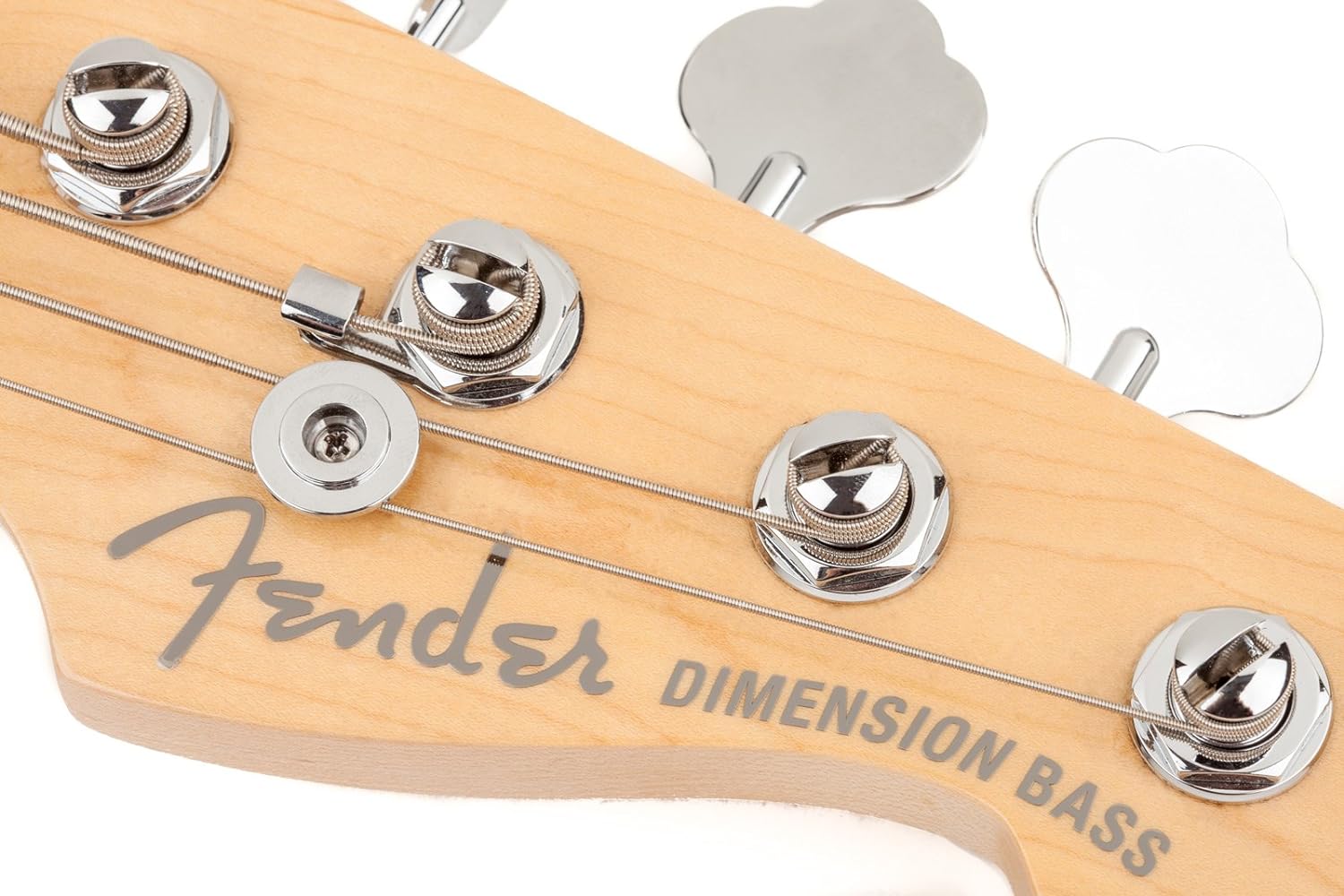
That's a "stealth string retainer".
Some people find that the break angle on some Fender basses is insufficient between the nut and the tuner and as a result it is troublesome to set up with one's preferred choice of strings/tunings without an awful rattle. The A-string break angle depends on a lot of variables. Nut, tuning machines, string trees, strings, tuning, compensation of the tuning machines, etc.
So Fender made this little string retainer to solve that problem. It comes aftermarket.
Are Fenders with the "stealth string retainer" installed lemons?


