
DARIO DEIDDA...he sounds great...30" scale, wooden bridge...I've always felt short scale basses to be very nice for playing upright style tone, and the it's easier to transition from my upright to short scale electric without left hand reorientation. Very natural feeling transition.

Enjoy the benefits of a premium membership!
Upgrade Account
-
TalkBass has been independent since 1998. Add your voice.
Create a free account to reply to discussions, view embedded media, and browse with fewer display ads.
Join free Log in
Want zero display ads or expanded classifieds tools? Compare plans.
You are using an out of date browser. It may not display this or other websites correctly.
You should upgrade or use an alternative browser.
You should upgrade or use an alternative browser.
Double Bass Lightness of touch (DB forum thread)
- Thread starter Chris Fitzgerald
- Start date
More options
Who Replied?
DARIO DEIDDA...he sounds great...30" scale, wooden bridge...I've always felt short scale basses to be very nice for playing upright style tone, and the it's easier to transition from my upright to short scale electric without left hand reorientation. Very natural feeling transition.
A 30" scale bass???
There's a "small d**k" joke in here somewhere, but I can't seem to put my hand on it.

This was custom made for me by Mike Kinal. Thick chunky neck, high string height as far as electrics go, ebony fingerboard and a passive piezo wired directly to the Jack, which is also a strap button. Spruce top and a maple back. Currently strung with white copper nylon Strings. E-C which also allows for comping which I think is a very useful addition to an instrument designed for a jazz environment. Still working out my comping chops.
I've got another bass on the way with a similar idea in mind.
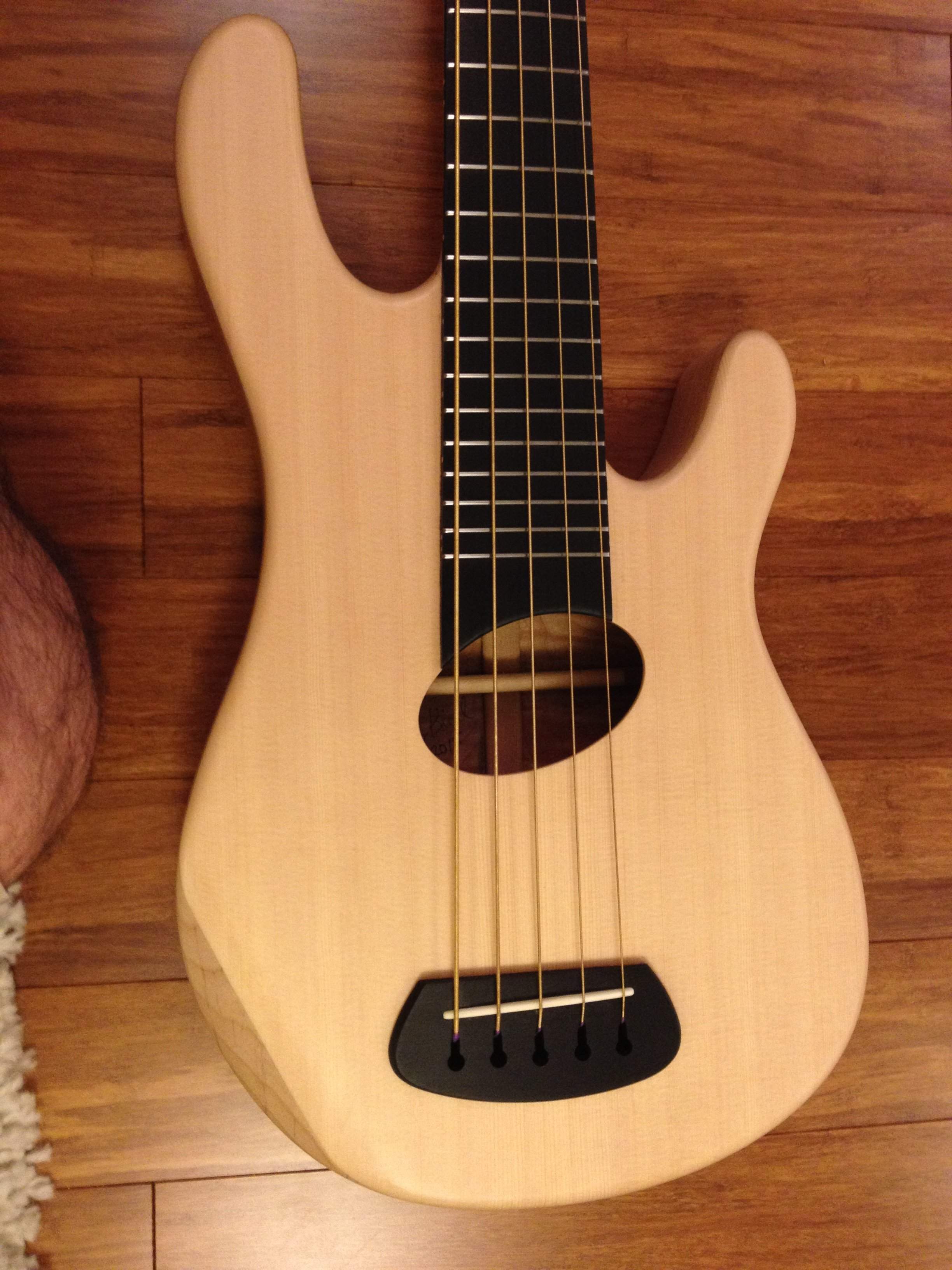
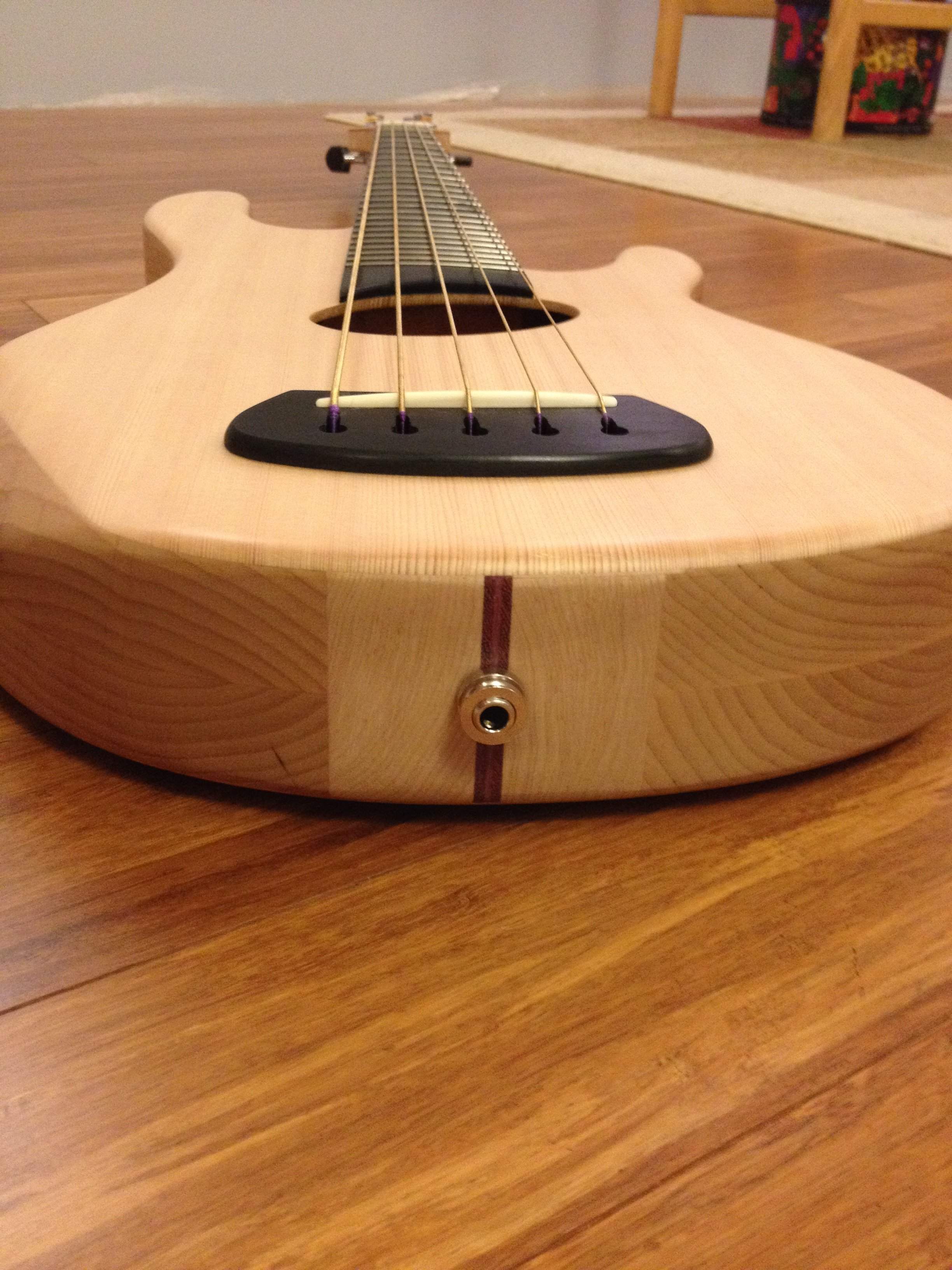
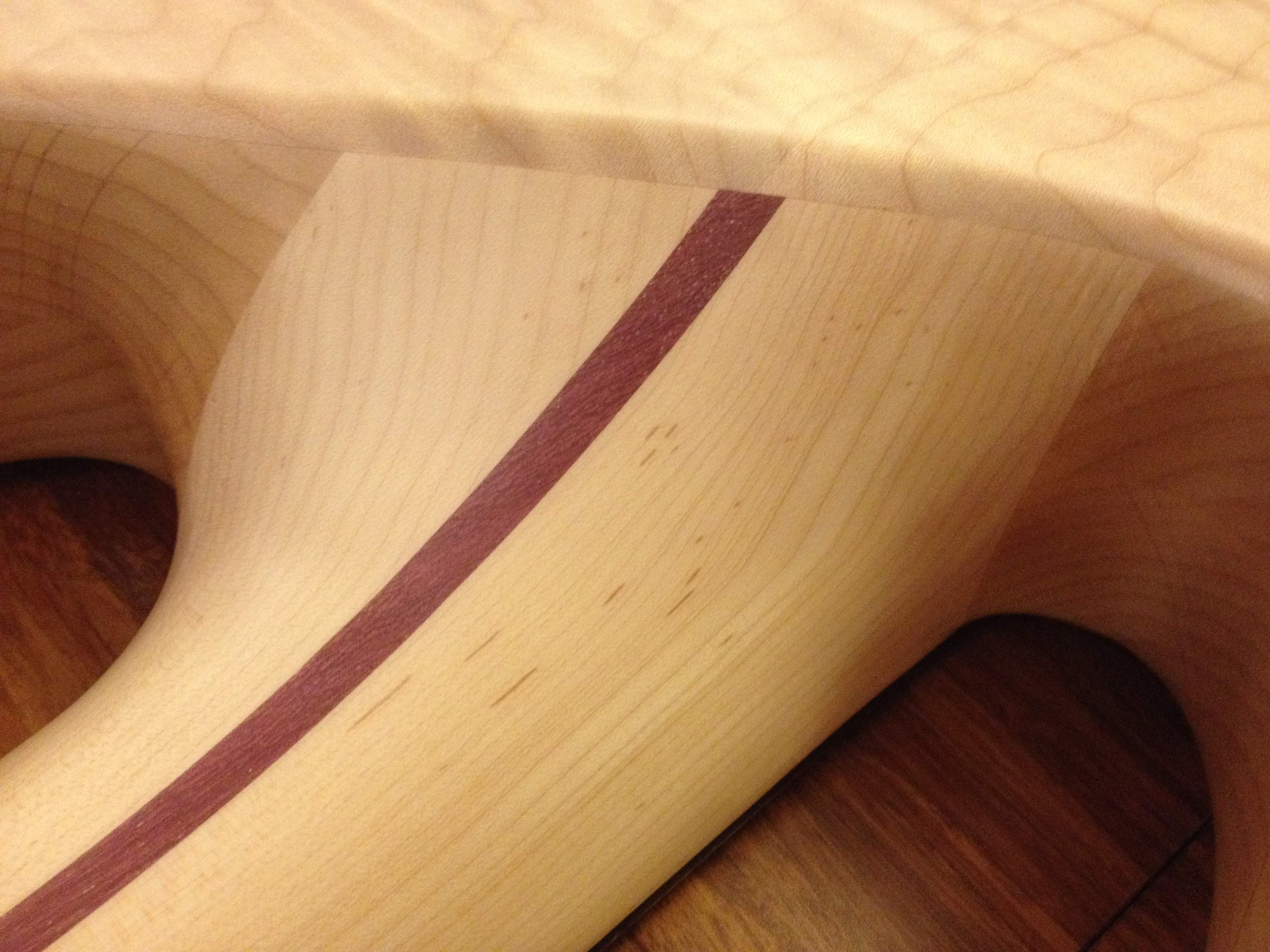
I've got another bass on the way with a similar idea in mind.
Very Nice.
It looks like the top 3 or 4 frets are inaccessible...Was this area (the cutaway) discussed prior to the build?
I tried to compensate for this on my (DIY) 6-string, by removing some of the material in that area. I wish I had removed more, as it can get crowded up there, esp. while playing chordal structures/comping.
See below:

It looks like the top 3 or 4 frets are inaccessible...Was this area (the cutaway) discussed prior to the build?
I tried to compensate for this on my (DIY) 6-string, by removing some of the material in that area. I wish I had removed more, as it can get crowded up there, esp. while playing chordal structures/comping.
See below:
We did discuss it and I was adapting to his design which is a complete hollowbody including that lower horn. You can play comfortably up to a G and even with an additional cut away your knuckles hit that lower horn. For the purposes of that instrument it is fine and notes above G (EDIT) are not as accessibleVery Nice.
It looks like the top 3 or 4 frets are inaccessible...Was this area (the cutaway) discussed prior to the build?
I tried to compensate for this on my (DIY) 6-string, by removing some of the material in that area. I wish I had removed more, as it can get crowded up there, esp. while playing chordal structures/comping.
See below:
View attachment 886217
In any case that was inspiration for this which I think solves a number of issues with the Kinal - Drake custom semi hollow. Should have it by month end.
Last edited:
A 30" scale bass???
There's a "small d**k" joke in here somewhere, but I can't seem to put my hand on it.
Not sure where that's coming from from..but the Fender Coronado bass Dario is playing there is a short scale instrument, 30 inches.

Back on track of the original course of the thread, I played a great gig last night with some of my favorite players in town, a themed show for the Jazz Society featuring the music of Mingus. It was a three horn band, all three in possession of serious horsepower and had all eaten their wheaties that day. The drummer and keyboard player were great young players, both former students of the program. The horn players kept taking the solos to church, almost competing to outdo each other and raise the roof higher than the last solo, and the music demanded that bare knuckle gut punch from the bass early and often.
At several points between tunes I thought of the topic of this thread, but it was a very joyful noise so I just went with it. Thank god that the keyboard player was quiet and subtle, and praise the lord for the beginning of each solo after the roof had been raised by the last one where the rhythm section can back off and clear the smoke. It made me think of that "hamburger helper" vibe as just an emotional dynamic level like any other: p, mp, mf, f, ff, hh... At the end of the night everyone felt like they had been through a musical catharsis, and the audience was on fire. I don't regret a thing, and somehow even though I spent a fair amount of time in hh land, I think some progress has been made. The trick is not avoiding going there, but choosing your spots by intuiting when the roof is going to be blown off by the soloist.
Normally at a certain point a more experienced drummer will take over the roof raising volume wise, but in this case it wasn't the young gun's nature and he was grooving deeper than I had ever heard him so I tried to carry it a little more than usual. No regrets, and live and learn. Feels good to play a show like that, and I can still count to ten with my pants and shoes on, so...
Woke up this morning and found this little gem from Marc and thought I'd repost for those who may not have read the beginning of the thread:
At several points between tunes I thought of the topic of this thread, but it was a very joyful noise so I just went with it. Thank god that the keyboard player was quiet and subtle, and praise the lord for the beginning of each solo after the roof had been raised by the last one where the rhythm section can back off and clear the smoke. It made me think of that "hamburger helper" vibe as just an emotional dynamic level like any other: p, mp, mf, f, ff, hh... At the end of the night everyone felt like they had been through a musical catharsis, and the audience was on fire. I don't regret a thing, and somehow even though I spent a fair amount of time in hh land, I think some progress has been made. The trick is not avoiding going there, but choosing your spots by intuiting when the roof is going to be blown off by the soloist.
Normally at a certain point a more experienced drummer will take over the roof raising volume wise, but in this case it wasn't the young gun's nature and he was grooving deeper than I had ever heard him so I tried to carry it a little more than usual. No regrets, and live and learn. Feels good to play a show like that, and I can still count to ten with my pants and shoes on, so...
Woke up this morning and found this little gem from Marc and thought I'd repost for those who may not have read the beginning of the thread:
I also know that I have the tendency on up tempo numbers to dig in just the same as the swingers. I zeroed in on this as a source of fatigue for me. The way I have learned to combat that is 3 fold. 1) try to breath normally. I know I sometimes get excited when things are cooking but I try not to confuse physical excitement with emotional/spiritual/musical excitement. Relaxation breathing never worked for me. Instead I just try to keep my breathing as normal as if I was on break. 2) I make sure there is no tension in my body. I learned about myself that I got really good at relaxing my arms but was transferring tension to other parts of my body... my back, my jaw, my knees. I try to maintain my posture and shift my weight from leg to leg and stay loose. I also keep the arm flapping. 3) Remember to let up a bit on uptempo stuff. This was a biggie for me. I learned you can still go for that same dark/woody tone but making the same physical commitment to each note as you would on a swinger is really hard on your body. Maintaining a light/dancing feel on uptempos is key and I felt like really digging in was giving them a 'heaviness' that wasn't happenin.
Lastly, I spend as much time shedding as time allows. Nothing like good old fashioned exercise to get ready for the big race.

A 30" scale bass???
There's a "small d**k" joke in here somewhere, but I can't seem to put my hand on it.
the Coronado bass has a big tone, not the reissue, i mean the original one. lightweight and with a big voice. Dario Deidda advised me to get one, and he was right. then he switched to another bass, but i'm very grateful to him for having found my "jazz voice" with this little bass
Revisiting this years later. The issue still persists, and still working on it. It’s more situational now, in that it doesn’t happen as often and I catch it quicker. But still a work in progress.
The stakes are also higher now as I am dealing with the beginnings of some arthritis in my right index finger and there’s a looseness in the middle joint that rears its head when I overdo things. My hand doc put me on a daily low dose of Meloxicam, and that is working wonders in general. But there are still those moments when I dig too hard and feel that pinch and then have to back off.
One came on the last tune of a really nice set with Tamir Hendelman a couple of weeks ago, and was accompanied by this strange sort of cramping which locks the index finger (and sometimes the middle as well) down into a closed position. That part is a different thing, a forearm cramp, like the charley horse cramp in the calf that can lock the big toe up at night. The doc says that’s a hydration/electrolyte thing, and I think she’s right.
So in the meantime, I just need to keep working a “dig ceiling” into my everyday practice. Anybody else dealing with this kind of thing these days? If so, I’d love it if you could share your experiences.
The stakes are also higher now as I am dealing with the beginnings of some arthritis in my right index finger and there’s a looseness in the middle joint that rears its head when I overdo things. My hand doc put me on a daily low dose of Meloxicam, and that is working wonders in general. But there are still those moments when I dig too hard and feel that pinch and then have to back off.
One came on the last tune of a really nice set with Tamir Hendelman a couple of weeks ago, and was accompanied by this strange sort of cramping which locks the index finger (and sometimes the middle as well) down into a closed position. That part is a different thing, a forearm cramp, like the charley horse cramp in the calf that can lock the big toe up at night. The doc says that’s a hydration/electrolyte thing, and I think she’s right.
So in the meantime, I just need to keep working a “dig ceiling” into my everyday practice. Anybody else dealing with this kind of thing these days? If so, I’d love it if you could share your experiences.
Probably not the same thing as what you’re referring to, but I’m finding that I really have to “calibrate” my touch on my new New Standard Cleveland hybrid as compared to my 1850’s Tyrolean. On that bass it really felt like you had to “pull” the sound out of it. The phrase “pulling a big sound” had a real practical application. The New Standard just seems so much more responsive; I can get the same or more volume and drive with much less effort. If I use the same effort as on the Tyrolean, it seems to overdrive the bass and add some subtle tone degradation.

Anybody else dealing with this kind of thing these days? If so, I’d love it if you could share your experiences.
I've had a bunch of hand issues in the last couple years, including the beginnings of arthritis. There's also been some tennis elbow, tendonitis and trigger finger thrown in for good measure. While I've seen a hand specialist and talked to my GP, i haven't really found any good ways of treating all this except to make sure I stay hydrated and warm when playing. I play seated now, which seems to help, and I feel like I've found the edge of where I might hurt myself and am able to back off when I feel I'm getting too close to it. I'm feeling pretty optimistic as I haven't had any really scary moments in over a year, but I think my days of 4 hour gigs playing mostly burning tempos may be behind me now. We'll see...

BobDeRosa
Commercial User
- May 16, 2012
- 2,444
- 4,402
- Disclosures
- Owner, Tritone Jazz Fantasy Camps
DURRRL, the thing about gut (or gutlike) strings is that yes, they choke if you dig in too hard like you would if you were trying to get a bigger sound out of a high tension steel string. But if you DON'T do that, you get a projecting, bouncy sound. That's much easier on the hands than what's currently happening with you.
I'm never going back.
What brand of guts are you using, Ed?

- Dec 13, 1999
- 11,736
- 8,941
- 70
- Disclosures
- Chuck Sher publishes my book, WALKING BASSICS:The Fundamentals of Jazz Bass Playing.
Oliv D and Chorda GWhat brand of guts are you using, Ed?
Revisiting this years later. The issue still persists, and still working on it. It’s more situational now, in that it doesn’t happen as often and I catch it quicker. But still a work in progress.
The stakes are also higher now as I am dealing with the beginnings of some arthritis in my right index finger and there’s a looseness in the middle joint that rears its head when I overdo things. My hand doc put me on a daily low dose of Meloxicam, and that is working wonders in general. But there are still those moments when I dig too hard and feel that pinch and then have to back off.
One came on the last tune of a really nice set with Tamir Hendelman a couple of weeks ago, and was accompanied by this strange sort of cramping which locks the index finger (and sometimes the middle as well) down into a closed position. That part is a different thing, a forearm cramp, like the charley horse cramp in the calf that can lock the big toe up at night. The doc says that’s a hydration/electrolyte thing, and I think she’s right.
So in the meantime, I just need to keep working a “dig ceiling” into my everyday practice. Anybody else dealing with this kind of thing these days? If so, I’d love it if you could share your experiences.
I've had the hand lock happen a few times. I agree that it was probably a hydration issue. Didn't seem to be related to any repetitive stress.
I've had this problem too of right-hand fingers locking up. I think it is a product of advanced years and not regularly playing gigs. I find it kicks in after a few hours at a gig. I tried the hydration suggestion but it did not work. I've replaced my strings with Spirocore solos, which helps (and they actually sound fantastic, really opened my bass up), but I think the only solution will be to try to change my right-hand technique and play lighter.I've had the hand lock happen a few times. I agree that it was probably a hydration issue. Didn't seem to be related to any repetitive stress.
What a delightfully relevant thread. I’ve been destroying my hands with manual labor recently trying to jack up my sinking two-story barn workshop (on f’n cinderblocks - no foundation!) and I’m having a really hard time bringing myself to practice bass with these ground beef hands. I’m still relatively young with no arthritis yet, but my aesthetic for how I want to approach this instrument in the long-term is certainly shifting. My gut strung bass is getting 100% of my attention and my lines and ideas are a lot more “path of least resistance” based and less athletic. No more slapping (‘cause I hate it and my
hands do even worse) and no more playing past ‘mf’ in any context. The amp can do the work. Youch.
hands do even worse) and no more playing past ‘mf’ in any context. The amp can do the work. Youch.
Last edited:
I admit I’ve only skimmed the responses, but I don’t believe anyone mentioned the “chicken wing” technique. I want to say a nameless old timer showed it to me in college while my amp was broken and I was playing with the big band ampless for a few rehearsals, Incedentally that coincided roughly with Christian McBride’s ampless phase so maybe it was an interview with him I read regarding playing ampless. The basic idea is that you lift and drop your right elbow, much like a flapping wing, while keeping your right hand and wrist straight and stiff. Using gravity and the weight of your arm to do the plucking. It works best with the old school fingers parallel to the strings pluck with your index knuckle/side of finger type thing. When it’s working right your hand and wrist aren’t doing much at all, all the power is coming from your spine, shoulder and lats just lifting your arm and the power is coming from the gravity of your arm falling. This way you are using big strong muscles in your back to do the work instead of the little hand and wrist muscles. Eases the burden on the hand a lot and produces a big sound. In addition you are spreading out the friction on the skin to a much wider area, i.e. the whole side of your finger so it also eases the burden on your skin. Obviously you aren’t gonna be playing Giant Steps with this technique, but it has its place. Anyway, hope someone finds this helpful. I wish I could remember my source for this, but the best I can recall is that came from the pre-amplified days.
Apparently, Christian McBride is not a fan of the “chicken wing” technique: . See 0:56-1:18.I admit I’ve only skimmed the responses, but I don’t believe anyone mentioned the “chicken wing” technique. I want to say a nameless old timer showed it to me in college while my amp was broken and I was playing with the big band ampless for a few rehearsals, Incedentally that coincided roughly with Christian McBride’s ampless phase so maybe it was an interview with him I read regarding playing ampless. The basic idea is that you lift and drop your right elbow, much like a flapping wing, while keeping your right hand and wrist straight and stiff. Using gravity and the weight of your arm to do the plucking. It works best with the old school fingers parallel to the strings pluck with your index knuckle/side of finger type thing. When it’s working right your hand and wrist aren’t doing much at all, all the power is coming from your spine, shoulder and lats just lifting your arm and the power is coming from the gravity of your arm falling. This way you are using big strong muscles in your back to do the work instead of the little hand and wrist muscles. Eases the burden on the hand a lot and produces a big sound. In addition you are spreading out the friction on the skin to a much wider area, i.e. the whole side of your finger so it also eases the burden on your skin. Obviously you aren’t gonna be playing Giant Steps with this technique, but it has its place. Anyway, hope someone finds this helpful. I wish I could remember my source for this, but the best I can recall is that came from the pre-amplified days.
BobDeRosa
Commercial User
- May 16, 2012
- 2,444
- 4,402
- Disclosures
- Owner, Tritone Jazz Fantasy Camps
Have you seen this advice from this young monster? Like petting a cat, he says. I haven't been able to reproduce his results -- digging in always seems louder than petting the cat -- but he's also a much better player than I. I suggested he try to prove this concept with a decibel meter, which he thought was a good idea, but I haven't seen this test conducted yet. I'm really having fun trying to get his great sound by playing really light, though. It's a very interesting exercise.


