• TalkBass has been independent since 1998. Add your voice.
    Create a free account to reply to discussions, view embedded media, and browse with fewer display ads.
    Join freeLog in
    Want zero display ads or expanded classifieds tools? Compare plans.

Low B - How to get it sound well

If your amp doesn't have a high-pass filter in it, possibly adding TBr fdeck's HPF V3 may help clear up the low end.

+1 to changing the strings. If the bass hasn't been set up recently, after changing strings would be a good time. Let the bass tech know what problems you're having.
 
I'm going for Elixir strings, but I'm not sure what gauge yet. Any recommendations?

I'm using a medium set of Elixirs with a 130 B-string, both on my 35 and 34 inch scale basses, and I'm very happy with the sound of the B-string.

And +1 to first look at the bass instead of the amp. Of course the B-string doesn't sound as huge on my small Roland cube 30 practice combo (one 10inch speaker) as on my main rig, but it does sound even with the other strings.
 
Instead of playing between your pickup, you should attack the B string near the bridge.

Most B string problem aren't even due to the amp or the string, it is all about the player who doesn't adapt.

Neat exercise :
Start at your B string near the bridge, then while moving to another string you get closer the neck. You'll be surprise how every string is so even
 
As far as cabs go my Acme 2x10 cab was the balls for playing
on the low B string and sounding huge. like the guys have said here
you need drivers with high excursion to handle this at volume.
Also my Eden 2x10 XST handles the low B with ease.
 
We go actually tad further all the way down to Low G.
I´ve finally managed to get kick ass sound from Low G with following setup.

Warwick Corvette FNA Jazzman 5 string bass (3band active eq w passive MECs) with customer string set (Warwick Black Label .175 + standard Medium set) Yes... tuning is odd, so odd string set too.

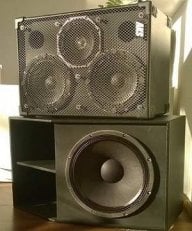
On amp side I´m running bass into Sansamp RPM from which uneffected signal is routed to Sansamp RBI and then back to RPM´s effect loop return (Thanks to JGR´s excellent thread) --> Next I have DBX 160A compressor from which I´m pushing signal to Crown XLS 2500 which is driving Markbass NewYork 122 (2x12) and Standard HF104 (4x10). Both cabinets are 800w at 4 ohm.

Also playing technique makes huge difference - With my current sound playing lowest notes I need to be very gentle to not make cabs fart and keep low notes sound good - Even with PA´s Highpass filter set to 50Hz.
I´ll be soon adding Rane PE 17 to my rig and after that I´ll tweak HPF from it. Cabs response area starts from 35hz and 45hz.
 
  • Like
Reactions: DECEMBER
...I´ve finally managed to get kick ass sound from Low G with following setup.

...I´m pushing signal to Crown XLS 2500 which is driving Markbass NewYork 122 (2x12) and Standard HF104 (4x10). Both cabinets are 800w at 4 ohm.

...I´ll be soon adding Rane PE 17 to my rig and after that I´ll tweak HPF from it. Cabs response area starts from 35hz and 45hz.

Not real sure about that last part. High-passing requires steeper slopes than you can generally get from a parametric EQ. Check out a real 24dB per octave HPF, like the latest FDeck.

Also, I suspect you'll find that 35 and 45Hz are actually the 10dB down numbers for those cabs, not the corner frequency.
 
I definitely think a good low B is a matter of overall construction , neck stiffness , string weight etc.. I know a luthier in the south of France who built a 31" 8 string headless bass , and every guy who tried it said the low B is huge and defined.It's difficult to make a low B sound bad when you already have a correct instrument , you know what I mean ? Here's the beast :

big_crbst_100_5991.jpg

Wow.... that picture makes my back hurt.. a beautiful instrument though..

To the OP ... yeah like many have said... the right strings, setup and the EQ is key..and you may have to experiment a bit to find the right strings.
 
Not real sure about that last part. High-passing requires steeper slopes than you can generally get from a parametric EQ. Check out a real 24dB per octave HPF, like the latest FDeck.

Also, I suspect you'll find that 35 and 45Hz are actually the 10dB down numbers for those cabs, not the corner frequency.

PE17 has standalone Low cut (10-250hz) and HIgh cut (3-40khz) sliders along with 5 fully adjustable bands...

Gotta do experimenting when I'll get eq added to my rig
 
Lots of really good advice about bass setup, EQ and plucking attack in this thread. I agree that 90% of the action lies in those areas.

That said, the right rig is still important when you're on a search for a good low B.

Granted, cost is a factor, but if you're comparing pound-for-pound, extended-range cabs from people like Greenboy, Duke LeJeune, and Andy Lewis slay the usual stuff from GC.

Looking at the OP's rigs:
- The 115BLX weighs 69lb, and uses a short-throw 15, rated at only 200W. Fart-out city with a 5-string and a loud drummer.
- The B2RE weighs 26lb, and only puts out 250w into 8 ohms. The bass control is centered way down at 40Hz. Cranking on that sucker is a bad idea in the first place, but stacking it with a 40Hz bottom slider on the graphic EQ is a recipe for disaster.
- The Backline 112 is a decent practice amp, but it's hardly G-K's "A game".

Substituting any number of newer combos for the 112, would net an improvement. Suggested candidates: TC BG250 or G-K MB212 for starters.

For the big rig, the combined weight of a fEarful 15/6 and a 500-900 watt micro from G-K or Genz would be less than the OP's cab by itself. More importantly, they would blow his current gear away in terms of loudness, low-end extension and clarity. And that is completely independent of how much time he puts into his technique, string choices and bass setup.
 
zrksteve
I understand your frustration. You want deep clean lows along with your mids and highs. You don't want to boost your mids to get a variation of your lows. you want your lows to sound like the subwoofer in an audio system.
I found the DNA (Dave Nordschow Amplification) cabinets (made in USA) along with his previous company, Eden, to produce excellent low end B string bottom. I found enough power with the Carvin Amps, BR1500 or B2000 (made in USA) or Eden's WT800 (which is now made in china) Carvin also makes some cabinets which can handle the B string much better than most cabinets. I like the DNA-410 the best.
 
I have had many 5 string basses and very few had decent B strings
my experience has shown me that the most important things are:
-plenty of amp headroom
-stiffness/density of neck

just a hunch, but I think PU placement plays a big part in the sound too; EG-a PU might be in the sweet spot for the other 4 strings but not necessarily for the B string...I dunno.

for the record, the best sounding B string I ever had in my arsenal was my BO warwick thumb 6er-couldn`t deny it-better sounding than the 3 dingwalls I had. YMMV
 
+1 on tapered strings
+1 on playing the B string higher up the frets.
+1 on keeping the 'bass' EQ either flat or maybe -1

The open B on my bass can sound muddy and off pitch, but between the 5th and 12th frets sounds crisp and right on pitch. Like one comment - I like playing mid-neck and just using the B to keep from moving my hand continually.