

Enjoy the benefits of a premium membership!
Upgrade Account
-
TalkBass has been independent since 1998. Add your voice.
Create a free account to reply to discussions, view embedded media, and browse with fewer display ads.
Join free Log in
Want zero display ads or expanded classifieds tools? Compare plans.
You are using an out of date browser. It may not display this or other websites correctly.
You should upgrade or use an alternative browser.
You should upgrade or use an alternative browser.
Low-cost DIY practice/coffeehouse tweeterless 110 [long]
- Thread starter DukeLeJeune
- Start date
More options
Who Replied?
- what type of wood to buy?
Void free birch ply is best, 1/2" is good. You might get by with thinner/lighter/cheaper, but that would be a small target for screws or nails.
- internal wood construction (anything to keep in mind or is it just a straight box with one opening at the front bottom - plus the round opening for the speaker of course?). Are there any assembly diagrams available for similar boxes?
- dimensions of the wood panels? Should I just go roughly as the dimensions listed on the specs for the E-10SP?
- Glue, screw or nail the panels together?
PL glue from you DIY store. Then you can clamp it, nail it, or screw itScrews may be left in or removed and holes filled. If you have an air powered nail gun, light gauge nails make assembly fast, but not a big deal on a small box.
- Anyone from the UK, do you know of any suitable alternatives to the E-10SP available over here?
Any help would be greatly appreciated. Thanks.

Thank you so much, very useful!Here are the dimensions of an old one I have:
all parts 1/2 inch MDF
(and they’re glued together)
16 1/2 inches tall
12 1/4 inches wide
14 1/2 inches deep
circular hole 9 1/4 inches diameter
the circle’s edge is 2 1/2 inches from the top
the port (that opening at the bottom you noticed) is 2 inches high
and a ledge extends 10 inches inside the box from the port opening to make the “horn.”
I’m sorry that I have no advice on making it out of plywood, but I know it would be lighter than this one.
Good luck.
Brilliant! Thanks so much! And the picture is such a massive help!I Posted the Dims that I built on post #875 a few pages back.
Do I understand correctly then that the panel that forms the upper side of the bottom opening inside the cabinet, is basically a sort of 'shelf' that's a little bit shorter than the bottom panel at the back, I presume so that air can get through to the bottom opening (i.e. dim marked 'F' in your pic)?

Excellent job notating this design! Did I miss seeing the final product or did you post it elsewhere? I like the idea of 1/2" plywood. I'm curious how you sealed the wood and protected the speaker. BTW I found whizzer cone speakers at US Speaker like my Eden EX110's....Here is the dims. I took the bought cabinet and removed the cheap carpet and then measured for my dimensions for my built box.
View attachment 785807

Brilliant! Thanks so much! And the picture is such a massive help!
Do I understand correctly then that the panel that forms the upper side of the bottom opening inside the cabinet, is basically a sort of 'shelf' that's a little bit shorter than the bottom panel at the back, I presume so that air can get through to the bottom opening (i.e. dim marked 'F' in your pic)?
Yes the shorter top and the longer bottom creates the shelf port.
Excellent job notating this design! Did I miss seeing the final product or did you post it elsewhere? I like the idea of 1/2" plywood. I'm curious how you sealed the wood and protected the speaker. BTW I found whizzer cone speakers at US Speaker like my Eden EX110's....
Finished picture on post 853. The finish on the cabinet is Duratek paint on finish. Great stuff.
Top Shelf! Very excellent results. You have a talent for cabinet building, I passed a couple other cabs you finished while browsing through the thread.I had the same problem as you are.
I can tell you go to the 2510's it is like night and day. Yes it costs more but the improvement is worth the extra money.
View attachment 780894

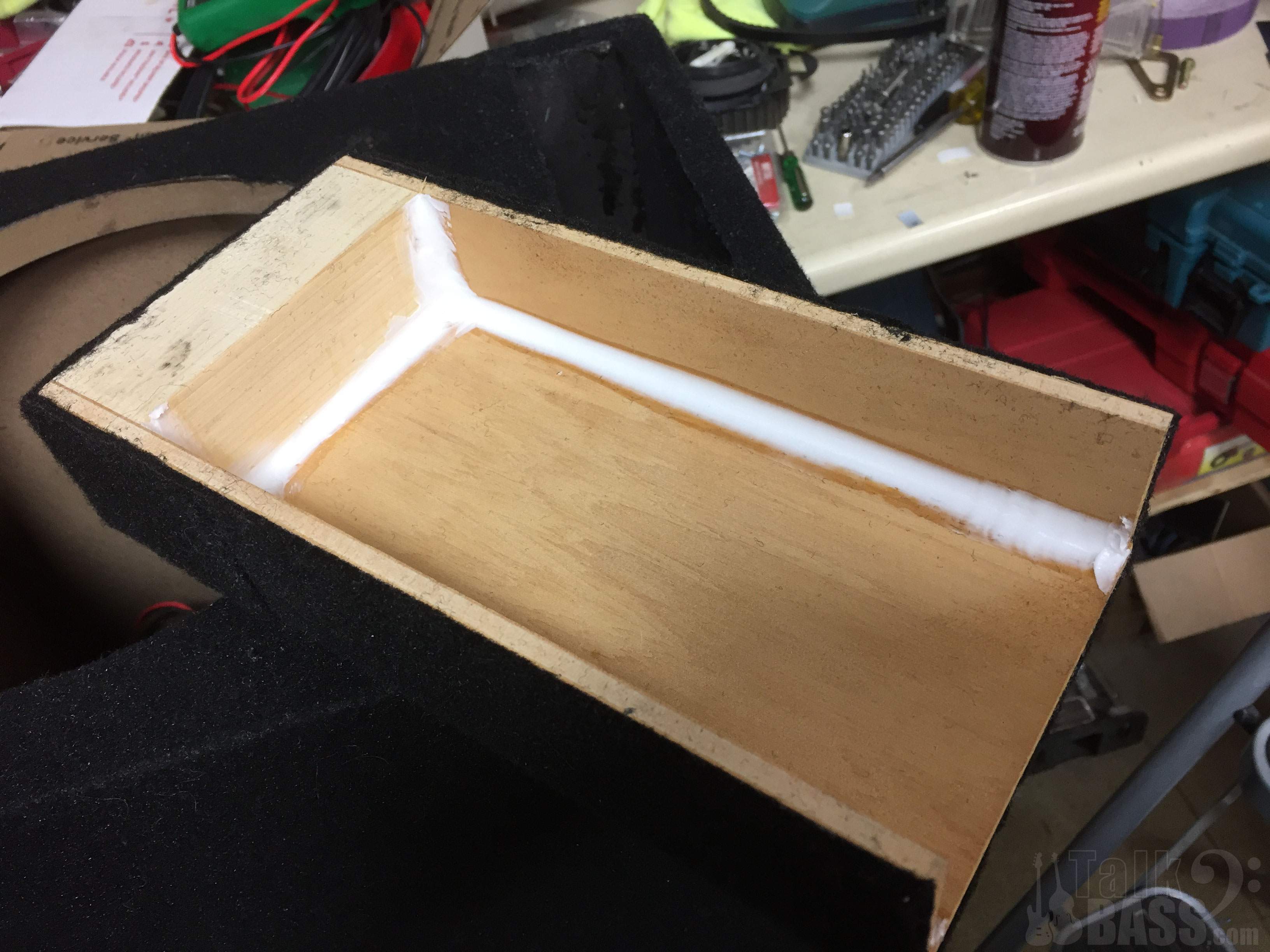
My build is almost complete. I'd probably make a couple of small changes if I did it again, and I need to resolve the air leak caused by the dual jacks, but overall I'm pretty pleased! I made a tray-shaped port insert, which allowed me to install a recessed handle without intruding on the cabinet space.

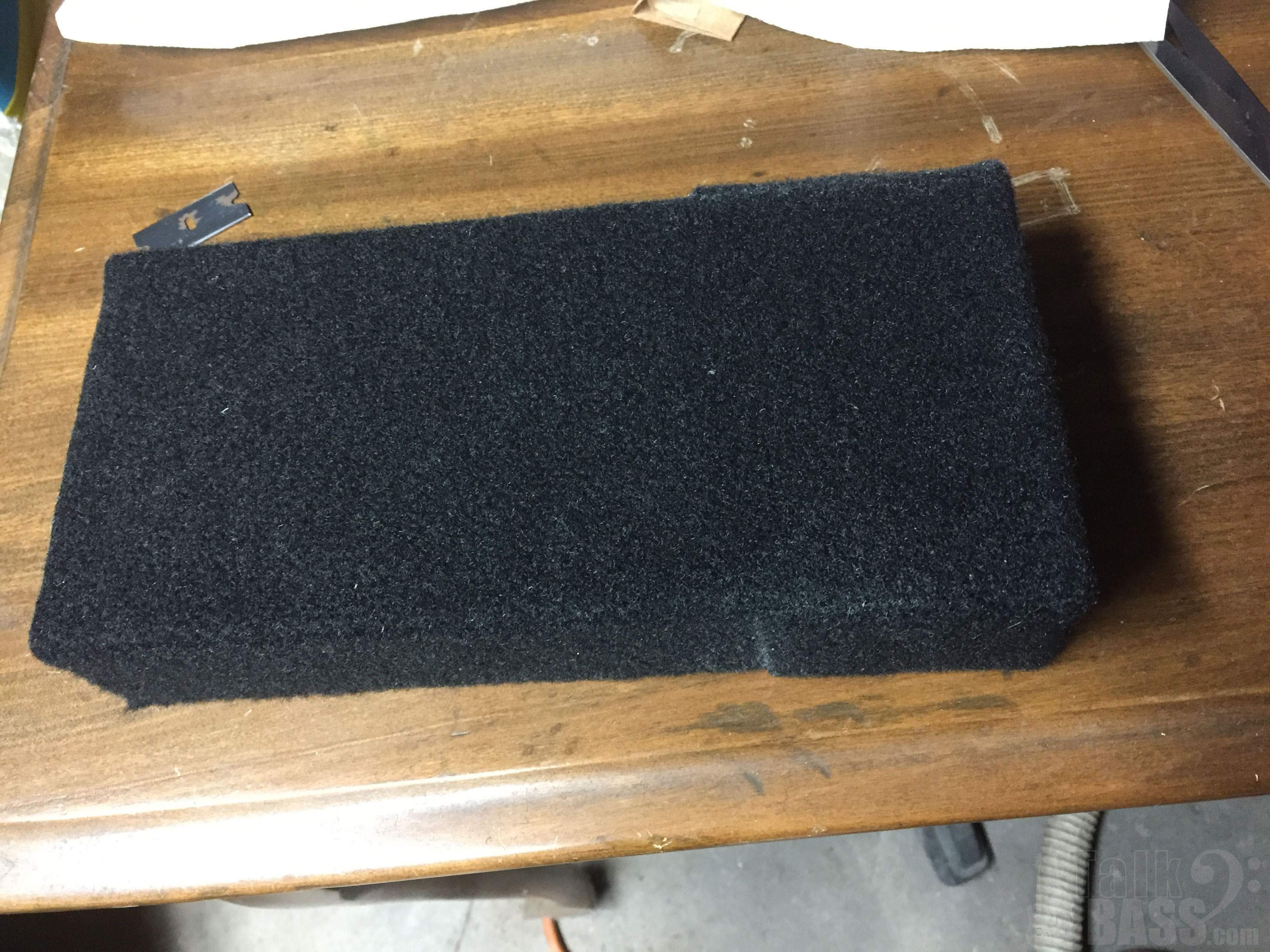


A foam earplug stuffed into the jack socket works as well.
Thanks!!Yes the shorter top and the longer bottom creates the shelf port.
Now the last two million dollars questions before I order my speaker and start cutting and assembling wood to build this cab!
After reading so many comments on this thread I am inclined to spend a little more on the speaker and get the Eminence DELTALITE II 2510 NEO 8ohm 10" 250watt instead.
Now, I mainly play a 5 string bass (UP-tuned to CGCFA) through a 500W amp head (GK MB500). With this in mind, would this cab be suitable? How about the low C?
I did mention before that my level of understanding of the technical side of things is rather appalling, so please bear with me if my questions have very obvious replies.
I do understand that the output of my MB500 amp head is much higher than the max power of the speaker, but would it be OK if I just don't crank the amp all the way up? Do I risk to blow the speaker or is it OK?
This is still a cab that I would use exclusively for home practice, and although I do like a little bit of juice when I practice my band's songs at home, my neighbours have never come knocking at my door to complain (I currently have a 15" Marshall 150W combo which I would like to replace with this), so I would still keep everything on reasonable levels for a home.
And my questions are still meant within the scope of such a small cab, I am aware that I cannot expect the same sound or response I would have from a big cab. Space is an issue at home so I am aware there is a compromise to be made.
Thanks so much in advance for any help!
After reading so many comments on this thread I am inclined to spend a little more on the speaker and get the Eminence DELTALITE II 2510 NEO 8ohm 10" 250watt instead.
Now, I mainly play a 5 string bass (UP-tuned to CGCFA) through a 500W amp head (GK MB500). With this in mind, would this cab be suitable? How about the low C?
I did mention before that my level of understanding of the technical side of things is rather appalling, so please bear with me if my questions have very obvious replies.
I do understand that the output of my MB500 amp head is much higher than the max power of the speaker, but would it be OK if I just don't crank the amp all the way up? Do I risk to blow the speaker or is it OK?
This is still a cab that I would use exclusively for home practice, and although I do like a little bit of juice when I practice my band's songs at home, my neighbours have never come knocking at my door to complain (I currently have a 15" Marshall 150W combo which I would like to replace with this), so I would still keep everything on reasonable levels for a home.
And my questions are still meant within the scope of such a small cab, I am aware that I cannot expect the same sound or response I would have from a big cab. Space is an issue at home so I am aware there is a compromise to be made.
Thanks so much in advance for any help!
Last edited:

So long as the cab isn't complaining you can run a 5000w amp.Now the last two million dollars questions before I order my speaker and start cutting and assembling wood to build this cab!
After reading so many comments on this thread I am inclined to spend a little more on the speaker and get the Eminence DELTALITE II 2510 NEO 8ohm 10" 250watt instead.
Now, I mainly play a 5 string bass (UP-tuned to CGCFA) through a 500W amp head (GK MB500). With this in mind, would this cab be suitable? How about the low C?
I did mention before that my level of understanding of the technical side of things is rather appalling, so please bear with me if my questions have very obvious replies.
I do understand that the output of my MB500 amp head is much higher than the max power of the speaker, but would it be OK if I just don't crank the amp all the way up? Do I risk to blow the speaker or is it OK?
This is still a cab that I would use exclusively for home practice, and although I do like a little bit of juice when I practice my band's songs at home, my neighbours have never come knocking at my door to complain (I currently have a 15" Marshall 150W combo which I would like to replace with this), so I would still keep everything on reasonable levels for a home.
And my questions are still meant within the scope of such a small cab, I am aware that I cannot expect the same sound or response I would have from a big cab. Space is an issue at home so I am aware there is a compromise to be made.
Thanks so much in advance for any help!
The HPF3 is ideal for ridding you of useless flabbing frequencies. Just don't cook the speaker(s).
^ This.So long as the cab isn't complaining you can run a 5000w amp.
The HPF3 is ideal for ridding you of useless flabbing frequencies. Just don't cook the speaker(s).
The MB500 will deliver 500W into a 4 ohm load, into 8 ohms it will be slightly more than half this so will be ideally suited to a 250w cab. You will still need to listen for signs of it struggling if you are playing near the limit of the cab.
A HPF will help here, increase the cutoff frequency until the bottom starts to disappear from your sound then take it back to where it returns but no further. This way you are not wasting amplifier power and speaker displacement on frequencies you cannot hear.
^ This.
The MB500 will deliver 500W into a 4 ohm load, into 8 ohms it will be slightly more than half this so will be ideally suited to a 250w cab. You will still need to listen for signs of it struggling if you are playing near the limit of the cab.
A HPF will help here, increase the cutoff frequency until the bottom starts to disappear from your sound then take it back to where it returns but no further. This way you are not wasting amplifier power and speaker displacement on frequencies you cannot hear.
Thanks a lot! Are there any decent alternatives to the HPF3? From what I gathered after researching it for a while today (although no recent information found) it looks like it's not easy to get hold of one in Europe as fdeck wouldn't ship outside US or Canada?
Thanks!!So long as the cab isn't complaining you can run a 5000w amp.
The HPF3 is ideal for ridding you of useless flabbing frequencies. Just don't cook the speaker(s).

Other HPF options are Broughton HPF or HPF/LPF pedal and the SFX Micro-Thumpinator.
Sorry I can't be any help there as I build all my own stuff like that but the Broughton HPF or HPF/LPF and the SFX Micro-Thumpinator get good reports.Thanks a lot! Are there any decent alternatives to the HPF3? From what I gathered after researching it for a while today (although no recent information found) it looks like it's not easy to get hold of one in Europe as fdeck wouldn't ship outside US or Canada?
SFX is UK based, not sure about Broughton.


