• TalkBass has been independent since 1998. Add your voice.
    Create a free account to reply to discussions, view embedded media, and browse with fewer display ads.
    Join freeLog in
    Want zero display ads or expanded classifieds tools? Compare plans.

Markbass Megathread PART 2

Status
Not open for further replies.
It's great in those genres. It has a big sound and is very controllable so you not only have tone, you have bass you can feel.

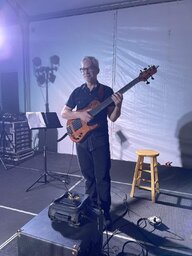
I have a weekly gig at a spoken word/Hip Hop type event in DC. No PA support and I use two Nahas cabs; a small 1-15 and smaller 1-12. It flat out kills. The thing I like the most besides the tone and the effortless volume is that it lets whatever I'm playing sound like it sounds. This week I took an Eshenbaugh J 5 and a Brubaker K6 and both of them have distinctive sounds and that came through like gangbusters.

Agreed. It sounds great for R&B, fingerstyle funk, slap, etc.
 
hey dave,

tell me about the sa450...


Its the amp of your dreams my friend:D

Well, it sounds like a MB head and has the same output as the LMII but it does of course have a better EQ section although i would say, like many LMII users (thats me as well) i tend to leave the EQ mostly flat. I do boost the lows very slightly if i think it needs it but generally i use the low mid, set to its lowest point which i believe is 100hz. just a slight boost here gives me a thicker sound without the added boom the low might give if pushed too high. I find i dont tend to use the low mid on the LMII as much as its set higher but to be honest i can be happy using either at most gigs. I use my LMII with my 1210 and my SA450 with my UL212 as that cab is a bit clearer and i find needs a bit of thickening up some times. The band i play the LMII with also have me in the vocal PA and i do find the XLR is a bit hot for the input (its only a Peavy all in one thingy, not a pro mixer)
The SA450 also has a pre/post XLR switch which makes life a bit easier although i dont tend to use PA support much. Also the XLR has a level control which again, is useful if needed. There are two speakon/jack combo sockets as opposed to one and a jack on the LMII but thats no big deal. One thing i dont like on the LMII is the XLR on the front. I know some use it but i will never use it and so i wish it wasnt there.

Anything else you want to know just ask. (oh, and mine came with rack ears)
 
Id be curious to know where everyone sets their EQ and filter knobs at......

I may vary from the norm here.

LMII
Input gain: 12 o'clock
low: 12 o'clock
low-mid: 12 o'clock
High-Mid: 3 o'clock (This gives more growly mids)
High - 12 o'clock.

VLE: usually about 8 o'clock - 9 o'clock
VPF: 9 o'clock - 12 o'clock

Master Vol/Gain: (adjusted for overall volume)
Usually 10 o'clock. Up to 12 o'clock if we are LOUD.

Cabs: Bergantino HT112/EX112 stack.
Bass: F Bass BN5
 
I have never used both filters really I usually have some of the VLF on my NS Wav 4 (I have the LMK so use chan 2 for this bass)...For my electric I will sometimes dial in the VLF hardly touch the VLE...

Otherwise im usually at about 11 on the Bass 11 low mid 12 high mid 1 on the highs

I am no eq guru by anymeans I have been meaning to work with it more.
 
I think I might be one of the first bass players in the U.S. to try out a Markbass amp. I was at Guitar Center the day they put them out on the floor for the first time. I tried a few of the Markbass amps and I was really impressed. I almost bought the TA501, but I never had heard of Markbass at the time and neither did the salesmen. The salesmen were ripping on Markbass because of the yellow and black finish. One said, "At least no one will want to steal it." lol. I went home to do some research and I was disappointed because I couldn't find any info about people that actually owned one. I was really interested in learning about the road worthiness from actual owners. The fact that they were so light weight really put me off believe it or not. I'm so glad to see that all of you are so happy with these amps.
I ended up buying an SWR WorkingPro 400 instead and I absolutely love it so I really have no regrets.
Now I know that when it comes time to buy another amp I will definitely consider giving Markbass another shot.
 
Mine's 5 days old. :)

rig2.gif
 
Vic
I know you're gonna think I'm a moron, but I have to ask.
If the switching from parallel to series doesn't let you bypass
the eq in the amp, why switch? What difference does it make?
And thank you again for the explanation. I just wish I were
one of the "shaper tools in the shed"
No prob!

You're just getting the DI confused with the EFX loop.

The EFX loop is what can be switched between series/parallel(default). The DI is what can be switched between pre/post(default).

The EFX loop is ALWAYS "pre" (before the tone controls). The difference is, in parallel, your straight bass signal is evenly mixed with whatever's going on in the EFX chain. In series, the EFX chain is the SOLE path so you have to use the mix controls on the effects pedals to control how much un-effected bass sound gets through. In short, series/parallel is strictly a matter of how you want to blend your effects into your sound. Nothing more.

The DI is just a "tap" that can be taken either before the tone/filtering (pre) or after (post). It just depends on whether you want the FOH production folks to eq your raw bass tone (usually the best idea... just like an outboard DI box between your bass and your amp) or if you want them to just take "your sound" per your tone/filter settings and work with that, which is "post".
 
Funny, no sooner did I commit my LMII settings and said I dial the High mids to 3 o'clock and I do a gig tonight and realize it's way too much. Back to 12 o'clock. What was I thinking? Maybe I was in a room where I really needed to 'cut' through the band mix. Heaven help me. I'm back to mostly flat settings on the EQ. That just seems to work famously.
 
No prob!

You're just getting the DI confused with the EFX loop.

The EFX loop is what can be switched between series/parallel(default). The DI is what can be switched between pre/post(default).

The EFX loop is ALWAYS "pre" (before the tone controls). The difference is, in parallel, your straight bass signal is evenly mixed with whatever's going on in the EFX chain. In series, the EFX chain is the SOLE path so you have to use the mix controls on the effects pedals to control how much un-effected bass sound gets through. In short, series/parallel is strictly a matter of how you want to blend your effects into your sound. Nothing more.

The DI is just a "tap" that can be taken either before the tone/filtering (pre) or after (post). It just depends on whether you want the FOH production folks to eq your raw bass tone (usually the best idea... just like an outboard DI box between your bass and your amp) or if you want them to just take "your sound" per your tone/filter settings and work with that, which is "post".

So, if I want to use my RavenLabs blender for upright bass
instead of the MB preamp, I can do it by switching the
effects loop to series?? Will the MB eq still be effecting the
tone of the head, or will I just be able to use the RavenLabs
or Sansamp for my tone?
I would ask this privately, but I figure there have to be others
like me who just don't quite understand the difference, and
I'll be the dolt who asks the question.
 
Status
Not open for further replies.