That's exactly why it would be even more sweet if Mesa made some updated Scout extension cabs.Having said all that, the combo cab does sound particularly sweet!

TalkBass has been independent since 1998. Add your voice.
Create a free account to reply to discussions, view embedded media, and browse with fewer display ads.
Join free Log in
Want zero display ads or expanded classifieds tools? Compare plans.
That's exactly why it would be even more sweet if Mesa made some updated Scout extension cabs.Having said all that, the combo cab does sound particularly sweet!

I crave none of those things, and please do not put words in mouth. This gig was a trio, in a record store, playing Rockabilly at reasonable volume, with an efficient cab. It just did not cleanly get louder when I needed more volume. My post was referring to another post about using more efficient cabs to get more clean volume from the WA.Well, if you crave surgical room clean at wall crushing volume using a small to medium cab, I suggest you to simply sell the WA. It's not your best choice, probably and actually

I crave none of those things, and please do not put words in mouth. This gig was a trio, in a record store, playing Rockabilly at reasonable volume, with an efficient cab. It just did not cleanly get louder when I needed more volume. My post was referring to another post about using more efficient cabs to get more clean volume from the WA.


 I'll just deal with it, because like you said- that combo is pretty sweet.

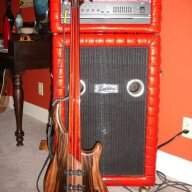

If you replace the driver, you want to be darn sure that the cabinet's tuning is appropriate for the new driver. With a passive radiator, you can't calculate it and have to determine the tuning and displacement empirically.Probably mentioned earlier somewhere, but worth mentioning again, the Scout cabs sound 100% better when sitting directly on the floor. The passive radiator needs to couple with the floor for that extended fat bottom end. Try comparing Scout cabs stacked, and then both on the floor. Also, take advantage of corner loading every time you can. Sometimes if I'm positioned out front, I'll put one of the cabs in the corner with a long cable. These two things are worth about a hundred watts in themselves (headroom).
Also, the later cabs are loaded with Alnico drivers not neodymium, so they are quite a bit heavier. I'm thinking I'll get a celestion neo 15 to replace the heavy ass driver in my combo15 cab. Just to see how it does. Anybody done this?

Probably mentioned earlier somewhere, but worth mentioning again, the Scout cabs sound 100% better when sitting directly on the floor. The passive radiator needs to couple with the floor for that extended fat bottom end. Try comparing Scout cabs stacked, and then both on the floor. Also, take advantage of corner loading every time you can. Sometimes if I'm positioned out front, I'll put one of the cabs in the corner with a long cable. These two things are worth about a hundred watts in themselves (headroom).
Also, the later cabs are loaded with Alnico drivers not neodymium, so they are quite a bit heavier. I'm thinking I'll get a celestion neo 15 to replace the heavy ass driver in my combo15 cab. Just to see how it does. Anybody done this?

Be careful, part of the magic sound of the Walkabout/Scout combo is the proprietary speaker. The general consensus is that neo drivers don't have the warmth that heavier drivers produce, so you might end up with a Scout combo that doesn't have that special sound that makes it so popular.
Respectfully: I don't hear anything different from neo drivers than those with heavier magnets, and I disagree that there's a "general consensus" to the contrary, although there are certainly many who do believe that's true and 2)I am pretty sure there was quite a long period when Scout cabs were built with neo drivers (before the price climbed). As I recall, when I bought my 1st Walkabout combo (some years ago), it was advertised as having a light, neo driver.....sounded just like the Walkabouts I have owned since, including my current one.


The neo drivers in the 12" version are made by Eminence. I'm surprised they went with Celestion on the 15".

It's possible that a cabinet that simply happens to have Neo drivers might be voiced differently than a similar one with ALNICO or ceramic magnets. I'd attribute that to speaker/cab voicing choices, not magnet material.Respectfully: I don't hear anything different from neo drivers than those with heavier magnets, and I disagree that there's a "general consensus" to the contrary, although there are certainly many who do believe that's true and 2)I am pretty sure there was quite a long period when Scout cabs were built with neo drivers (before the price climbed). As I recall, when I bought my 1st Walkabout combo (some years ago), it was advertised as having a light, neo driver.....sounded just like the Walkabouts I have owned since, including my current one.

That's true for toasters but i think we all agree the best toast is made over a fire, preferebly one that was satrted by rubbing 2 sticks together...It's possible that a cabinet that simply happens to have Neo drivers might be voiced differently than a similar one with ALNICO or ceramic magnets. I'd attribute that to speaker/cab voicing choices, not magnet material.
As an engineer (albeit not a specialist in this area) I have a hard time imagining a magnetic field cares what type of material created it when it's interacting with other components in a speaker. I know it's a bit of stretch, but my toaster doesn't care I f the electricity it's getting comes from a nuclear power plant, a coal fired plant or a portable generator running on 87 octane gas I siphoned from car's gas tank.
This is so much better in terms of an explanation than my lame toaster analogy...although as lame analogies go, it wasn't all that bad.Correct, the magnetic field is the magnetic field no matter how it's generated.
What a neo based motor allows us to do as a designer is locate the magnet (and it's electro-magnetic properties of it's material itself) is a different location and with different materials which can more easily lower the effective inductance of the VC which can increase the potential for more extended, lower distortion higher frequency response. It's not the magentic field that's generated, but what we as designers can do to exploit the higher magnetic density and thus place differently. It's very similar to a flux shorting ring on a conventional ceramic magnet motor, which also improves frequency respons in much the same way. It then becomes a design & voicing preference rather than based purely on the limitations of the motor.
Maybe, it depends entirely on the desire (and technical chops) of each designer. It's possible to make a Neo driver brighter or darker just like it is with a ceramic driver depending on the goals. It's just easier to extend the response with a Neo, but it's not because of the magnet, but what we can do with it and where we can place it.I'm thinking that's the technical answer to what I'm hearing?