
Enjoy the benefits of a premium membership!
Upgrade Account
-
TalkBass has been independent since 1998. Add your voice.
Create a free account to reply to discussions, view embedded media, and browse with fewer display ads.
Join free Log in
Want zero display ads or expanded classifieds tools? Compare plans.
You are using an out of date browser. It may not display this or other websites correctly.
You should upgrade or use an alternative browser.
You should upgrade or use an alternative browser.
Mesa Subway D-800+
- Thread starter donahue
- Start date
-
- Tags
- mesa mesa subway subway
More options
Who Replied?
- Feb 12, 2006
- 60,961
- 5
- 220,646
- Disclosures
- Development Engineer-Mesa Boogie, Development Engineer-Genzler (pedals), Product Support-Genz Benz
The deep switch will always shift the effective HPF down a few Hz. The same thing will happen with the bass eq, it's part of how filter response is defined or specified. This is true of all amps, not just ours of course. This is why the variable HPF can be a useful tool for tuning the overall low end response.How does the deep switch interact with the new hpf control?


This is why the variable HPF can be a useful tool for tuning the overall low end response.
When you put one HPF in front of another is it simply a matter of the higher frequency roll-off taking the lower one out of play or can there be more going on? I'm thinking the small Broughton and FDeck boxes that are so popular around here in front of this amp.
When you put one HPF in front of another is it simply a matter of the higher frequency roll-off taking the lower one out of play or can there be more going on? I'm thinking the small Broughton and FDeck boxes that are so popular around here in front of this amp.
Same question! I'm thinking if you set the pedal above 30hz (where the D800's HPF filter is) it would of course start rolling off where the pedal is set, but because of the filter in the amp the slope would be much steeper. I'm just guessing.

The D800 is history. Now I just have to wait for the 800+ to come in.
The D800 is history. Now I just have to wait for the 800+ to come in.
I know I've given you a hard time at just about every corner but you did the right thing. You're gonna be happier with the plus.
- Feb 12, 2006
- 60,961
- 5
- 220,646
- Disclosures
- Development Engineer-Mesa Boogie, Development Engineer-Genzler (pedals), Product Support-Genz Benz
There are a couple of reasons why cascading two second order filters is the best of all worlds (IMO) but because there are 2 DIFFERENT things being affected by the same filter set.When you put one HPF in front of another is it simply a matter of the higher frequency roll-off taking the lower one out of play or can there be more going on? I'm thinking the small Broughton and FDeck boxes that are so popular around here in front of this amp.
With the control all the way to the left, it's a classic 4th order filter which operates at 30Hz and at the control is rotated clockwise up to 40Hz at which point the filter set begins to operate as 2 independent but related filters, the first variable filter has a second order response and works better for tuning of low end response. So for say the adjustable HPF being set at 70Hz, it looks like a classic second order filter (a cross between a BW and SK alignment) and as the audio program material drops down to around 40Hz, begins the transition from second order to 4th order for driver protection purposes. This transition point varies based on the variable filter's knee frequency. It kills several birds with one well placed stone, and is a circuit that I have used for many years in both bass guitar as well as pro audio.
The problem with using a single variable forth order filter is that the transition is just too steep and does not sound very musical as well as feels awfully abrupt to most players. This is the case of more not being better


There really was never any question about getting the 800+. I just wanted it a year ago. I'm sure I'll like it - the D800 is a fine amp, but I need more controls.I know I've given you a hard time at just about every corner but you did the right thing. You're gonna be happier with the plus.

There really was never any question about getting the 800+. I just wanted it a year ago. I'm sure I'll like it - the D800 is a fine amp, but I need more controls.
It's good At least until the D800++ comes out at NAMM
- Feb 12, 2006
- 60,961
- 5
- 220,646
- Disclosures
- Development Engineer-Mesa Boogie, Development Engineer-Genzler (pedals), Product Support-Genz Benz
Or possiblyskip to the D800+++ just to keep you guys guessing?It's good At least until the D800++ comes out at NAMM


score........
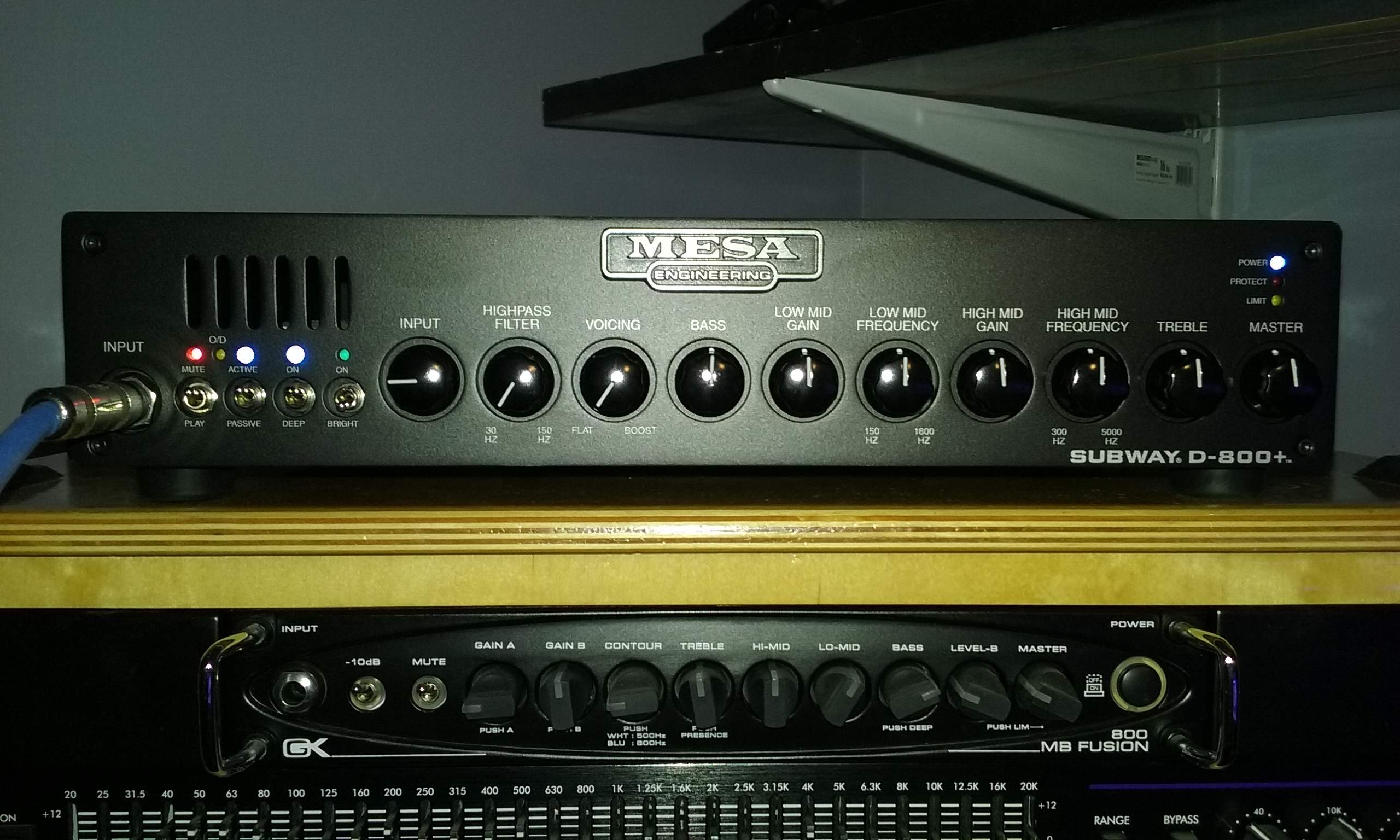
if you are worried about high end hiss I can tell you this,...one of the things I like to do when I check out a new amp (as I did today) is to crank up all the bass and treble controls well beyond useable levels and see if I get any hum or hiss, the 800+ didn't make a peep, his or buzzDon't care what you call it as long as it has that "missing" variable LPF on the DI

Or possiblyskip to the D800+++ just to keep you guys guessing?
I'm holding out for the D900+++. Should be ready for summer Namm...

You guys are aiming really low! I am waiting on the D1600St two (full complement) channel stereo model.

I want Mesa to make their version of the Demeter 800w old-skool-lookin' bass head. Without a gaudy logo blocking the view of the glowing tubes.
Mesa 800 Double-Plus Good.
Please?
VTBP-M-800D
Seen it for the 1st time just yesterday. Classic, cool and crushing in any easy carry. Gotta have all 4 C's.
Mesa 800 Double-Plus Good.
Please?
VTBP-M-800D
Seen it for the 1st time just yesterday. Classic, cool and crushing in any easy carry. Gotta have all 4 C's.
Last edited:


8lb 2 channel with 2x800 bridgableYou guys are aiming really low! I am waiting on the D1600St two (full complement) channel stereo model.

The D1600 Gemini !
- Feb 12, 2006
- 60,961
- 5
- 220,646
- Disclosures
- Development Engineer-Mesa Boogie, Development Engineer-Genzler (pedals), Product Support-Genz Benz


