• TalkBass has been independent since 1998. Add your voice.
    Create a free account to reply to discussions, view embedded media, and browse with fewer display ads.
    Join freeLog in
    Want zero display ads or expanded classifieds tools? Compare plans.

Mic inside bass cab?

Force and temperature sensors on the speaker could be part of a feedback circuit to protect the speaker.

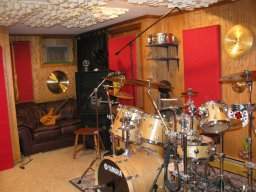
There are isolation cabinets that hold the speaker cab and a mic. They are used for recording. Not too difficult to build if you have the space for one.
 
Maybe some sort of contact pickup (for acoustic gtr) could be mounted inside the cabinet on the sides or rear . This would pick up cabinet vibrations (boom). A phase-reversal switch would get it right for the front sound or amp D.I.
 
Guitar folks seem to have an idea about this. Timo Somers(Delain) has this Box of Doom cabinet(opened up view at 0:29):


It would seem to be not impossible to build a similar Box of Doom with a bass speaker of your choice and a couple of mics.....say a 57 and a 421.
 
Guitar folks seem to have an idea about this. Timo Somers(Delain) has this Box of Doom cabinet(opened up view at 0:29):


It would seem to be not impossible to build a similar Box of Doom with a bass speaker of your choice and a couple of mics.....say a 57 and a 421.

That's an iso box, which isn't like putting a mic inside a cabinet at all. It's more like building a cabinet with a speaker and a mic in front of it.
 
I would think the SM57 would last .. ?! I've helped install them inside several sets of tom toms ... can't be much worse than the booming of a floor tom .. !?

but ... if the mic got bumped or moved , it would be a pain to put it back in place ... !! and like others , I think it would sound like crap inside the cab .. !!??
 
The microphone wouldn't last inside the cabinet is my guess. Maybe a microphone with a strong diaphragm like a kick drum microphone might have a better chance of survival, but that is just an assumption on my part.
There are many mics out there that can handle 140+ dB SPL. You might want a windscreen to block any moving air but most dynamic and condenser mics are extremely robust. The bigger issue is the signal path might not be designed for such high levels, but that's nothing a strong pad can't solve. Now, ribbons on the other hand...
 
I wouldn't bother trying.
I have tried all sorts of kick drum mics for bass - you have to be careful as many of them have a bump right where you don't want it for bass. I recorded one of my songs with recording artist Jukka Rousu (Finland Reggae Artist stage name Jukka Poika) a couple of years ago and I used a Heil Pr-40 on a 15" cab. I like that mic so much, so versatile. For a bass cab put it slightly off-center.
 
I suspect that the microphone's diaphragm won't last too long when exposed to the full pressure within a speaker cabinet.

A large diaphragm mic will handle the SPL's. You can close mic a tuba or baritone sax with the right mic.

But------ the mic inside the bass cab wouldn't be the same sound as doing it the "right way".
 
I always mic and never run direct. Just like a guitarist, I dial in my tone using my bass, pedals, amp, and cabinet, so that's what I want to project to the audience (yeah, yeah I know, here comes Mr. Science of Sound to tell me there's something wrong with that concept, but it works for me). I used to use a Beta 52 kick mic live, and it sounded pretty great, but have recently switched to just using a Beta 57. It seems to pick up more low end than a regular sm57, but doesn't have the "not enough mids and highs" issue you can get with a beta 52. My goal was to find a single mic that would sound good on my cabinet live, since most venues I play only have one line for each instrument. IMO, unless you are in a big band or have your own sound guy, I prefer to shape my tone as much as possible and not rely on a sound guy to blend a DI and mic signal. Now, I have seen guys run a DI and Mic(s) into their own mini-mixer board and then send an out from that board to the sound guy. Always interested me but never wanted to lug around the extra gear.
 
I suspect that the microphone's diaphragm won't last too long when exposed to the full pressure within a speaker cabinet.

Some of the mics for bass drums and/or brass can cope with high SPL but you'd need to pick one with the right response. But you'd still be better off with a speaker-level DI and emulation than sticking a mic inside a cabinet behind the speaker.

A left-field alternative concept is to consider a high impedance entirely sealed unit, assuming you are running at 8 ohms. With high impedance most signal goes to your existing amp, but you can then have a mic inside that pointing at the correct side of a speaker. You'd need careful selection to get a good sound, but you can pick something with a good sound that isn't very sensitive, e.g. a not very sensitive 32 ohm 8" speaker. I built one once, but it was a lot of work when a speaker level DI did the job. Fun to sit on, though (vibrations!). I didn' t need to worry about 32 ohms.

But you'd still be better off with the speaker level DI if an mic or DI from the amp isn't an option.
 
Force and temperature sensors on the speaker could be part of a feedback circuit to protect the speaker.

There are isolation cabinets that hold the speaker cab and a mic. They are used for recording. Not too difficult to build if you have the space for one.

That's what I was describing. Just for live projection too you want a high impedance once to send most signal to the main speaker. With an 8" speaker they aren't too big.