

Enjoy the benefits of a premium membership!
Upgrade Account
-
TalkBass has been independent since 1998. Add your voice.
Create a free account to reply to discussions, view embedded media, and browse with fewer display ads.
Join free Log in
Want zero display ads or expanded classifieds tools? Compare plans.
You are using an out of date browser. It may not display this or other websites correctly.
You should upgrade or use an alternative browser.
You should upgrade or use an alternative browser.
Double Bass Motown D.I.
- Thread starter thejumpcat
- Start date
More options
Who Replied?
Precisely. I think it's fair to say that most DB players prefer non-voiced equipment because the goals of amplification are typically different from those on the BG side of the house.
I'm a very enthusiastic REDDI owner and it hadn't occurred to me to use it with the DB. I'll probably do a quick track with it the next few days though just hear what it does.
Jamerson played DB, too.
If there's a DI that will give me Jamerson's sound on Heatwave I'd gladly pay $450 to keep it the shag away from my bass.

When I posted I didn't even notice it was DB. I just assumed it was BG.
No harm, no foul ddnidd1, this happened many times when Talkbass first converted over to the new version of the software. It's not as frequent now, mostly because they keep refining the visual interface, making it simpler and easier to use. Jumpcat posted the initial thread, and he definitely is a DB player, so he was asking us to comment on the Motown D.I. for use with Double Bass. That's certainly a valid question to ask, but apparently no TB member on the DB side has any experience with the box. Since it's a pretty high end box, for just a D.I., I would suppose, that no one over on this side has used one. I think the Acoustic Box Live, Headway EDB-2, Bass Bone OD, Empress Para Acoustic DI, 3 Leaf Audio Enabler, and Countryman, are all good choices, if you feel you have to have an external D.I. either because you amplifier doesn't have one, or you want something more sophisticated. As I mentioned before, many players have Acoustic Image, Euphonic Audio, or Genz Benz amps all of which have a built in DI.
Ric
P.S. James Jamerson most certainly did play Double Bass, and by all accounts was very accomplished on that instrument. He's using one on the early Motown tracks, my guess is that at that time, that famous 4 Channel Motown D.I. hadn't been built yet, but I could be wrong about that. It's most likely they used a studio microphone when he tracked with a Double Bass, so the D.I. didn't play into that scenario.

Last edited:


The Motown box is a basic passive DI. They're short on technical details and don't provide any specifications. That indicates to me that they're marketing hype.
See the attached circuit for a basic passive DI design with a variable pad. If you want a very good DI check out a JDI Passive, if you want an incredible DI, look at a REDDI.
As was mentioned, there was a complex signal chain that went into the Motown sound. Starting with what Jamerson produced, add contributions from the outboard gear, the mixing board, the analog tape machine, and all the people in between. The DI didn't make their sound what it was.
See the attached circuit for a basic passive DI design with a variable pad. If you want a very good DI check out a JDI Passive, if you want an incredible DI, look at a REDDI.
As was mentioned, there was a complex signal chain that went into the Motown sound. Starting with what Jamerson produced, add contributions from the outboard gear, the mixing board, the analog tape machine, and all the people in between. The DI didn't make their sound what it was.
Attachments
Last edited:
The Motown box is a basic passive DI. They're short on technical details and don't provide any specifications. That indicates to me that they're marketing hype.
See the attached circuit for a basic passive DI design with a variable pad. If you want a very good DI check out a JDI Passive, if you want an incredible DI, look at a REDDI.
As was mentioned, there was a complex signal chain that went into the Motown sound. Starting with what Jamerson produced, add contributions from the outboard gear, the mixing board, the analog tape machine, and all the people in between. The DI didn't make their sound what it was.
David,
Welcome to the Double Bass forums, your input is always appreciated and insightful.

David,
Welcome to the Double Bass forums ....
Thanks Ric.
A link from the amps forum got me here. I was wondering where I was and thinking, this doesn't look like Kansas toto.

Last edited:

I'm fully aware of that, but this device is clearly being discussed for the "how to sound like Jamerson on P-bass" crowd. Just sayin'.Jamerson played DB, too.
Last edited:
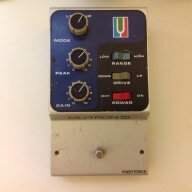
Been waiting for a gut shot. Now I've got my work cut out.I'd like to see a gut shot of this thing.
When you see what's inside a REDDI it's pretty obvious why it costs what it does....and why sounds like it sounds.

I have no doubt that the REDDI is made well and that it's costly to make. The question, for me, is whether all of that is required to fulfill the function of mating an unbalanced, high-impedance source to a low-impedance, balanced input. That may not be the question for others. I understand that. Looking at the picture, I see a modern power supply with toroidal transformer, an iron-core "matching" transformer and a small tube-buffer circuit, wired together point-to-point. As I posted above, many who use such devices seem to prefer a "baked in" sound. If that's what one wants, then one should enjoy. These devices remind me of the esoteric 10-watt, single-ended triode amps for hi-fi. They are very well made, cost multiple thousands, and certainly have a "sound." Any of those could be built and sold for far less but there is a premium added for mystique. Value is, of course, judged by the one holding the wallet. To each his own. There is no arguing with preference.
It's always a difficult decision with many tradeoff involved when deciding if a piece of equipment is worth it. No question that the REDDI is a high end item for what it does.
The toroidal transformer and filtered power supply that the 6N1P tube uses affords the unit a low noise floor. I think that the magic though is in the big iron transformer. Some DI's will add distortion, transients, and phase issues that blur notes that are played together, loosing clarity. As you said, some boxes are more transparent than others. The REDDI is a basic unit that delivers a high quality signal free of those sort of artifacts and that enhances the quality of your sound.
Some DI's will add distortion, transients, and phase issues that blur notes that are played together, loosing clarity. As you said, some boxes are more transparent than others. The REDDI is a basic unit that delivers a high quality signal free of those sort of artifacts and that enhances the quality of your sound.
The REDDI sounds colored to my ears yet I believe you when you say it's free of the problem artifacts you mention. So what is it I'm hearing that gives it the even very present sound it has?
The REDDI sounds colored to my ears yet I believe you when you say it's free of the problem artifacts you mention. So what is it I'm hearing that gives it the even very present sound it has?
The answer is likely right here
I think that the magic though is in the big iron transformer.
That transformer likely gives it the transfer function that underlies the coloration you hear. I'm quite sure it's intended that way.
The REDDI sounds colored to my ears yet I believe you when you say it's free of the problem artifacts you mention. So what is it I'm hearing that gives it the even very present sound it has?
There is good and bad distortion. By distortion I mean anything that alters the input other than amplifying in a linear way. A tube is a non-linear device. The more that you push it, the more non-linear it can get. That's an important point. It will add harmonics, and compression. This sounds good to our ears. But it can also add unpleasant distortion.
Push a tube too hard and distortions can set in. For example, the positive or negative going part of the signal might get compressed or even cut off, the resulting uneven signal results in distortion. Choosing the right tube and optimizing it's operating region is important. Hit a hard note and the power supply can dip for a few milliseconds. This affects how the tube operates. Transients can appear. Everything is interdependent.
That transformer likely gives it the transfer function that underlies the coloration you hear. I'm quite sure it's intended that way.
Yes, I think so as well.
The transformer itself can be a source of distortion. With iron transformers, a large size is particularly good in minimizing unpleasant low end distortion. That's one reason why the transformer is so big. How the transformer handles the signal from the tube factors in as well. I imagine that the designers spent a lot of time iterating designs to get an optimal sound. Of course there are always cost and performance tradeoffs that have to be considered. I think that evenness over the frequency range comes mostly from the transformer design. It helps filter those transients.
It all comes down to the overall design and limitations in operation that the circuit is constrained to. Cleaning up bad distortion makes it sound better. Good distortion adds coloration and, arguably, enhances the tone. A good transformer helps even out the sound over the frequency range and helps with clarity.
Last edited:
The IEEE standard definition for distortion involves 1) nonlinearity between input and output and 2) nonuniform transmission across frequency, and 3) nonlinear phase-shifts with frequency (group delay, etc.). The harmonics and compression produced by tubes do not always "sound good." Even the so-called "consonant" even-order distortion of single-ended tube designs can be quite objectionable.There is good and bad distortion. By distortion I mean anything that alters the input other than amplifying in a linear way. A tube is a non-linear device. The more that you push it, the more non-linear it can get. That's an important point. It will add harmonics, and compression. This sounds good to our ears.
For some, this very distortion is desirable and is created intentionally. It depends upon what are the goals of the player.Push a tube too hard and distortions can set in.
I don't believe that is generally true. The physical size is typically dictated by the current-handling requirements.Yes, I think so as well.
The transformer itself can be a source of distortion. With iron transformers, a large size is particularly good in minimizing unpleasant low end distortion.
Actually, it is the unevenness of the frequency response, likely stemming from the transformer, that produces the coloration that some find pleasant. That's a form of distortion (see #2 above). The transformer does act as a low-pass filter and will filter the highest frequencies within the broad spectrum of transients.I think that evenness over the frequency range comes mostly from the transformer design. It helps filter those transients.
Typically, one does not employ the transformer to smooth out sins that occur upstream. In any case, if the device sounds good to a player, then, as I said before, he/she should go a nd be happy.A good transformer helps even out the sound over the frequency range.

The answer is likely right here
That transformer likely gives it the transfer function that underlies the coloration you hear. I'm quite sure it's intended that way.
I'm a toddler when it comes to electronics but when anyone asks why the REDDI sounds like it does I always say, "Big Iron Transformer". Lots of stuff has tubes or doesn't and in a preamp I can never hear anything that distinctly indicates one or the other. But things with a fist sized iron transformer always seem to have a sound with pleasingly rounded off edges.
It's always a difficult decision with many tradeoff involved when deciding if a piece of equipment is worth it. No question that the REDDI is a high end item for what it does.
The toroidal transformer and filtered power supply that the 6N1P tube uses affords the unit a low noise floor. I think that the magic though is in the big iron transformer. Some DI's will add distortion, transients, and phase issues that blur notes that are played together, loosing clarity. As you said, some boxes are more transparent than others. The REDDI is a basic unit that delivers a high quality signal free of those sort of artifacts and that enhances the quality of your sound.
+1 I have two Walter Woods amplifiers that were pretty expensive when I first purchased them in 1994 and 1997, respectively. Walter did not put D.I.s on his amplifiers, because he felt that individual players would want to chose what they wanted in a D.I. While I'm sure that REDDI sounds wonderful,
it's probably overkill for most of us who play DB, since IHMO, it's size and bulk make it roughly equivalent to carrying a second amplifier head. It weighs 10 lbs. with dimensions of (W x H x D) 3-1/2” x 3-1/2” x 14-1/2”. Double Bassists are more in the market for something that's less bulky, because our instruments
size and weight make them less easy to load in, and we usually also carry a separate amp, stool, and other accessories. For most of my gigs a Countryman 85 will do the job nicely, and most competent sound folks already have one. Just my opinion, I suppose that if I were playing my Lakland 55-94 and Fender Precision exclusively without my Double Bass, then the REDDI becomes more of an option, but at heart I'm a Double Bassist, so toting around that massive a D.I. just isn't written in the stars for me.


Ric
That makes sense. Transformers, in combination with tubes, often produce just the frequency-response anomalies that lead to your description. Such anomalies are positive characteristics when they sound good to you.I'm a toddler when it comes to electronics but when anyone asks why the REDDI sounds like it does I always say, "Big Iron Transformer". Lots of stuff has tubes or doesn't and in a preamp I can never hear anything that distinctly indicates one or the other. But things with a fist sized iron transformer always seem to have a sound with pleasingly rounded off edges.
The harmonics and compression produced by tubes do not always "sound good."
Yes, of course. Getting the design to sound good with the right balance of "good" harmonics and compression is the hard part.
Size and current handling capability do go hand in hand. But there are other issues. Turns and core material affect power handling and how low a frequency the transformer will support. Core saturation comes into play. Larger size helps reduce saturation at lower frequencies.I don't believe that is generally true. The physical size is typically dictated by the current-handling requirements.
Actually, it is the unevenness of the frequency response, likely stemming from the transformer, that produces the coloration that some find pleasant. That's a form of distortion (see #2 above). The transformer does act as a low-pass filter and will filter the highest frequencies within the broad spectrum of transients.
Yes.
Sometimes you want to express something in a simple way without getting too technical. It think that this comes down to semantics.
Transformers are non linear devices. They saturate, which affects how they respond to frequencies. They smooth as you said. What I intended to say was that the transformer design can reduce the extent of these non-linearities over the frequency range. Making them respond in a more even way. Not that they even out the signal.
Typically, one does not employ the transformer to smooth out sins that occur upstream.
Ideally not. But real live doesn't always work that way.
...when anyone asks why the REDDI sounds like it does I always say, "Big Iron Transformer". Lots of stuff has tubes or doesn't and in a preamp I can never hear anything that distinctly indicates one or the other. But things with a fist sized iron transformer always seem to have a sound with pleasingly rounded off edges.
The Ampeg B-15 has a relatively big output transformer for the 25W or 30W that the amps are rated for. The tone is rich and lacks harshness. There are other contributing factors but maybe the output has something in common with the REDDI in that respect.
Except for the low-frequency cutoff, those are all really the same issue. Power handling is current handling. Core saturation is, again, a function of the current drawn. It's also the case that the low-frequency cutoff is not one-to-one with size, but, of course the value of the windings in mH.Size and current handling capability do go hand in hand. But there are other issues. Turns and core material affect power handling and how low a frequency the transformer will support. Core saturation comes into play. Larger size helps reduce saturation at lower frequencies.
Keep in mind that the current handled by the REDDI is very low. There's a limit to the return one gets by choosing larger and larger transformers. I wonder how much smaller the xformer in the REDDI could be without producing any audible difference or meaningful difference in the measures.
It very much does, given that "semantics" refers to the meaning of words.It think that this comes down to semantics.
 Still, I get what you meant.
Last edited:


