• TalkBass has been independent since 1998. Add your voice.
    Create a free account to reply to discussions, view embedded media, and browse with fewer display ads.
    Join freeLog in
    Want zero display ads or expanded classifieds tools? Compare plans.

Multiscale Chambered 8-string Hybrid Singlecut

H-8 chambered singlecut multiscale 8-stringer

OK so this is a collaboration with Ben to build a chambered singlecut 8-string bass/guitar hybrid instrument – and a multiscale on top of it (why not, right?). The design borrows from some obvious influences, but also benefits from some improvements to the body design, neck joint and layout of the multiple scales. There are some cool features to the build that will be good to document.

Here’s the menu:
Walnut chambered body core
Figured claro walnut top, back & headstock lam with wenge accent layers
5-piece maple-walnut neck with CF reinforcement
Tru Oil finish
29.5” to 25.5” scale, 7th fret perp
Bartolini humbuckers and paired P-bass pickups (passive)
Master Vol (push-pull coil tap) & Tone, 3-way switch for humbuckers
Stacked Vol-Tone for bass pickups
Separate outputs for bass & guitar pickups

Ben will be using this for pursuing some new directions in jazz guitar – I am almost as anxious as he is to hear what he can do on this thing.

Here are some shots of the claro top with the body outline superimposed – the knots in the center will be mostly routed out in the pickup routs by angling the bookmatch seam.
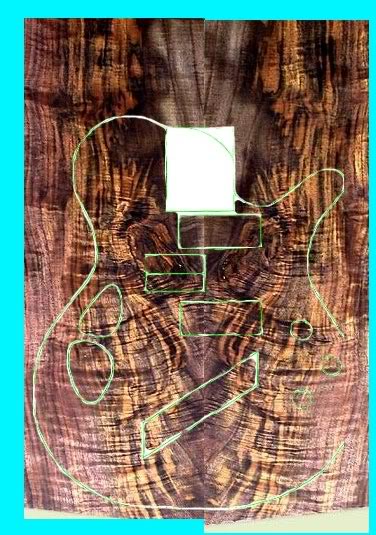
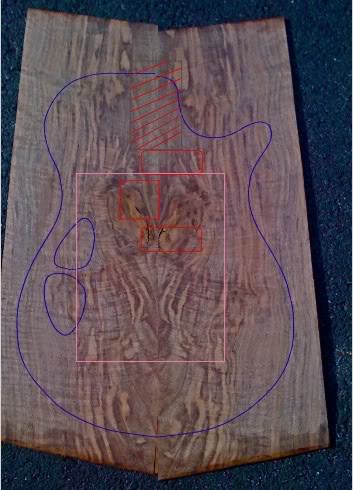
ClaroTop.jpg

TopTaper5deg.jpg


Gotta have a template:

Template.jpg
 
Neck lams are individually milled in the drum sander.

NeckLams1.jpg


This might be the first photo I’ve shown of my glue press – pretty simple, a set of 2” high aluminum angles to keep everything dead straight and distribute the pressure from 8-10 bar clamps. Trigger clamps at the ends and in the middle (through a hole in the table) keep all the lams firmly down against the table. Wax paper underneath so I don't glue the neck to the bench....

NeckLams3.jpg

NeckLams4.jpg


Carbon fiber bars routed and installed. I like the System 3 epoxy adhesive for all my epoxy gluing tasks (resin 105 and slow hardener) – it is very forgiving in the mix ratio, so that you can use pumps instead of measuring with a scale.

CFbars1.jpg
 
Slick idea. I take it Ben's a fan of Charlie Hunter? :D

Are you guys going to use three bass strings and five guitar strings like Hunter's guitar?

I dig the shape too, its more like the Traugott guitar. I know Hunter has been quoted stating that without the fanned frets his music would be much more difficult to perform...
 
This week I am in Oregon for a conference, but had a free day to drop by Gilmer Hardwoods in Portland to pick up the Madagascar ebony for Ben's fretboard. Gilmer has been in Portland for ~25 years, and Jim MacDermott at the warehouse was very helpful in guiding me to exactly what I needed - a solid straight quartersawn piece that is black as night.

Gilmer.jpg


MadEbony.jpg
 
We're tuning it E-A-D on the bass side, A-D-G-B-E on the guitar side. I believe Erik is going to use the 10 gauge novak strings. This puts the bass string gauges close to medium short scale strings. Flats on the bass side for now, I may be switching them to la bella nylon tapewounds down the road.
 
Lots of progress today - routed for the truss rod (Allied), I like to rout after installing the CF bars so that I don't have to have 3 open routs side-by-side with thin walls between (increasing chances for blow-out).

I cut the scarf joint, then brandsawed the neck taper (just outside the line) and routed the final taper using my trusty neck-taper template. If the neck I'm working on doesn't fit an existing taper, then I will make a new one from 3/4" (which I did for this build). I double-stick the neck onto the top of the neck-taper template then rout the edges using a pattern-following bit with shaft bearing.

neck8.jpg

neck9.jpg

neck11.jpg
 
  • Like
Reactions: Beej
The Madagascar ebony fretboard will have "integral binding" which is binding of the same wood made from off-cuts of the board sliced off after cutting the taper.

fretboard1.jpg


I cut the taper - and trued up the edges - underneath the outermost strings (so that the scale is accurate when I slot the board). The edges of the offcuts were trued up by sanding on a flat marble door threshold (c/o Home Depot).

I print the fret layout from CAD (using "hairline" mode so the fret lines are very narrow), stick it to the fretboard, and cut the slots on the radial arm saw.

fretboard4.jpg


After all the slots are cut, I'll go back and enlarge the nut slot.

fretboard6.jpg
 
Then the offcuts are glued back onto the board and clamped - I'm using epoxy (West System) in this case, apply to the offcuts, let it sit for 30 minutes to tack up, then clamp. I like it better than Titebond for ebony.

fretboard7.jpg


Another 30 minutes later, I go back and clean out the slots while the epoxy is still soft.

fretboard8.jpg
 
Today I also started laminating the walnut top & back to the underlying wenge accent - I started with a 1"+ thick piece about 12" wide, resawed it into two 1/2" pieces, planed them flat, then glued a top (or back) panel to both sides, and clamped the whole works in the press with a big piece of limba as a caul.

body1.jpg

body2.jpg

body3.jpg


Once the sandwiches are dry, I will trim them and resaw them again to yield a thin veneer of wenge underneath the walnut top & back plates.
 

Latest posts