• TalkBass has been independent since 1998. Add your voice.
    Create a free account to reply to discussions, view embedded media, and browse with fewer display ads.
    Join freeLog in
    Want zero display ads or expanded classifieds tools? Compare plans.

NBD, sort of...

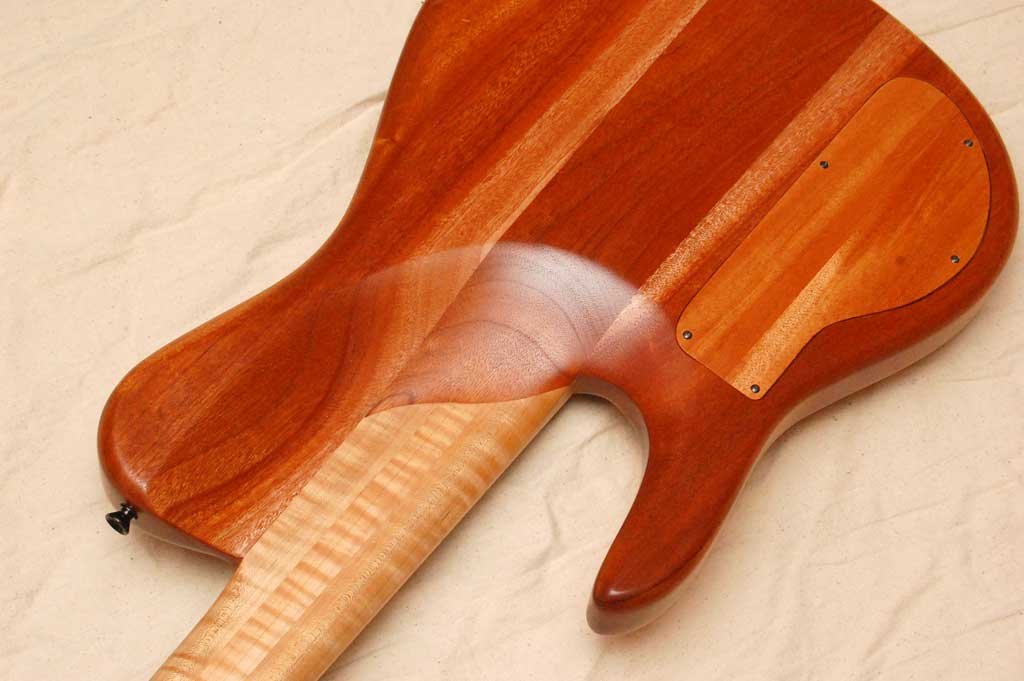
You could always route a larger control cavity and make a new cover to drop even more weight. I had Josh Helms do this on my Helms to fit a Fodera Preamp and lost about half a pound in the process.

Helms3.jpg

(Wipes drool off iPad) Wow, just wow. That heel area is pure poetry. That's the difference between a hack like me, and someone who has the gift...
 
Okay, fine. I mean, yeah, it's beautiful and all that. But, when are you going to start on mine??? :D

...If you have any, before and after pics (and various stages of its evolution) would be fun..

I do have some older pictures...

The original configuration, 1 EMG 40DC, and a "more" knob. This was during the Behrens nitro lacquer phase:

Mybasslacquered20038_zpse039a165.jpg


The original slab shape, no tapering other than the arm and tummy cuts. Sharper lines around the neck heel:

Mybasslacquered20036_zpsd1d7f2aa.jpg


That lacquer was crazy thick. I laid it on with a borrowed airbrush gun. I didn't use grain filler, and kept cutting through to bare wood while wet sanding. I ended up with 24 coats (!!!) on there.

When I froze it in the car overnight one Ottawa winter, it lacquer-checked something awful:

Mybasslacquered20032_zps4378c4e9.gif
 
WOW - that's one unique beautiful bass Steve! Great work.

Thanks for the compliment, but it's pretty far from unique nowadays. When I finished it in '94, a neck-through 35" singlecut fiver with carbon fibre in it was bleeding edge, but not anymore.

Vinnie Fodera hit the ball out of the park with his singlecut contrabass for Anthony Jackson, and again with the Imperial. It seems like just about every boutique builder is paying tribute to his work these days...
 
Some more pics. These are during the application of my favourite finish, Lee Valley Polymerized Tung Oil, after an early-2003 minor recarve. As always, I rubbed it out with progressively finer sandpapers before oiling, from about 120 out to 1500 grit, and then with micromesh out to about 4,000 grit. Not a lot of strokes with each grade, just a quick rubdown, and then on to the next.

It sounds anal, to be sure, but I find that burnishing maple out to a high polish before applying the finish helps to prevent blotchiness and other issues. The first time I applied a dye after sanding to 320 grit, I just about had a heart attack at the way the end grain sucked it up in the cutaways...

This recarve brought the weight of the instrument down from 12+ lb, to about 11 1/2lb.

Headstock detail, nitro lacquer still visible in the truss rod adjuster cavity:

Mybassoiled20033_zpsaafc2e7a.jpg


Here you can see the mild taper, and more aggressive tummy and forearm cuts. You can also see remnants of the amber aniline dye and tung oil in the pickup cavity. That was the original finish when I completed it in early 1994:

Mybassoiled20032_zps7cd03fcc.jpg


The finished product. I loved the simple look with the single vol and pickup:

Mybassoiled20036_zps98af52d1.jpg
 

Latest posts