
Double basses with high Cs are fairly uncommon, and while they do exist, 5 strings with low Bs (sometimes tuned to C) are the most common way orchestral bassists in Europe reach low notes; in the US, UK, and Canada it's more common to see C-extensions.5 string upright isn't too uncommon. They used them in orchestral music depending on the piece. More commonly with high C and they would add low extensions to the E string by the headstock for lower notes.

Enjoy the benefits of a premium membership!
Upgrade Account
-
TalkBass has been independent since 1998. Add your voice.
Create a free account to reply to discussions, view embedded media, and browse with fewer display ads.
Join free Log in
Want zero display ads or expanded classifieds tools? Compare plans.
You are using an out of date browser. It may not display this or other websites correctly.
You should upgrade or use an alternative browser.
You should upgrade or use an alternative browser.
More options
Who Replied?
it's easier to play cello music, some bassists are (mostly middle school upright ), jealous of cello players whose music is written lower than db music.Double basses with high Cs are fairly uncommon, and while they do exist, 5 strings with low Bs (sometimes tuned to C) are the most common way orchestral bassists in Europe reach low notes; in the US, UK, and Canada it's more common to see C-extensions.

Just a theory, but the B0 string was added to electric basses, so the cooler tuba player, didn't play lower notes


If Fender had put a B string on it’s basses in the 50s or 60s I bet it wouldn’t have gained much popularity just based on the limitations of bass amplification available...
Ding ding! We have a winner! Alex, tell him what's he's won!
Another way of thinking of this is to get in your time machine, and go back to the early 50's. Ask Leo why he set the lowest string at E. He may not even answer you, as he's busy trying to fix an issue - the 57 P bass has different pole pieces, because, even with an E as the lowest note, people were blowing up the speakers on his amps (which were pretty much the only amps for bass at the time). Tuning the lowest string lower would have made things much worse.
Nowadays, we do have better speakers, but if you look closely, you will find that, even today very few (I don't actually know of any) commercially available bassss guitar cabinets actually go down to 41 Hz (-3dB). 32 Hz (low B) is not really well reproduced in your amp. It may be in the PA, if it's decent, but in most cases, the PA probably doesn't really cover it that well.

I tune A-G-C-F and would like all basses tuned that way moving forward. thank you.
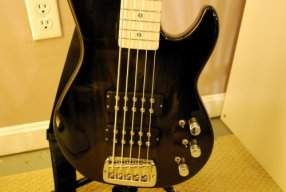
Back before there were steel strings the low E on the URB was a challenge - fro example Simandl discourages the use of the E string above the B (if I remember right) because there is nothing usable coming out of this. Do - the low E was the lowest reasonable note to produce with the technology available at the time.
When it came to electric bass, the problem really was the amp and the available loudspeaker technology. Low B needs good speakers and lots of power, and in the late 60s for example the Ampeg 8x10 had 200 W power handling, and you needed 2 in conjunction with the SVT head. So, a lot had to do with technology.
And it has not been that long that the low B stings started to sound really good - until about 10 years ago I felt that the low B was there, but not on par with the low E sound wise.
When it came to electric bass, the problem really was the amp and the available loudspeaker technology. Low B needs good speakers and lots of power, and in the late 60s for example the Ampeg 8x10 had 200 W power handling, and you needed 2 in conjunction with the SVT head. So, a lot had to do with technology.
And it has not been that long that the low B stings started to sound really good - until about 10 years ago I felt that the low B was there, but not on par with the low E sound wise.
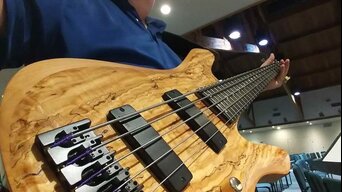


I could have used a retuned viola, and called it a mezzo-piccalo bass.
I think the question now is, "Why does this guitar vs. bass thing bother you so much?"
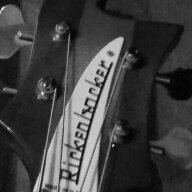

The first low B five stringer was made for Jimmy"Flim"Johnson by Alembic in 1975.
First 5 String (NWYT)
Bass guitar - Wikipedia
View attachment 2889068
That spacing...ugh! awful.
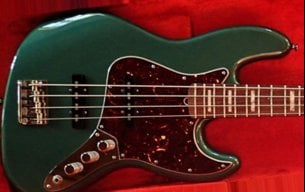
Bass guitar or double bass ?? 5 string double basses ..probably 100 years ago . Bass Guitar mid 60's .hmm i wonder when the first 5 er came out.

That is simply untrue. Double bass, going back to it’s birth, has been responsible for notes down to low C, 1 octave below the cello. Hence the name “double” bass. How this was accomplished has changed through the years (various tunings, C extensions, 5 strings) but the low C was always expected of orchestra players.Therefore no one would consider the need to go lower than the bass instruments in an orchestra at that time.
Because B strings sound like crap on standard 34" scale basses.
Haven't met a Pedulla yet have ya? Fender Elite I got has pretty dang good B too. Had a Japanese ESP J-five that had an amazing B too....But 34" scale for most inexpensive basses isn't the greatest.


the guitarist gets the girls?I think the question now is, "Why does this guitar vs. bass thing bother you so much?"
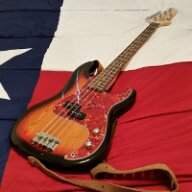
Big Hoss
Up note, down note, blue note, brown note...
- Sep 5, 2014
- 5,455
- 4,234
- Disclosures
- None
I would think the electric bass predates the ability of electric audio systems ability to reasonably reproduce the lower notes.
The strings used to make the lower notes weren't around at first, really not until some time in the mid to late 70s I think.
So yeah, it was more of a, because the tech wasn't there yet when the 4 string electric bass was developed.
The strings used to make the lower notes weren't around at first, really not until some time in the mid to late 70s I think.
So yeah, it was more of a, because the tech wasn't there yet when the 4 string electric bass was developed.
the strings were there, I started playing upright in 65, the round wire strings were ancient, and thicker than the B0s used on current electric basses. And then you have strings for pianosI would think the electric bass predates the ability of electric audio systems ability to reasonably reproduce the lower notes.
The strings used to make the lower notes weren't around at first, really not until some time in the mid to late 70s I think.
So yeah, it was more of a, because the tech wasn't there yet when the 4 string electric bass was developed.
The comments on speaker technology I believe are right on. Fender switched to 410 combos, do to high failure rates on 15" speakers. Imo, the bassman was already too heavy, without adding another 3 or 4 lbs to the ot to handle lower frequencies. I don't think piggybacks were available until later.
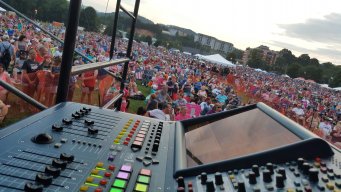
I play my BEAD 4 more than my EADG 4s.
Personally, I'd rather be able to go lower than higher.
Personally, I'd rather be able to go lower than higher.


I also wonder if the EADG scheme is not also done to match a piano? On a grand piano, E is the lowest note. Just wondering?
A0 (27.5Hz) is the lowest note on a standard 88 key piano.
A Bosendorfer 97 key piano goes down to C0 and their 92 key model goes down to F0.
Last edited:


